
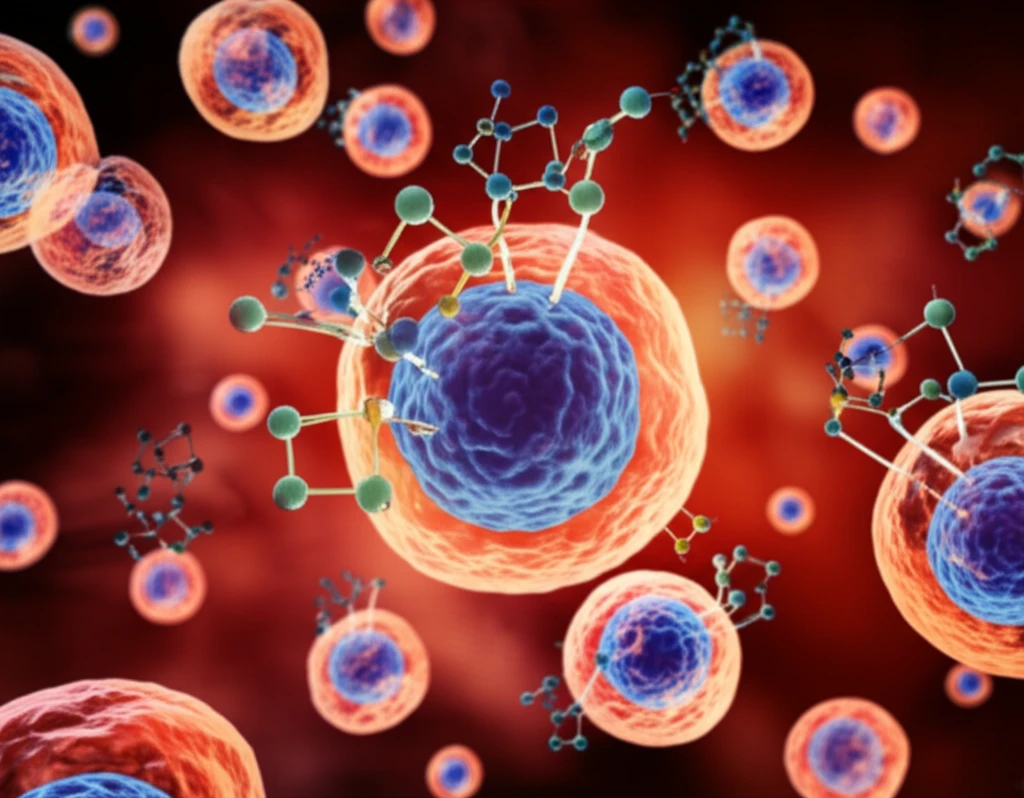
Gastric cancer cells under attack by bufalin, experiencing endoplasmic reticulum stress.

Unlock Bufalin's Potential: How This Compound Fights Gastric Cancer

"Discover how bufalin, a compound derived from traditional medicine, targets human gastric cancer cells by disrupting endoplasmic reticulum stress and enhancing apoptosis."


Gastric cancer remains a significant global health challenge, especially in regions like China, Japan, and South Korea. While early detection and surgery offer high survival rates, advanced stages of the disease often present a grim prognosis, complicated by drug resistance. Traditional chemotherapies, though helpful, frequently encounter resistance, underscoring the pressing need for innovative treatments.

Bufalin, a key component extracted from Chan Su, a traditional Chinese medicine, has emerged as a promising candidate. Studies indicate its potential to inhibit the proliferation and induce apoptosis in various cancer cell lines without significant side effects. However, the precise mechanisms behind its anti-tumor effects have remained elusive.

Recent research has shed light on how bufalin combats gastric cancer cells by inducing endoplasmic reticulum (ER) stress and modulating autophagy, a cellular self-cleaning process. This article delves into these mechanisms, explaining how bufalin enhances apoptosis (programmed cell death) in gastric cancer cells by blocking autophagy, offering new avenues for treatment strategies.

Bufalin's Multifaceted Attack on Gastric Cancer Cells

Gastric cancer cells under attack by bufalin, experiencing endoplasmic reticulum stress.

The study reveals that bufalin significantly suppresses the growth of human gastric cancer (HGC) cells, specifically SGC7901 and BGC823 cell lines, in a dose- and time-dependent manner. This means the higher the concentration of bufalin and the longer the exposure, the more effective it is at inhibiting cancer cell proliferation. Importantly, bufalin shows minimal impact on normal gastric cells, indicating a selective toxicity towards cancer cells.

Apoptosis, or programmed cell death, is a crucial mechanism in cancer treatment. Bufalin actively promotes apoptosis in HGC cells. The research pinpoints that bufalin achieves this by:

  • Increasing the Bax/Bcl-2 ratio: This is vital for mitochondrial-mediated apoptosis.
  • Activating caspase-3: A key executioner protein in the apoptotic pathway.
  • Inducing ER Stress: Disrupting the endoplasmic reticulum, leading to cellular dysfunction and eventual death.
Autophagy, a cellular process where cells degrade and recycle their components, can sometimes protect cancer cells. However, bufalin appears to tip the balance towards cell death by modulating this process. The study found that while bufalin initially induces autophagy, blocking this autophagy significantly enhances bufalin-induced apoptosis. This suggests that autophagy, in this context, acts as a survival mechanism for cancer cells, and inhibiting it makes them more vulnerable to bufalin's cytotoxic effects.

Implications for Future Therapies

This research highlights bufalin as a promising compound for gastric cancer treatment, particularly due to its ability to induce ER stress and modulate autophagy. By understanding these mechanisms, scientists can develop more effective strategies to target and eliminate cancer cells.

The discovery that blocking autophagy enhances bufalin-induced apoptosis opens new therapeutic avenues. Future treatments might combine bufalin with autophagy inhibitors to maximize its cytotoxic effects on gastric cancer cells.

While these findings are encouraging, further research is essential. Clinical trials are needed to assess the safety and efficacy of bufalin-based therapies in humans. Understanding the optimal dosage, delivery methods, and potential side effects will be crucial for translating these laboratory findings into effective cancer treatments.

About this Article -

This article was crafted using a human-AI hybrid and collaborative approach. AI assisted our team with initial drafting, research insights, identifying key questions, and image generation. Our human editors guided topic selection, defined the angle, structured the content, ensured factual accuracy and relevance, refined the tone, and conducted thorough editing to deliver helpful, high-quality information.See our About page for more information.

This article is based on research published under:

DOI-LINK: 10.1242/bio.026344, Alternate LINK

Title: Blocking Autophagy Enhances The Pro-Apoptotic Effect Of Bufalin On Human Gastric Cancer Cells Through Endoplasmic Reticulum Stress

Subject: General Agricultural and Biological Sciences

Journal: Biology Open

Publisher: The Company of Biologists

Authors: Hongyan Zhao, Qinghua Li, Jie Pang, Huilin Jin, Hongwei Li, Xiaoying Yang

Published: 2017-01-01

Everything You Need To Know

1

What is Bufalin and why is it important in the context of gastric cancer treatment?

Bufalin is a compound extracted from Chan Su, a traditional Chinese medicine. It is being investigated for its potential in treating gastric cancer. Its significance lies in its ability to target and eliminate human gastric cancer cells, offering a potential alternative to conventional treatments which are often hindered by drug resistance. Bufalin's origin in traditional medicine adds a layer of historical context and potential for further research into natural compounds for cancer therapy.

2

What is apoptosis, and how does bufalin contribute to it in gastric cancer cells?

Apoptosis is programmed cell death, a crucial process where cells self-destruct, and it is a key strategy in cancer treatment. Bufalin enhances apoptosis in human gastric cancer (HGC) cells by increasing the Bax/Bcl-2 ratio, activating caspase-3, and inducing endoplasmic reticulum (ER) stress. By promoting apoptosis, bufalin aims to eliminate cancer cells, offering a targeted approach to combat the disease, potentially improving patient outcomes by reducing the number of cancer cells and preventing tumor growth.

3

What is endoplasmic reticulum (ER) stress, and why is it relevant to the action of bufalin?

Endoplasmic reticulum (ER) stress is a cellular condition where the ER, responsible for protein folding and processing, is disrupted, leading to cellular dysfunction and ultimately cell death. Bufalin induces ER stress in human gastric cancer (HGC) cells, contributing to apoptosis. This is important because cancer cells can sometimes evade cell death, and by inducing ER stress, bufalin overcomes this resistance, triggering the self-destruction of cancer cells. The implications are that by targeting the ER, bufalin can make cancer cells more vulnerable to cell death.

4

How does bufalin interact with autophagy, and what does this interaction mean for cancer treatment?

Autophagy is a cellular process where cells degrade and recycle their components, often acting as a survival mechanism. In the context of bufalin's effects, autophagy appears to protect cancer cells. Bufalin initially induces autophagy but ultimately enhances apoptosis by blocking it. This suggests that cancer cells use autophagy to survive, and by inhibiting it, bufalin makes these cells more susceptible to programmed cell death. This is significant because it shows that bufalin doesn't just promote cell death; it also tackles the cancer cells' defenses, enhancing its effectiveness as a treatment.

5

What are the potential implications of bufalin research for future therapies?

Bufalin's ability to induce ER stress and modulate autophagy suggests it could be a foundation for new gastric cancer treatments. Current research suggests that, by understanding how bufalin interacts with cancer cells, scientists can create more effective treatments. For example, it opens the door to combination therapies where bufalin is used with other drugs or treatments to enhance its effects. Further research can potentially lead to clinical trials and, ultimately, new treatment options.

Newsletter Subscribe

Subscribe to get the latest articles and insights directly in your inbox.