
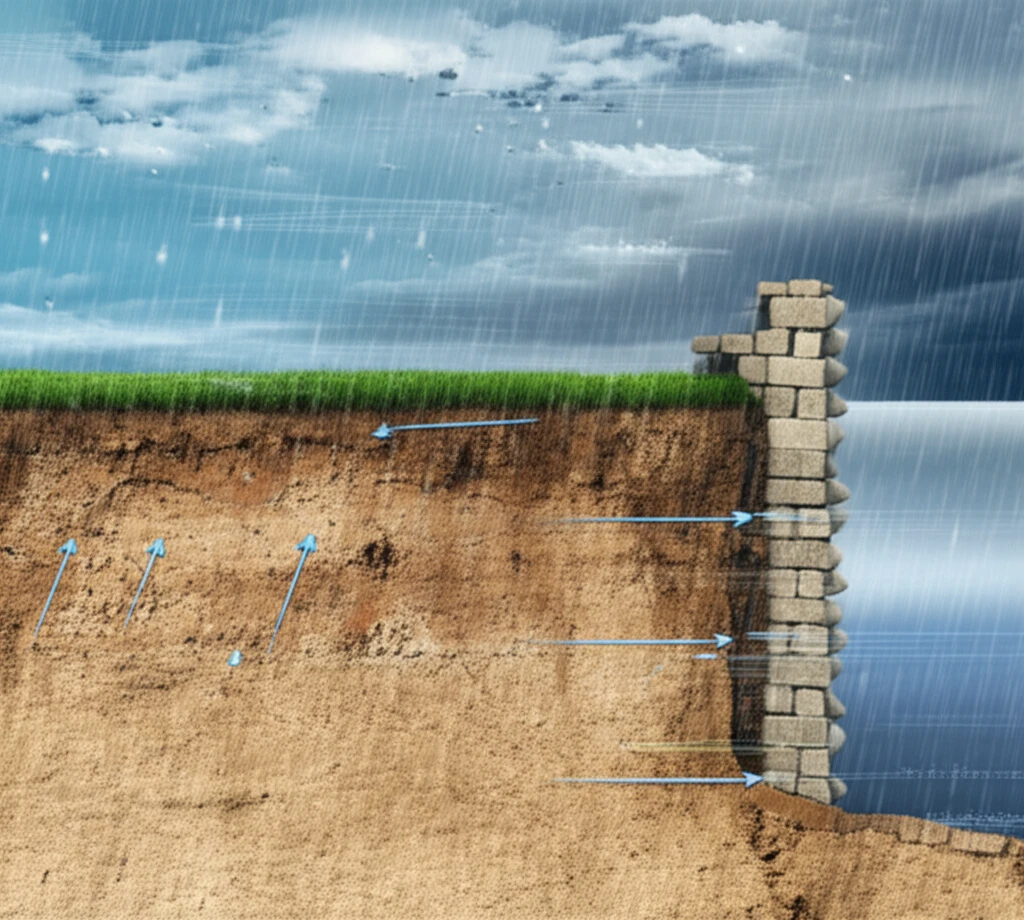
Cross-section of earth retaining wall showcasing soil-atmosphere interaction.

Unearthing Stability: How Soil-Atmosphere Interaction is Revolutionizing Earth Retaining Structures

"Discover the innovative design techniques inspired by environmental dynamics for safer and more sustainable infrastructure."


The ground beneath our feet is far from static. It's a dynamic environment, constantly influenced by the very air we breathe. This interaction between soil and atmosphere is especially critical when designing earth retaining structures – those walls and supports that hold back soil masses in landscapes, construction sites, and infrastructure projects. In regions with distinct wet and dry seasons, ignoring these environmental factors can lead to over-engineered, costly, and potentially unstable structures.

Traditional design methods often take a conservative approach, casting a wide net of safety due to the uncertainty introduced by environmental variables. Factors like rainfall, evaporation, and temperature fluctuations significantly impact soil moisture, suction (the force that holds soil particles together), and overall stability. These variables directly influence the performance and longevity of retaining walls, slopes, and other earth-supporting systems.

But what if we could harness a deeper understanding of these interactions to create smarter, more efficient designs? Recent advances in numerical modeling are doing just that, allowing engineers to simulate the complex interplay between soil and atmosphere. By incorporating parameters like soil suction and moisture content into design calculations, we can move beyond overly conservative methods and develop earth retaining structures that are both robust and resource-conscious.

Why is Soil-Atmosphere Interaction a Game-Changer for Structural Design?

Cross-section of earth retaining wall showcasing soil-atmosphere interaction.

Imagine a retaining wall built in a region with intense monsoon seasons. During heavy rainfall, the soil behind the wall becomes saturated, increasing the pressure it exerts. Conversely, in the dry season, the soil loses moisture, potentially leading to shrinkage and cracking. Traditional designs often assume worst-case scenarios, leading to massive, expensive structures. However, a design that accounts for soil-atmosphere interaction can adapt to these changing conditions.

Here's how:

  • Optimized Material Use: By accurately predicting soil behavior under varying moisture conditions, engineers can use materials more efficiently, reducing overall costs.
  • Enhanced Stability: Understanding suction and its impact on soil strength allows for designs that are inherently more stable, even during extreme weather events.
  • Reduced Maintenance: Structures designed with soil-atmosphere interaction in mind are less likely to experience premature failure or require frequent repairs.
  • Sustainable Construction: Efficient material use and reduced maintenance contribute to a more sustainable approach to construction.
The key lies in incorporating sophisticated numerical models that consider factors like rainfall infiltration, evaporation rates, and soil properties. These models allow engineers to simulate how the soil will respond to different environmental conditions over time, leading to designs that are both safe and economical.

The Future of Earth Retaining Structures: A Shift Towards Smarter Design

While the integration of soil-atmosphere interaction into geotechnical design is still evolving, the potential benefits are undeniable. By embracing these advanced modeling techniques, we can move towards a future where earth retaining structures are not just strong, but also sustainable, resilient, and perfectly adapted to their environment. This shift promises safer infrastructure, reduced construction costs, and a more harmonious relationship between the built environment and the natural world.

About this Article -

This article was crafted using a human-AI hybrid and collaborative approach. AI assisted our team with initial drafting, research insights, identifying key questions, and image generation. Our human editors guided topic selection, defined the angle, structured the content, ensured factual accuracy and relevance, refined the tone, and conducted thorough editing to deliver helpful, high-quality information.See our About page for more information.

This article is based on research published under:

DOI-LINK: 10.1051/e3sconf/20160912002, Alternate LINK

Title: Implications Of The Atmosphere-Soil Interaction For The Design Of Earth Retaining Structures

Subject: General Medicine

Journal: E3S Web of Conferences

Publisher: EDP Sciences

Authors: Juan Carlos Ruge, Julio E. Colmenares, Renato P. Da Cunha, David Mašín

Published: 2016-01-01

Everything You Need To Know

1

What is soil-atmosphere interaction and why is it important for earth retaining structures?

Soil-atmosphere interaction refers to the dynamic interplay between the soil and the atmospheric conditions that affect it. This interaction is crucial for earth retaining structures because factors like rainfall, evaporation, and temperature fluctuations directly impact soil moisture and suction. These in turn influence the stability, performance, and longevity of retaining walls, slopes, and other earth-supporting systems. Ignoring these interactions can lead to over-engineered, costly, and potentially unstable structures, especially in regions with distinct wet and dry seasons.

2

How do traditional design methods for earth retaining structures differ from designs that consider soil-atmosphere interaction?

Traditional design methods for earth retaining structures often employ a conservative approach, assuming worst-case scenarios to account for uncertainties in environmental variables. These methods can result in massive, expensive structures. In contrast, designs that consider soil-atmosphere interaction utilize numerical models to simulate the complex interplay between soil and atmosphere. By incorporating parameters like soil suction and moisture content into design calculations, engineers can develop earth retaining structures that are both robust and resource-conscious, adapting to changing conditions such as seasonal rainfall and drought.

3

What are the benefits of incorporating soil-atmosphere interaction into the design of earth retaining structures?

Incorporating soil-atmosphere interaction offers several key benefits. Firstly, it enables optimized material use by accurately predicting soil behavior under varying moisture conditions, thus reducing costs. Secondly, it enhances stability by considering suction and its impact on soil strength, leading to more resilient designs. Thirdly, structures designed with this approach are less prone to premature failure, reducing maintenance needs. Finally, it promotes sustainable construction through efficient material use and reduced maintenance, contributing to a more environmentally friendly approach.

4

Can you explain how numerical models are used to account for soil-atmosphere interaction in geotechnical design?

Numerical models play a crucial role in accounting for soil-atmosphere interaction. These models consider several factors, including rainfall infiltration, evaporation rates, and specific soil properties. By inputting these parameters, engineers can simulate how the soil will respond to different environmental conditions over time. This allows for more accurate predictions of soil behavior, leading to designs that are both safe and economical. For example, engineers can model how a retaining wall will respond to a monsoon season or a prolonged drought, tailoring the design to withstand these specific conditions.

5

How does the integration of soil-atmosphere interaction contribute to the future of earth retaining structures, and what are the implications of this shift?

The integration of soil-atmosphere interaction into geotechnical design is paving the way for a future where earth retaining structures are not only strong but also sustainable, resilient, and perfectly adapted to their environment. This shift towards smarter design promises several implications: safer infrastructure, reduced construction costs due to optimized material use, and a more harmonious relationship between the built environment and the natural world. By embracing advanced modeling techniques, engineers can create structures that are better suited to withstand environmental changes and contribute to a more sustainable approach to construction.

Newsletter Subscribe

Subscribe to get the latest articles and insights directly in your inbox.