
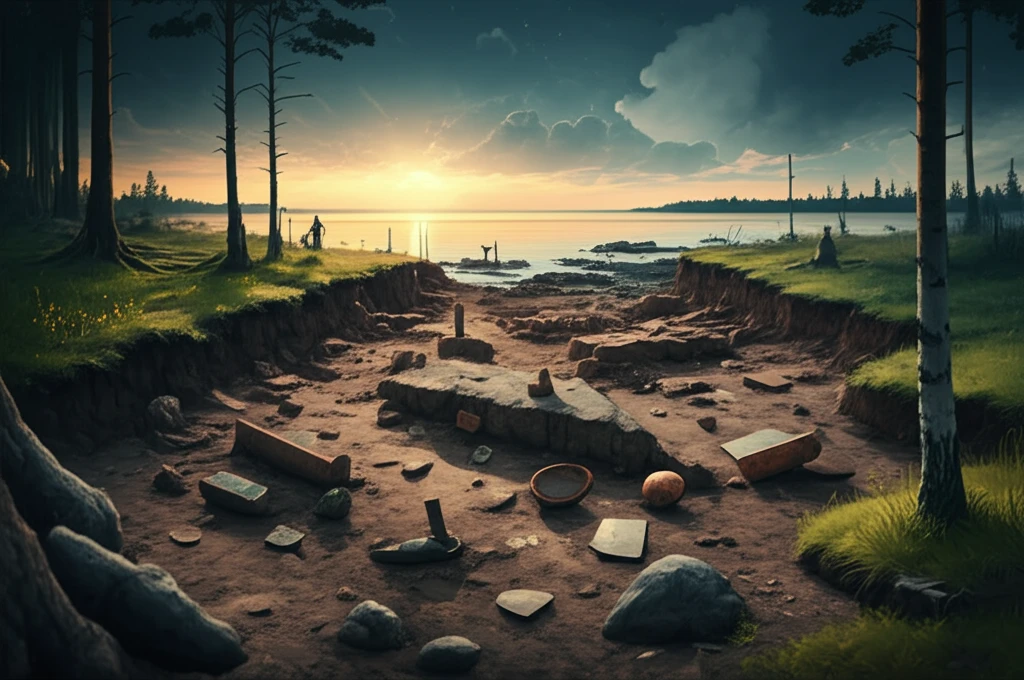
Archaeological dig site in Estonia at sunset, revealing bronze artifacts.

Unearthing Estonia's Bronze Age: A Journey Through Archaeological Discoveries and Cultural Shifts

"Explore the fascinating history of Bronze Age Estonia, from early research limitations to modern archaeological insights, and discover how these findings reshape our understanding of Baltic societies."


For many years, a clear understanding of Bronze Age settlements in Estonia was hindered by limited published information about the Asva region and its material culture. The term 'Asva' was often used loosely as a synonym for an entire archaeological culture or ceramic style within the Baltic Sea area, lacking precise definition. Despite several excavations, knowledge of Bronze Age settlements in Estonia remained superficial, confined to basic details about settlement forms, sizes, and general finds.

Initially, research focused more on burial customs and economic subsistence strategies rather than the material culture itself. However, advancements were made in understanding the landscape and ecological conditions of the time. Numerous studies explored the cultural ecology of the Bronze Age inhabitants of the Eastern Baltic, offering insights into their world. A key resource for this is the collection 'Archaeological Research in Estonia 1865-2005,' where Valter Lang reviews the progress and methodologies of Bronze Age research.

The limited progress in systematically studying the archaeological material of the Asva group was largely due to the stagnation of scientific activities during the Soviet era in Estonia. Archaeology in Estonia suffered from isolation from international scientific exchange, hindering methodological and theoretical development. Additionally, archaeological research and education faced adverse conditions due to political-ideological constraints and technical-organizational challenges.

From Soviet Stagnation to Modern Discovery: How Estonia's Bronze Age Came to Light

Archaeological dig site in Estonia at sunset, revealing bronze artifacts.

In Soviet Estonia, research on prehistoric periods was usually conducted by individuals, with considerable effort concentrated on periods other than the Bronze Age, such as the Neolithic and Early Iron Age. Although similar patterns occurred in neighboring Baltic countries like Latvia, Bronze Age research there was more advanced in terms of evaluating and publishing findings compared to Soviet Estonia. This historical context highlights the challenges and eventual breakthroughs in understanding Estonia's Bronze Age.

The initial investigations into the Asva site were based on observations and findings from excavations carried out in the 1930s, 1940s, and 1960s. This early work provided the foundation for later research, revealing essential information about the settlements and artifacts of the period. These discoveries gradually painted a picture of a vibrant Bronze Age culture in Estonia, challenging previous assumptions about the region's development.

  • Early Limitations: Limited publications hindered clear understanding of settlements.
  • Soviet-Era Stagnation: Political and logistical constraints slowed progress.
  • Key Excavations: Initial investigations in the 1930s-1960s provided a foundation.
  • Modern Breakthroughs: Recent research transforms understanding of Bronze Age societies.
The discovery of the Asva site in 1930 coincided with the rise of archaeology as a recognized academic discipline in Estonia. The study of Estonia's early history became a focal point in antiquarian and historical sciences, sparking public and national interest in the Asva investigations. This interest was fueled by a growing sense of national identity and cultural awareness among Estonians, eager to explore and celebrate their heritage.

The Future of Estonian Bronze Age Research

Modern Estonian Bronze Age research, spearheaded by Valter Lang, employs a cultural-ecological approach that integrates archaeological findings with environmental geography. Lang's work emphasizes the interplay between cultural features and various aspects of the environment, focusing on early agricultural history and settlement patterns. This approach is transforming our understanding of Bronze Age societies in the Baltic region and their interactions with the environment, setting the stage for future discoveries and interpretations.

About this Article -

This article was crafted using a human-AI hybrid and collaborative approach. AI assisted our team with initial drafting, research insights, identifying key questions, and image generation. Our human editors guided topic selection, defined the angle, structured the content, ensured factual accuracy and relevance, refined the tone, and conducted thorough editing to deliver helpful, high-quality information.See our About page for more information.

This article is based on research published under:

DOI-LINK: 10.3176/arch.2014.2s.05, Alternate LINK

Title: 4. Forschungsgeschichte

Subject: Archeology

Journal: Estonian Journal of Archaeology

Publisher: Estonian Academy Publishers

Authors: U Sperling

Published: 2014-01-01

Everything You Need To Know

1

What were the primary limitations that hampered the understanding of Estonia's Bronze Age settlements?

The major obstacles to understanding Bronze Age settlements in Estonia were the limited published information, especially about the Asva region and its material culture. The term 'Asva' was imprecisely used, hindering a clear definition of the archaeological culture. Research initially prioritized burial customs and economic subsistence over material culture. During the Soviet era, stagnation in scientific activities further limited progress, due to isolation from international scientific exchange and adverse political conditions. These factors collectively slowed the systematic study of the Asva group's archaeological materials.

2

How did the Soviet era influence the study of Estonia's Bronze Age, and what specific challenges did researchers face?

The Soviet era significantly hindered Bronze Age research in Estonia. Research was often conducted by individuals, with more focus on periods like the Neolithic and Early Iron Age. Archaeology suffered from isolation, which restricted methodological and theoretical advancements. Political-ideological constraints and technical-organizational challenges added to the difficulties, leading to less progress compared to neighboring Baltic countries like Latvia, where research and publishing were more advanced.

3

What is the significance of the Asva site in the context of Bronze Age research in Estonia, and why was it so important?

The Asva site is fundamental to Bronze Age research in Estonia. Its discovery in 1930 coincided with the rise of archaeology as a recognized academic discipline. Excavations in the 1930s, 1940s, and 1960s at the Asva site laid the groundwork for subsequent research. It provided essential insights into settlements and artifacts, challenging existing assumptions and highlighting the importance of this era in Estonian history. The Asva investigations sparked public and national interest, fueling a growing sense of national identity and cultural awareness among Estonians.

4

How did the approach to studying Estonia's Bronze Age evolve from the early research phases to modern methodologies?

Early research on Estonia's Bronze Age concentrated on burial customs and economic strategies, with less emphasis on material culture. The modern approach, spearheaded by Valter Lang, has shifted to a cultural-ecological perspective. This contemporary method integrates archaeological findings with environmental geography, focusing on the interplay between cultural features and the environment, particularly early agricultural history and settlement patterns. This modern approach is transforming the understanding of Bronze Age societies and their interactions in the Baltic region.

5

Can you explain the cultural-ecological approach used by Valter Lang in studying Estonia's Bronze Age and its impact?

Valter Lang's cultural-ecological approach integrates archaeological findings with environmental geography. It examines the relationship between cultural features and various aspects of the environment, focusing on early agricultural history and settlement patterns. This methodology is pivotal because it allows researchers to understand how Bronze Age societies adapted to their environment, how they utilized resources, and how the environment shaped their cultural development. This approach is transforming the comprehension of Bronze Age societies in the Baltic region, setting the stage for future discoveries and interpretations by providing a holistic view that connects cultural practices with ecological factors.

Newsletter Subscribe

Subscribe to get the latest articles and insights directly in your inbox.