
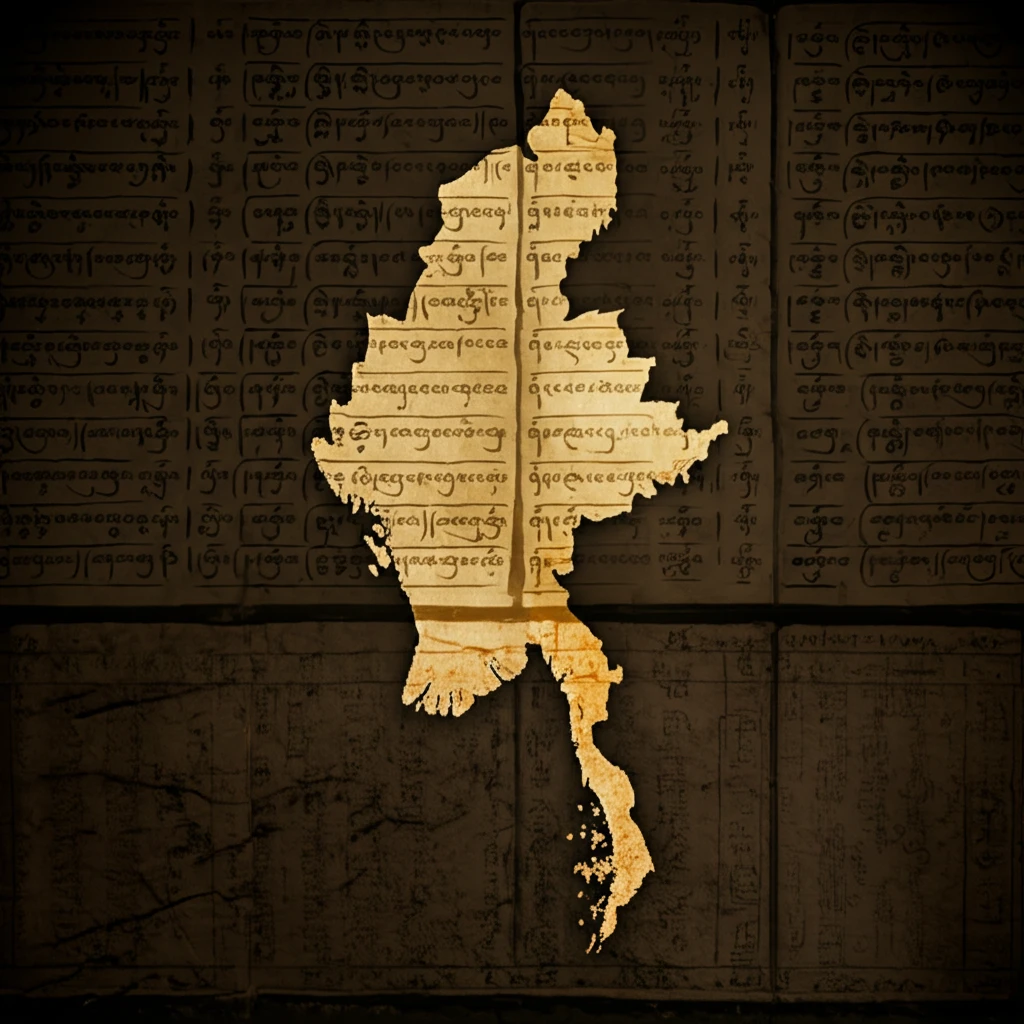
Unearthing Arakan: How New Studies Rewrite the History of Burma

"Explore how groundbreaking research is challenging long-held assumptions about Arakan's role in Southeast Asian history and its connections to neighboring regions."
For centuries, the region bordering the Bay of Bengal has been a melting pot of cultures, economies, and religions. Within this vibrant zone lies Arakan (Rakhine), a region whose historical significance has often been overshadowed or viewed through a limited lens. Traditionally, Arakan's story has been told from the perspective of European colonial powers or through Indo-Persian records, leaving a gap in our understanding of its local nuances.
Now, a new wave of scholarship is emerging, aiming to rectify this imbalance. By delving into vernacular and Indic language documents produced within Arakan itself, researchers are uncovering a wealth of information that promises to rewrite the region's history. This fresh perspective challenges established narratives and sheds light on Arakan's intricate connections with its neighbors.
This article explores how these new studies are reshaping our understanding of Arakanese history. By examining epigraphic, numismatic, and manuscript archives, we'll uncover the hidden connections, challenge existing narratives, and gain a more nuanced appreciation of Arakan's role in the broader Southeast Asian context.
Arakan in Transition
Arakan became one of the divisions of the Union of Burma following independence from British rule, governed as a parliamentary democracy until the 1962 coup d'état. Recent textual and epigraphic studies are revealing previously hidden connections and challenging established narratives about the region's past, prompting a reassessment of Burma's history. The Center for Arakan Studies (CAS), established in December 2021, produces monthly reports covering politics, economics, social issues, and the humanitarian context in Arakan. A CAS report has examined the marginalization of once-dominant Rakhine political actors—including the ALP, ANC, ALD, RNDP, ANP, AFP, and RNP—in the shadow of the United League of Arakan/Arakan Army (ULA/AA).
Methodological Overview
The study of Arakan has historically relied on a combination of textual analysis, oral histories, and archaeological fieldwork, though the region's political volatility has limited sustained access for researchers. Scholars have increasingly turned to epigraphy and numismatic evidence to reconstruct trade networks and political affiliations that written chronicles alone cannot illuminate. One significant methodological challenge is the politicization of naming conventions, which can shape research framing from the outset. Despite these constraints, a growing body of interdisciplinary work is expanding the evidentiary base available to historians and political scientists alike.
Deep Roots of Arakan
Arakan's historical trajectory is far more complex than conventional Burmese national narratives typically acknowledge, with the region functioning as a distinct political and cultural entity for much of its recorded history. Early scholarship established the kingdom's long-standing connections to the Indian subcontinent and maritime Southeast Asia, laying the groundwork for subsequent revisions. The accumulation of new epigraphic discoveries in recent decades has enabled scholars to challenge older, Burma-centric frameworks that marginalized Arakanese agency. These foundational shifts continue to reverberate through contemporary historiography.
Why Arakan's History Needs a Rewrite: Overcoming Neglect and Unearthing Local Voices
The relative neglect of Arakanese sources has led to a skewed understanding of the region's past. The lack of attention to local cultural production—inscriptions, manuscripts, and archaeological evidence—has perpetuated a narrative largely shaped by external perspectives. This isn't due to a lack of local materials; rather, it stems from the ongoing neglect of Arakan and Arakanese archives by preservationists, archaeologists, and historians, both within and outside Burma.
- Inscriptions: These provide direct evidence of political events, religious practices, and social structures.
- Manuscripts: Offering insights into literature, law, and religious beliefs.
- Archaeological Finds: Providing tangible evidence of past settlements, trade networks, and artistic traditions.
Emerging Scholarship
Recent years have seen a notable surge in academic interest in Arakan, driven partly by the unfolding humanitarian crisis and partly by genuinely new source discoveries. Researchers are revisiting long-held assumptions about Arakan's political autonomy and its relationship to both Burmese and Bengal-based power centers. Interdisciplinary collaborations—bringing together linguists, archaeologists, and political scientists—are producing more nuanced accounts of the region's past. The challenge remains to integrate these fragmentary findings into coherent narratives that do not impose modern ethnic categories retroactively.
Points of Contention
Scholarly debate over Arakan's history is not without significant disagreements, particularly regarding the extent of early Islamic influence and the political status of pre-colonial Arakanese kingdoms. Some historians caution against over-relying on archaeological evidence that may be interpreted in multiple ways, while others argue that textual sources carry their own biases. The politicization of historical narratives—both by state actors and by ethno-nationalist movements on multiple sides—adds a layer of difficulty to dispassionate scholarship. Acknowledging these tensions is essential for any honest appraisal of what the evidence currently supports.
Arakan Through Comparative Lenses
The history of Arakan—known today as Rakhine State—is deeply linked to Bengal through political, religious, and socio-cultural contacts traceable to at least the 8th century. Islam is understood to have been introduced to Arakan through these Bengal connections, beginning with the immigration of seafarers and extending through periods of British colonial annexation. The region's name itself is a point of contention: while "Rakhine State" is the most common English-language official usage in line with the 1974 and 2008 constitutions, alternatives persist. In 1989 the military government changed the official name from Burma to Myanmar, but the use of either term has itself become politicized, reflecting deeper disputes over identity and sovereignty.
A New Chapter for Arakanese History
The ongoing effort to uncover and interpret Arakanese sources represents a significant step forward in our understanding of Southeast Asian history. By amplifying local voices and challenging colonial narratives, these new studies are paving the way for a more inclusive and accurate portrayal of Arakan's past. As research continues, we can expect further revelations that will continue to reshape our understanding of this fascinating region.
Pulling It Together
Taken together, the new wave of Arakan-focused research suggests that the region's history cannot be fully understood through the lens of any single national narrative. Scholars increasingly emphasize the need to treat Arakan as a crossroads of South and Southeast Asian civilizations rather than a peripheral appendage of Burma. The ongoing political situation, meanwhile, ensures that academic work continues to carry real-world implications for affected communities. A more inclusive and evidence-based historiography may ultimately serve both scholarly understanding and human rights accountability.
Where Research Is Headed
The future of Arakan studies will likely depend on both the expansion of accessible archives and the political conditions that allow fieldwork in Rakhine State. Digital humanities tools offer new possibilities for cataloguing and sharing epigraphic and manuscript sources that have yet to be fully exploited. Comparative frameworks—drawing parallels with other contested borderland regions—may help illuminate patterns that Arakan-specific studies alone cannot capture. Continued support for institutions like the Center for Arakan Studies will be critical in sustaining momentum.
Institutions and Infrastructure
The Center for Arakan Studies (CAS) emerged in December 2021 as an independent, non-partisan research institution founded by a group of young professionals including journalists, political analysts, researchers, and social workers. The Center's stated aim is to promote understanding of human rights, politics, economics, and social dynamics in Arakan—a mission made more urgent by the evolving political landscape in the region. The CAS model highlights both the potential and the fragility of locally rooted research capacity in conflict-affected settings. Sustaining such institutions will be essential for ensuring that Arakan's story is told with depth and integrity.
History and Its Human Stakes
Behind the epigraphic debates and political analyses lie communities whose daily lives are shaped by the narratives that gain traction—or are suppressed. The marginalization of certain Rakhine political actors, as documented by recent reports, illustrates how shifts in regional power dynamics translate into tangible consequences for governance and representation. Any rewriting of Arakan's history carries implications not only for academic discourse but also for how affected populations understand their own past and present. The stakes of getting this right extend well beyond the university.