
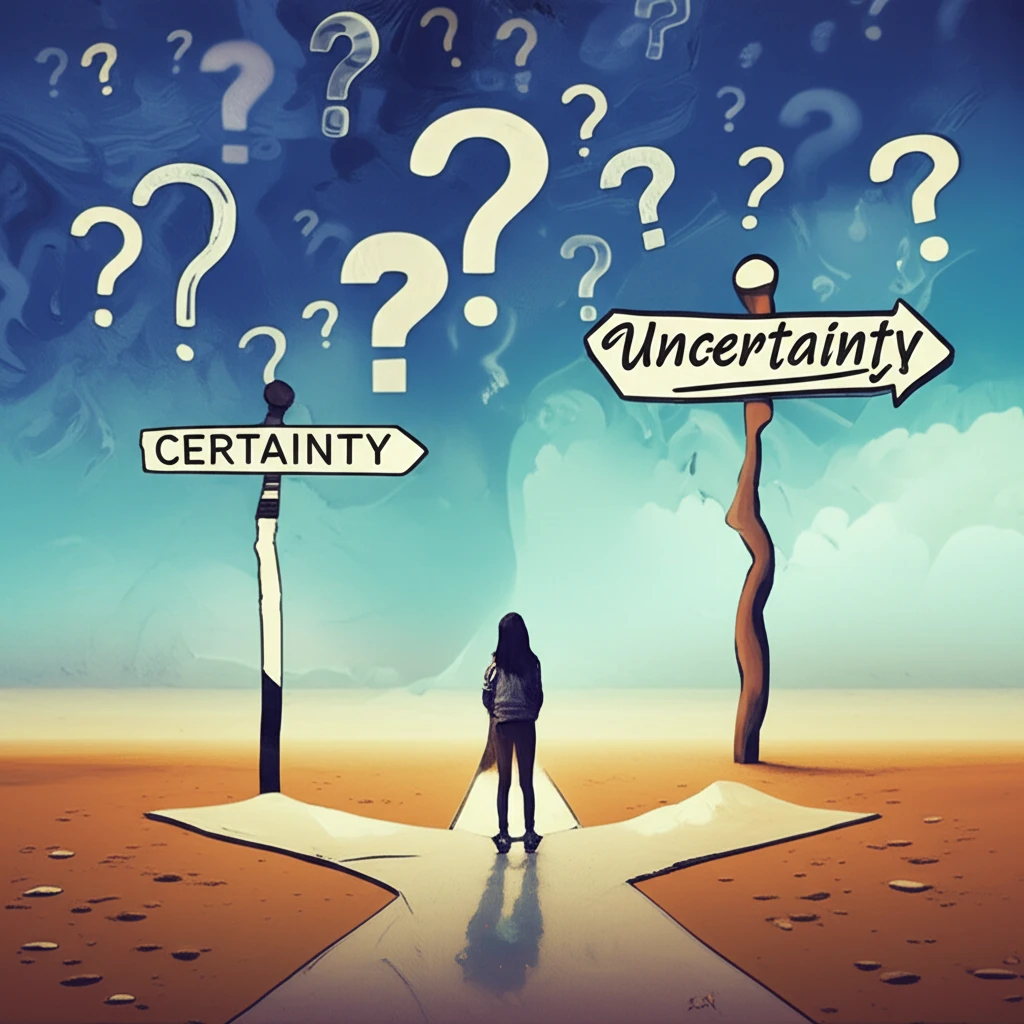
Uncertainty Overload: Why We Avoid Information (and When We Crave It)

"New research reveals the psychology behind our desire for information, showing when we embrace the unknown and when we desperately want answers."
In an uncertain world, the question of when we want to know is a constant companion. Should you peek at the calorie count on that tempting dessert? Should you find out if you're carrying a gene that could change your life forever? The ability to calculate the value of information (VOI) is therefore a crucial cognitive skill.
Classical decision theory suggests that we should always welcome more information, because it never hurts to be better informed. Learning a croissant is high in calorie will guide you to a salad instead; learning you will not get Huntington's might make you delay a hasty marriage. However, real-world behavior often throws a wrench in this neat equation. People actively seek information that won’t change their decisions, while simultaneously avoiding information that could be beneficial.
New research digs into this paradox, exploring why we care so deeply about information that seemingly has no impact. Imagine being locked in a room for an hour, with a chance of winning or losing money at the end. Would you want to know your fate at the beginning? The study reveals we're far from indifferent, and our preferences depend on a complex interplay of factors.
The Resource-Rationality Model: Planning and Cognitive Limits
The key to understanding our seemingly irrational information choices lies in recognizing our limited cognitive resources. We don't just passively receive information; we actively decide whether to plan for it. If an event is not going to happen, there is no need to prepare. But if it is going to occur, having early knowledge gives us a valuable head start.
- Obtain Information: If we get the information, we can plan accordingly (if needed) and gain utility. However, we also incur a cost for acquiring that information.
- Live in Uncertainty: We can choose to remain ignorant and plan based on the probability of the event occurring. This saves the cost of information but may lead to inefficient planning.
- Live in Denial: We can ignore the possibility altogether, freeing up mental resources. However, this carries the risk of being completely unprepared if the event does occur.
The Bigger Picture: Planning, Prospect Theory, and Why It Matters
This research provides a framework for understanding the cognitive task of obtaining information, explaining why we seek answers even when there are no immediate decisions to make. It highlights two key reasons for rejecting information: the desire to "live in denial" (when the event is unlikely) or to "live in uncertainty" (when the probability is high, and the residual risk is deemed acceptable).
The model also incorporates prospect theory, recognizing that we are risk-averse, experience losses more intensely than gains, and perceive probabilities non-linearly. These factors further influence our desire for information, highlighting the complexity of human decision-making.
Ultimately, understanding when and why we choose to reduce uncertainty has become increasingly important. As information becomes ever more accessible, from genetic predispositions to online habits, the ability to discern its true value will be crucial to navigating our complex world.