
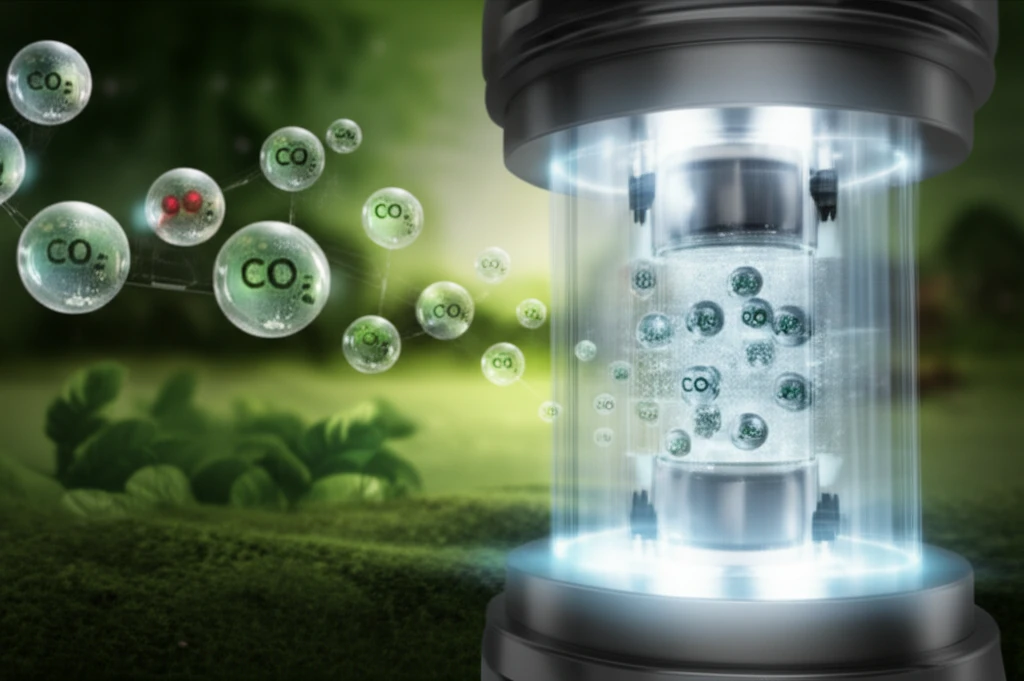
Turning Pollution into Power: How Scientists are Fixing CO2 with Electricity

"Electrocatalysis offers a promising method for converting carbon dioxide into valuable chemicals, paving the way for a sustainable future."
Global warming, driven by the relentless increase of atmospheric carbon dioxide (CO2), has become one of the most pressing environmental issues of our time. Finding effective ways to capture and convert CO2 into valuable chemicals is no longer just an academic pursuit; it's a necessity for a sustainable future.
Unlike the hazardous carbon monoxide and phosgene, CO2 stands out as a renewable and environmentally friendly building block for organic synthesis. However, its inherent stability makes it difficult to convert. Electrocatalysis, which uses electricity to drive chemical reactions, offers a promising solution by enabling CO2 reduction under mild conditions.
Now, a team of scientists is exploring the use of electrochemistry to convert CO2 into useful chemicals called picolinic acids. This innovative approach not only addresses the challenge of CO2 fixation but also provides a pathway for creating valuable resources from a problematic greenhouse gas.
A Technology at a Turning Point
Across the climate and energy landscape, solar, wind, and other renewable sources now produce electricity in growing abundance, yet a large share of the carbon dioxide emitted by human activity still ends up in the atmosphere each year. Electrocatalysis—using electricity to turn CO2 into fuels and chemicals—has emerged as a promising way to close that carbon loop rather than simply store the captured gas. Researchers frame the approach as part of a broader shift toward a circular carbon economy, in which waste CO2 becomes a feedstock instead of a pollutant. The field is nonetheless at an early stage, and most published results remain at laboratory scale rather than commercial deployment. Widely accepted figures on real-world impact are therefore still hard to pin down, and much depends on how quickly the technology scales.
How CO2 Electrolysis Works and Where It Stalls
The standard approach is the electrochemical reduction of CO2 (CO2RR), which uses electrical energy to convert carbon dioxide into value-added fuels and chemicals through the carbon dioxide reduction reaction. Reviews describe this as a promising route to closing the carbon cycle and advancing a circular economy, in which waste CO2 is recycled rather than released. For the technique to become industrially relevant, however, electrocatalyst engineering and reactor design must be pursued together, with targets such as a high current density above 200 mA cm−2 and an electrolyzer lifetime of up to 50,000 hours. Current design strategies still face pitfalls and scientific gaps, especially around electrode and reactor development, and some contributions emphasize the need to accelerate novel materials rather than refine existing ones. The continuously rising CO2 released from human activities is cited as the underlying driver for pursuing this route at all.
From Early Electrocatalysis to CO2RR
The electrochemical reduction of carbon dioxide—commonly known as CO2RR—is defined as a process that converts CO2 to more reduced chemical species using electrical energy. Reviews of the history of electrocatalysis trace its development through examples spanning CO2 reduction, the hydrogen evolution reaction, and the oxygen reduction reaction, covering catalysts such as metal oxides, carbon-based materials, alloys, and noble and precious metals. These foundational studies established the reaction principles and catalyst families on which today's CO2 electroreduction research builds. The field has expanded from these early anchored-reaction experiments into a dedicated area of research, though much of that historical work was conducted at a fundamental or laboratory level.
Electrocatalysis: A Silver Bullet for CO2 Conversion?
The study focuses on using a silver electrode to facilitate the electrocarboxylation of bromopyridines, converting them into picolinic acids. These acids are important industrial and fine chemicals with diverse applications. The researchers systematically investigated how various factors, such as the choice of solvent, supporting electrolyte, current density, electrode material, charge passed, and temperature, affect the yield of picolinic acids.
- Solvent Matters: Dimethylformamide (DMF) proved to be a superior solvent compared to acetonitrile (MeCN), leading to higher yields of picolinic acids.
- Electrolyte Influence: Tetrabutylammonium bromide (TBABr) emerged as the most effective supporting electrolyte, maximizing the efficiency of the conversion process.
- Current Density Optimization: The yield of picolinic acids peaked at a current density of 9 mA cm-2, highlighting the importance of fine-tuning reaction conditions.
- Electrode Material: Silver (Ag) outperformed other electrode materials like nickel (Ni), titanium (Ti), platinum (Pt), and glassy carbon (GC), demonstrating its exceptional electrocatalytic activity.
- Temperature Control: A temperature of 0°C was found to be optimal for the reaction, balancing CO2 solubility and reactant activity.
Recent Advances in Catalytic CO2 Conversion
Recent reviews systematically outline advances in converting CO2 into valuable products through multiple catalytic routes, including photocatalysis, electrocatalysis, CO2 hydrogenation, and photothermal conversion. Within electrocatalysis specifically, the focus has narrowed to the selective reduction of CO2 into chemicals and fuels as a closed-loop solution in the anthropogenic carbon cycle, driven by global warming concerns and the push for sustainable material conversion. Scaling remains the central obstacle, since electrochemical CO2 and CO reduction to multicarbon products is a promising low-carbon pathway but requires catalyst and electrode manufacturing far beyond laboratory scales. A notable innovation reported by Yale researchers combines electrocatalysis with high-energy plasma technology, using catalysts to facilitate electrochemical reactions while plasma drives chemical transformations for CO2 conversion.
The Gap Between Promise and Practice
Despite the enthusiasm in the research community, CO2-to-fuel electrolysis has not yet delivered a broad commercial breakthrough, and critics and cautious reviewers note a persistent gap between laboratory demonstrations and industrial performance. Many promising catalysts achieve high selectivity and efficiency only under ideal conditions that are difficult to replicate at scale. Long-term stability, energy efficiency, and the cost of electricity and equipment all remain open questions that could determine whether the technology is economically viable. As a result, while the potential is widely acknowledged, sustained, field-scale success is still largely a future prospect rather than a current reality.
Electrocatalysis Compared with Batteries and Thermocatalysis
Comparative analyses of electrochemical CO2 conversion technologies treat direct electrocatalytic CO2 reduction (ECO2RR) and metal–CO2 (M–CO2) batteries as promising but distinct approaches, and reviews examine their similarities and differences to guide development and innovation. Another major comparison contrasts electrocatalysis with thermocatalysis for converting CO2 to chemicals and fuels, focusing on the catalysts and reaction mechanisms involved. The thermocatalytic and electrocatalytic processes, as well as their respective catalysts, are discussed in detail in terms of shared features and key differences. Across both comparisons, reviews stress that advancing either technology depends on developments in catalysts, electrolytes, and other functional components.
A Greener Future Powered by Electrocatalysis
This research demonstrates a promising electrochemical route for converting CO2 into valuable chemicals under mild conditions. By optimizing reaction parameters and using a silver electrode, the researchers achieved high yields of picolinic acids, showcasing the potential of electrocatalysis for CO2 fixation.
Why eCO2R Is a Promising Climate Pathway
Expert reviews describe the electrochemical reduction of CO2 (eCO2R) as a promising pathway for addressing climate change by converting CO2 into value-added chemicals and fuels, with the design of materials at the core of the technology. From a commercial perspective, electrochemical CO2 reduction (eCO2RR) is seen as an effective strategy that offers distinct advantages over other CO2 reduction routes, including a wide range and higher selectivity of products. Its ease of integration with growing renewable energy infrastructure is singled out as a practical strength. Together, these commentaries position eCO2R as a route to reduce the global carbon footprint while producing useful molecules.
Open Frontiers on the Horizon
Looking ahead, the most promising frontiers for pollutant-to-power research lie in making electrochemistry cheap, durable, and selective enough for real factories rather than specialized laboratories. Energy efficiency remains the overarching constraint, since using clean electricity to split CO2 only helps the climate if the overall process consumes less energy than the fossil pathway it replaces. Researchers are also exploring a wider range of products—from simple fuels to complex multicarbon chemicals—and the integration of CO2 conversion with emerging plasma- and otherwise-assisted reaction systems. Progress will depend as much on engineering and economics as on new catalyst chemistry, and near-term breakthroughs are inherently difficult to predict.
Ten Years of Momentum, Still Scaling
A commentary in Nature Energy characterizes electrocatalytic conversion of carbon dioxide as an emerging approach that uses electricity to produce useful molecules, noting that the field has advanced enormously over the past ten years. The same analysis cautions that further progress will require moving beyond laboratory demonstrations to address the systemic challenges of industrial deployment. This framing places CO2 electrolysis within a broader energy transition in which abundant renewable electricity enables new chemical production routes. The commentary implies that real-world traction will depend on techno-economic performance, durability, and integration with the wider clean-energy system.
From Lab Innovations to Real-World Solutions
Researchers position electrochemical carbon dioxide conversion technologies as promising new answers to pressing environmental and energy issues, which gives the work a clear stakes for society rather than purely academic interest. Attention is paid to the role of well-designed functional materials—electrodes and catalysts, electrolytes, and membranes and separators—in enabling both ECO2RR and M–CO2 batteries at an industrial level. The emphasis on the impact of these components signals a shift toward engineering systems that could operate in real-world facilities. Success in that direction would translate laboratory discoveries into industrial processes that address climate concerns directly.
The study's findings not only contribute to fundamental research but also pave the way for practical applications in CO2 conversion and the synthesis of pharmaceutical intermediates. With further development, this approach could offer a simple and efficient means of mitigating climate change and creating a more sustainable future.
As we continue to seek innovative solutions for combating climate change, electrocatalysis offers a ray of hope. By harnessing the power of electricity, we can transform a problematic greenhouse gas into valuable resources, creating a win-win scenario for both the environment and the economy.