
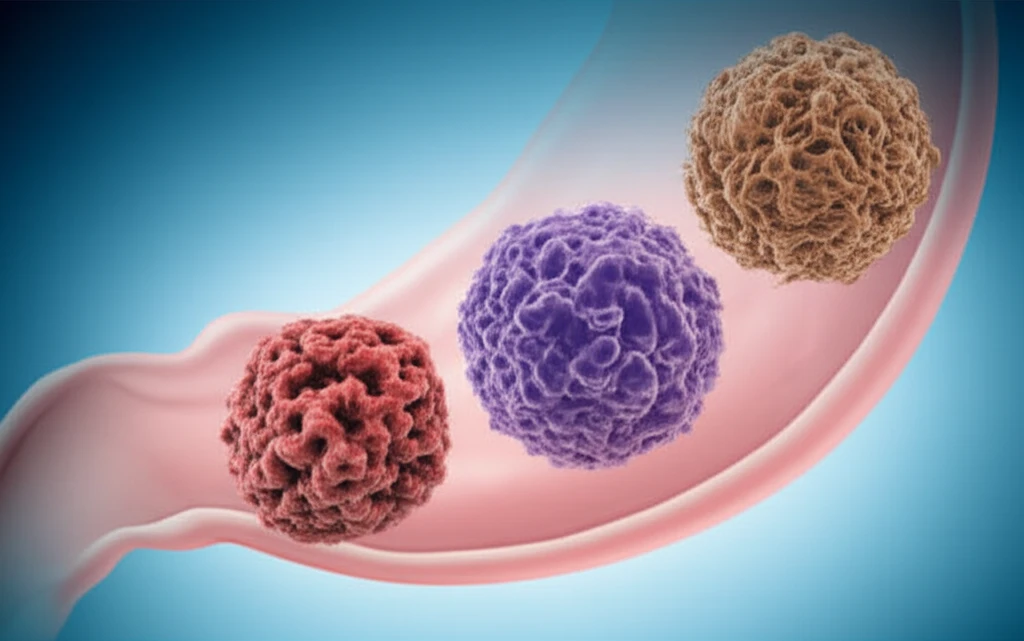
Surreal illustration of three interconnected cellular structures representing different types of gastric cancer.

Triple Threat: When Gastric Cancers Collide

"Exploring the rare phenomenon of synchronous gastric adenocarcinoma, mucosa-associated lymphoid tissue lymphoma, and gastrointestinal stromal tumor in a single patient."


Gastric cancer, a formidable adversary, typically presents as a singular entity. However, in extremely rare instances, it can manifest as a convergence of multiple distinct cancers within the stomach. Medical literature on the simultaneous occurrence of different gastric cancer types is sparse, making each case a valuable opportunity for enhanced understanding and improved clinical strategies.

A recent case study sheds light on one such extraordinary occurrence: a 70-year-old male diagnosed with synchronous gastric adenocarcinoma, mucosa-associated lymphoid tissue (MALT) lymphoma, and gastrointestinal stromal tumor (GIST). This convergence of three different cancers in one patient challenges existing paradigms and underscores the importance of vigilance in diagnosis and treatment.

This article delves into the details of this remarkable case, exploring the diagnostic journey, treatment approach, and the intriguing questions it raises about the etiology and interactions of different gastric cancer types. We aim to highlight the need for clinicians to be aware of such unusual presentations, as they can significantly impact treatment strategies and patient outcomes.

Decoding the Triple Cancer Case: Diagnosis and Treatment

Surreal illustration of three interconnected cellular structures representing different types of gastric cancer.

The patient, a 70-year-old male, presented with symptoms suggestive of gastric distress. Initial investigations revealed the presence of not one, but three distinct cancerous lesions within the stomach. Histological examination confirmed the diagnoses: adenocarcinoma, MALT lymphoma, and GIST. This unusual combination prompted an in-depth review of the patient's medical history and lifestyle factors.

Interestingly, the patient tested negative for Helicobacter pylori (H. pylori), a bacterium commonly associated with gastric adenocarcinoma and MALT lymphoma. This finding adds another layer of complexity to the case, suggesting that other factors may have contributed to the development of these cancers.

  • Adenocarcinoma: The most common type of gastric cancer, originating from the glandular cells of the stomach lining.
  • MALT Lymphoma: A type of non-Hodgkin lymphoma that develops in the mucosa-associated lymphoid tissue of the stomach.
  • GIST: A sarcoma that arises from the interstitial cells of Cajal, specialized cells found in the wall of the digestive tract.
Given the complexity of the case, the medical team opted for an aggressive treatment approach: a total gastrectomy followed by esophago-jejunostomy Roux-en-Y anastomosis. This procedure involves removing the entire stomach and reconstructing the digestive tract by connecting the esophagus directly to the jejunum (a part of the small intestine). Post-surgical pathology confirmed the presence of all three cancers, further validating the initial diagnosis.

Implications and Future Directions

The synchronous occurrence of gastric adenocarcinoma, MALT lymphoma, and GIST in a single patient presents a unique challenge and opportunity for the medical community. While H. pylori is known to play a significant role in gastric adenocarcinoma and MALT lymphoma, its role in GIST development remains unclear. Further research is needed to elucidate the underlying mechanisms that contribute to the development of these concurrent cancers, particularly in H. pylori-negative patients. This case underscores the importance of considering the possibility of multiple primary cancers, even in the presence of seemingly straightforward diagnoses. Heightened awareness and vigilance can lead to more accurate diagnoses, tailored treatment strategies, and ultimately, improved outcomes for patients facing these complex oncological challenges.

About this Article -

This article was crafted using a human-AI hybrid and collaborative approach. AI assisted our team with initial drafting, research insights, identifying key questions, and image generation. Our human editors guided topic selection, defined the angle, structured the content, ensured factual accuracy and relevance, refined the tone, and conducted thorough editing to deliver helpful, high-quality information.See our About page for more information.

Everything You Need To Know

1

What is the significance of a patient being diagnosed with gastric adenocarcinoma, MALT lymphoma, and GIST simultaneously?

The simultaneous diagnosis of gastric adenocarcinoma, mucosa-associated lymphoid tissue (MALT) lymphoma, and gastrointestinal stromal tumor (GIST) is an extremely rare occurrence. This convergence challenges conventional understanding of gastric cancer development and treatment strategies. It highlights the need for heightened awareness among clinicians to consider the possibility of multiple primary cancers, even when initial diagnoses seem straightforward. Such cases offer valuable opportunities to enhance our understanding of cancer etiology and improve clinical approaches. Further research is needed to understand the interactions and potential shared risk factors or pathways that could lead to the synchronous development of these distinct cancers.

2

How did the patient's negative Helicobacter pylori (H. pylori) status influence the understanding and treatment of their condition?

The patient's negative Helicobacter pylori (H. pylori) status complicated the understanding of their condition, as H. pylori is commonly associated with gastric adenocarcinoma and mucosa-associated lymphoid tissue (MALT) lymphoma. This suggests that other factors, beyond H. pylori infection, contributed to the development of these cancers in this particular case. This finding underscores the need to investigate other potential risk factors and underlying mechanisms that may promote the development of these concurrent cancers in H. pylori-negative individuals. It broadens the scope of research and clinical consideration beyond the typical H. pylori-related pathways.

3

What treatment approach was employed for the patient diagnosed with gastric adenocarcinoma, MALT lymphoma, and GIST, and why was it chosen?

Given the complexity of the case involving gastric adenocarcinoma, mucosa-associated lymphoid tissue (MALT) lymphoma, and gastrointestinal stromal tumor (GIST), the medical team opted for an aggressive treatment approach. This involved a total gastrectomy followed by esophago-jejunostomy Roux-en-Y anastomosis. A total gastrectomy, the removal of the entire stomach, was performed to ensure all cancerous lesions were eradicated. The esophago-jejunostomy Roux-en-Y anastomosis was then performed to reconstruct the digestive tract by connecting the esophagus directly to the jejunum. This approach was chosen to address all three distinct cancers comprehensively and provide the best chance for long-term disease control.

4

What implications does the synchronous occurrence of gastric adenocarcinoma, MALT lymphoma, and GIST have for future research and clinical practice?

The synchronous occurrence of gastric adenocarcinoma, mucosa-associated lymphoid tissue (MALT) lymphoma, and gastrointestinal stromal tumor (GIST) underscores the importance of considering the possibility of multiple primary cancers, even in the presence of seemingly straightforward diagnoses. It emphasizes the need for heightened awareness among clinicians to improve diagnostic accuracy and tailor treatment strategies to each patient's unique circumstances. Future research should focus on elucidating the underlying mechanisms that contribute to the development of these concurrent cancers, particularly in H. pylori-negative patients. Further investigation of potential genetic predispositions, environmental factors, and molecular pathways may also be warranted.

5

What are the individual characteristics of gastric adenocarcinoma, MALT lymphoma, and GIST, and how do they differ from each other?

Gastric adenocarcinoma, the most common type of gastric cancer, originates from the glandular cells of the stomach lining. Mucosa-associated lymphoid tissue (MALT) lymphoma is a type of non-Hodgkin lymphoma that develops in the mucosa-associated lymphoid tissue of the stomach. Gastrointestinal stromal tumor (GIST) is a sarcoma that arises from the interstitial cells of Cajal, specialized cells found in the wall of the digestive tract. Each cancer type has distinct cellular origins, genetic profiles, and clinical behaviors. Gastric adenocarcinoma typically presents with features of epithelial cancers, while MALT lymphoma exhibits characteristics of lymphomas, and GIST displays features of sarcomas. They respond differently to various treatments, highlighting the importance of accurate diagnosis and tailored management strategies.

Newsletter Subscribe

Subscribe to get the latest articles and insights directly in your inbox.