
Trade Winds Evolving: How a New Economic Model Could Reshape Global Commerce

"Exploring the Enhanced Gravity Model and its potential to revolutionize our understanding of international trade networks."
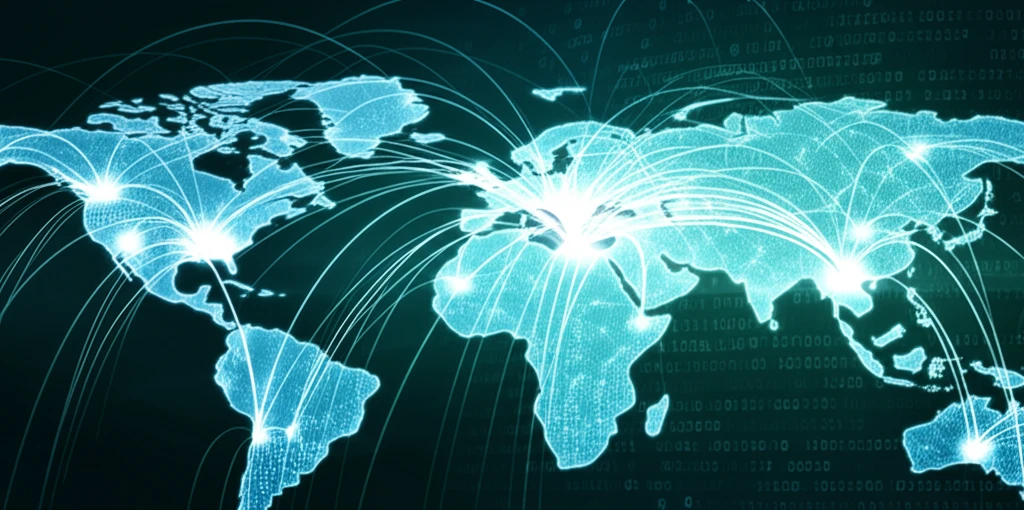
The world of international trade is a complex web, connecting countries through intricate economic relationships. This network, known as the International Trade Network (ITN), plays a vital role in shaping globalization, economic integration, and the distribution of wealth and resources across the globe. Understanding the dynamics of this network is essential for policymakers, businesses, and anyone interested in the forces that shape our interconnected world.
Traditional models, like the Gravity Model (GM), have long been used to explain trade patterns, focusing on factors such as GDP and geographic distance. However, these models often fall short in capturing the intricate structure of the ITN, failing to account for the complex relationships and heterogeneous connections that characterize real-world trade.
Now, a new approach is emerging: the Enhanced Gravity Model (EGM). By combining macroeconomic factors with network analysis, the EGM offers a more comprehensive and accurate way to understand the forces driving international trade. This innovative model has the potential to revolutionize our understanding of global commerce and inform more effective economic policies.
The Limitations of Traditional Trade Models: Why GDP and Distance Aren't Enough
For decades, the Gravity Model has been a cornerstone of international trade analysis. It posits that the volume of trade between two countries is directly proportional to their economic size (GDP) and inversely proportional to the distance between them. While the GM has proven useful in explaining some broad patterns, it has significant limitations.
- Overly simplistic assumptions: The GM relies on a few key variables, neglecting the influence of factors such as political relationships, cultural similarities, and trade agreements.
- Inability to model zero trade flows: The GM struggles to explain why some countries do not trade with each other, even when GDP and distance would suggest otherwise.
- Homogenous network structure: The GM fails to capture the rich heterogeneity and complex relationships that characterize the real-world ITN.
The Future of Trade Modeling: A More Holistic Approach
The Enhanced Gravity Model represents a significant step forward in our understanding of international trade. By integrating macroeconomic factors with network analysis, the EGM offers a more comprehensive and nuanced perspective on the forces driving global commerce. As the world becomes increasingly interconnected, models like the EGM will be crucial for policymakers, businesses, and researchers seeking to navigate the complexities of the global economy and promote sustainable and equitable trade relationships.