
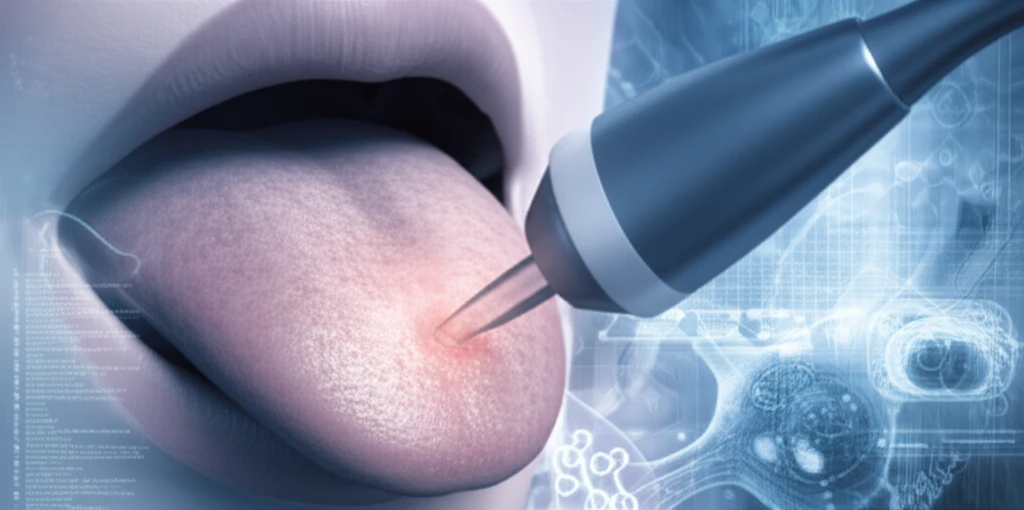
Tongue Cancer Detection: Can Ultrasound Elastography Make a Difference?

"A new study explores how intraoral ultrasonography combined with strain elastography could offer a less invasive way to characterize tongue lesions."
Detecting tongue cancer early is crucial for successful treatment, but distinguishing between benign lesions and early-stage cancer can be challenging. Traditional methods, including visual exams and palpation, have limitations, highlighting the need for more advanced diagnostic tools.
Ultrasonography is often the first imaging method used to investigate oral and maxillofacial lesions. While conventional ultrasonography provides valuable information, strain elastography is a newer technique that assesses the stiffness of tissues, potentially offering additional insights into the nature of tongue lesions.
This article explores a recent study that investigates the use of intraoral ultrasonography combined with strain elastography for characterizing tongue carcinoma. This preliminary research aims to determine if this combined approach can differentiate between normal tissues and cancerous lesions in the tongue, potentially leading to earlier and more accurate diagnoses.
How Does Strain Elastography Work?
Strain elastography is based on the principle that cancerous tissues are generally stiffer than normal tissues. The technique involves applying slight pressure to the tissue using an ultrasound probe and measuring the tissue's deformation. This information is then used to create a visual representation of tissue stiffness.
- Applying gentle compression and decompression to the tongue using the ultrasound probe.
- Monitoring tissue strain over time using a strain graph.
- Using integrated software to measure quantitative strain (%) within regions of interest (ROIs).
- Comparing strain measurements between normal tissues and lesions.
The Future of Tongue Cancer Diagnosis
This preliminary study suggests that strain elastography using intraoral ultrasonography is a promising technique for characterizing and differentiating normal tissues and SCC in the tongue. While the study involved only two patients, the results warrant further investigation with larger sample sizes.
The potential benefits of this approach include:
<ul><li>Non-invasive: It does not require surgical biopsies.</li><li>Relatively inexpensive: It utilizes existing ultrasound technology with specialized software.</li><li>Easy to use: The procedure can be performed by trained clinicians.</li><li>Early detection: It may help identify cancerous lesions at an earlier stage.</li></ul>