
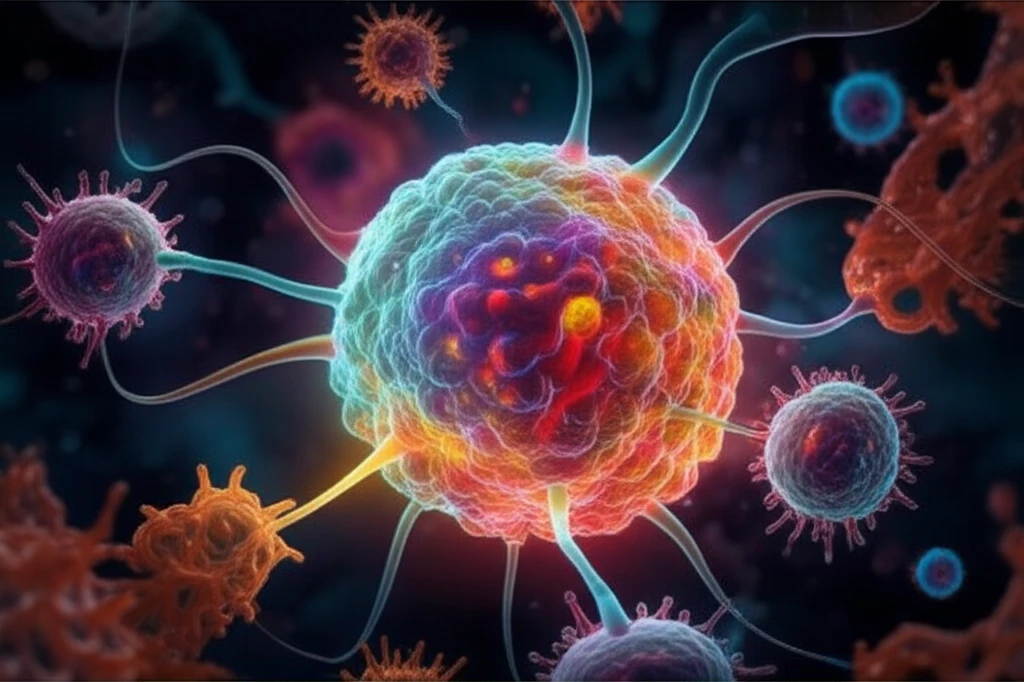
Miniature tumor glowing with vibrant colors, surrounded by immune cells.

Tiny Tumors, Big Impact: How Mini-Tumors Are Revolutionizing Cancer Research

"Unlocking the Secrets of Immunotherapy Resistance with Miniature Tumors"


Cancer research is constantly evolving, seeking innovative ways to understand and combat this complex disease. One promising avenue lies in the study of miniature tumors, also known as organoids. These tiny, three-dimensional models of tumors are created in the lab and offer a unique platform for studying cancer cells and their interactions with the immune system.

Organoids mimic the structure and function of real tumors, providing researchers with a powerful tool to investigate cancer biology. They allow scientists to observe how cancer cells grow, respond to treatments, and interact with immune cells in a controlled environment. This is particularly valuable for understanding why some tumors develop resistance to immunotherapy, a revolutionary approach that harnesses the power of the body's own immune system to fight cancer.

The use of organoids in cancer research is a game-changer, offering unprecedented insights into the disease and opening doors to more effective and personalized treatments. As research continues, these mini-tumors hold the potential to transform the way we understand and treat cancer, bringing new hope to patients worldwide.

What Are Mini-Tumors and Why Are They Important?

Miniature tumor glowing with vibrant colors, surrounded by immune cells.

Mini-tumors, or organoids, are small, three-dimensional structures grown in the laboratory that mimic the characteristics of real tumors. They are typically created from cancer cells taken from patients and cultured in a special environment that allows them to self-organize and form structures that resemble the original tumor.

These mini-tumors are important for several reasons:

  • Realistic Models: They provide a more realistic model of tumors compared to traditional two-dimensional cell cultures, allowing researchers to study cancer cells in a more natural context.
  • Personalized Medicine: Organoids can be created from individual patients' cancer cells, enabling personalized testing of different treatments to determine the most effective approach for each patient.
  • Understanding Resistance: They offer a platform to study why some tumors resist immunotherapy, helping scientists identify the mechanisms behind resistance and develop strategies to overcome it.
  • Drug Discovery: Organoids can be used to screen new drugs and identify those that are most effective at killing cancer cells.
By using mini-tumors, researchers can gain valuable insights into cancer biology and develop more effective and personalized treatments for patients.

The Future of Cancer Treatment: Personalized Immunotherapy

The use of mini-tumors in cancer research is paving the way for a future where cancer treatment is personalized and more effective. By understanding why some tumors resist immunotherapy, scientists can develop strategies to overcome resistance and harness the full potential of the immune system to fight cancer. This approach holds the promise of transforming cancer care and improving the lives of patients worldwide.

About this Article -

This article was crafted using a human-AI hybrid and collaborative approach. AI assisted our team with initial drafting, research insights, identifying key questions, and image generation. Our human editors guided topic selection, defined the angle, structured the content, ensured factual accuracy and relevance, refined the tone, and conducted thorough editing to deliver helpful, high-quality information.See our About page for more information.

Everything You Need To Know

1

What exactly are mini-tumors or organoids, and how do they differ from traditional cell cultures used in cancer research?

Mini-tumors, also known as organoids, are three-dimensional structures grown in a lab that mimic the characteristics of real tumors. They are created from cancer cells, often taken from patients, and cultured in a special environment. Unlike traditional two-dimensional cell cultures, organoids self-organize into structures resembling the original tumor, providing a more realistic model for studying cancer cell behavior, drug responses, and interactions with the immune system.

2

How are mini-tumors being utilized to enhance personalized medicine approaches in cancer treatment, particularly concerning immunotherapy?

Mini-tumors, or organoids, are used to create personalized models of a patient's specific tumor. Researchers can test different treatments, including immunotherapies, on these organoids to determine which approach is most effective for that individual. This allows for a more tailored and precise treatment plan, increasing the likelihood of a positive outcome. By observing how the organoids respond, scientists gain insights into the tumor's unique characteristics and vulnerabilities, leading to more informed decisions about treatment strategies.

3

What role do mini-tumors play in understanding and overcoming immunotherapy resistance in cancer?

Mini-tumors, or organoids, offer a valuable platform to study why some tumors resist immunotherapy. Researchers can observe how cancer cells within the organoids interact with immune cells and identify the mechanisms that enable tumors to evade the immune system's attack. By understanding these resistance mechanisms, scientists can develop strategies to overcome them, such as combining immunotherapy with other treatments or modifying the immune response to be more effective against the tumor. This is crucial for expanding the effectiveness of immunotherapy and improving outcomes for cancer patients.

4

Beyond personalized medicine and immunotherapy resistance, in what other areas of cancer research are mini-tumors proving to be particularly useful?

Besides personalized medicine and immunotherapy resistance, mini-tumors, or organoids, are valuable in drug discovery. They serve as a platform to screen new drugs and identify those most effective at killing cancer cells. Their realistic modeling of tumors, compared to traditional 2D cell cultures, means drug responses observed in organoids are more likely to translate to patient outcomes. Organoids are also used to study cancer biology, observing how cancer cells grow and respond to treatments in a controlled environment.

5

What are the broader implications of using mini-tumors in cancer research for the future of cancer treatment and patient care?

The use of mini-tumors, or organoids, in cancer research is paving the way for a future where cancer treatment is highly personalized and more effective. By providing insights into tumor biology, drug responses, and immunotherapy resistance, organoids enable the development of targeted therapies that are tailored to individual patients' needs. This approach promises to improve treatment outcomes, reduce side effects, and ultimately transform cancer care, bringing new hope to patients worldwide. The ability to predict treatment responses using organoids can also save time and resources by avoiding ineffective therapies.

Newsletter Subscribe

Subscribe to get the latest articles and insights directly in your inbox.