
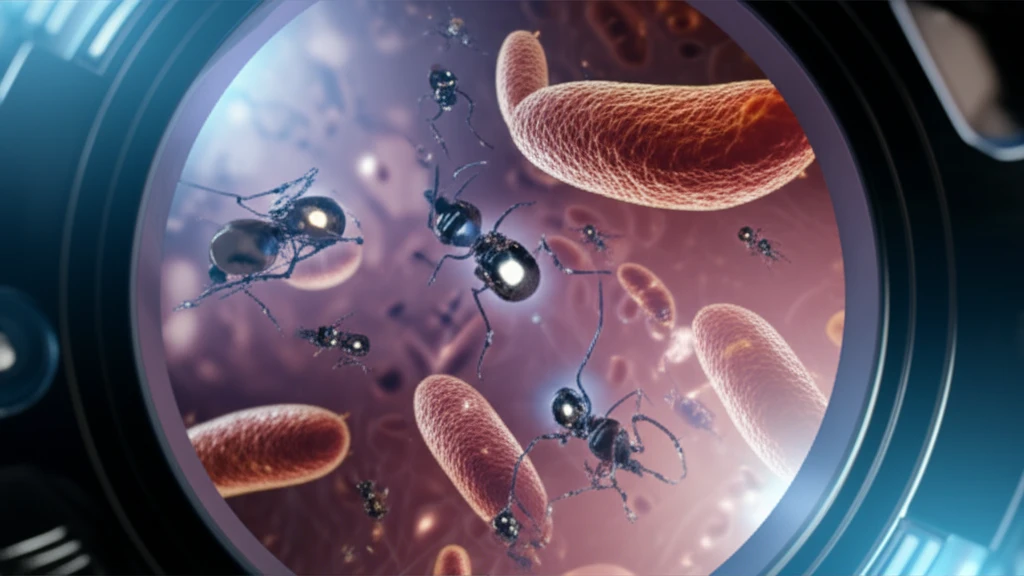
Tiny Particles, Big Impact: Revolutionizing Amoebiasis Treatment with Nanotechnology

"Can tinidazole nanosuspensions offer a better way to fight this widespread parasitic disease?"
Amoebiasis, an infectious disease caused by the protozoan Entamoeba histolytica, poses a significant health challenge worldwide, particularly in developing countries where sanitation and hygiene are often lacking. This parasitic infection, primarily affecting the gastrointestinal tract, can lead to a range of symptoms from mild discomfort to severe dysentery and liver abscesses. The rapid multiplication of the protozoa within their hosts underscores the need for effective treatment strategies.
Chemotherapy remains the primary approach for managing amoebiasis, with nitroimidazoles like tinidazole (TNZ) playing a crucial role. These drugs are effective against both intestinal and systemic forms of the disease. However, a major drawback is the high doses required, often accompanied by a metallic or bitter taste, leading to poor patient compliance, especially among children. The challenge, therefore, lies in enhancing drug efficacy while minimizing these adverse effects.
Nanotechnology offers a promising avenue for improving the treatment of amoebiasis. By formulating drugs into nanosuspensions—ultra-fine suspensions of drug nanoparticles—researchers aim to enhance dissolution rates and bioavailability. This approach could potentially reduce the required dosage, improve patient compliance, and ultimately lead to more effective treatment outcomes. Recent studies focus on nanoprecipitation methods to create these nanosuspensions, offering a simple and scalable means of production.
What are the benefits of tinidazole nanosuspensions for treating amoebiasis?
Nanosuspensions offer several advantages over traditional drug formulations, particularly for drugs with poor solubility. By reducing the particle size to the nanometer scale, the surface area of the drug is significantly increased. This leads to a faster dissolution rate, which is often the rate-limiting step in drug absorption. The result is enhanced bioavailability, meaning a greater proportion of the drug reaches the systemic circulation.
- Increased Saturation Solubility: Nanosuspensions can increase the saturation solubility of a compound, further driving dissolution.
- Altered Crystalline Structure: The nanosizing process can alter the crystalline structure of the drug, potentially increasing the amorphous fraction and improving solubility.
- Improved Physical Stability: Due to their small size, nanoparticles experience less gravitational force, reducing the risk of flocculation and Ostwald ripening, which can compromise stability.
- Reduced Drug Dosage: Enhanced bioavailability may allow for a reduction in the required drug dose, minimizing side effects and lowering therapy costs.
The Future of Nanotechnology in Amoebiasis Treatment
The development of tinidazole nanosuspensions represents a significant step forward in the treatment of amoebiasis. By improving drug delivery and bioavailability, this innovative approach holds the potential to enhance treatment outcomes, reduce side effects, and improve patient compliance, especially in vulnerable populations such as children. Ongoing research and development efforts are likely to further refine these formulations, paving the way for more effective and accessible treatments for this widespread parasitic disease. Further research includes human trials to validate effectiveness and safety, and exploring large-scale manufacturing techniques to ensure accessibility.