
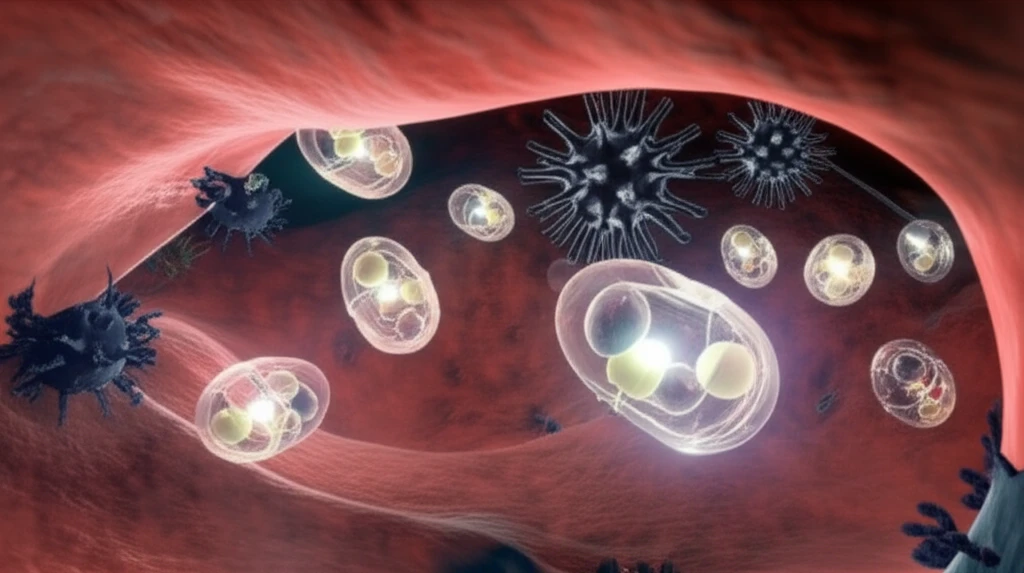
Nanocapsules delivering medication within the human body to fight viruses.

Tiny Capsules, Big Impact: Can Nanotechnology Conquer AIDS Drug Delivery?

"Scientists are exploring how nanotechnology can improve the effectiveness and availability of Lopinavir, a crucial anti-AIDS drug, offering hope for better treatment outcomes."


The global fight against Acquired Immune Deficiency Syndrome (AIDS) continues, with millions affected worldwide, particularly in resource-limited countries. Significant progress has been made in antiretroviral therapy, utilizing several classes of agents, including nucleotide reverse transcriptase inhibitors (NRTIs), non-NRTIs (NNRTIs), protease inhibitors (PIs), and integrase inhibitors. Effective treatment often involves a combination of three to four potent agents tailored to the individual, reducing viral load and improving the patient’s T-lymphocyte count.

However, administering multiple drugs (poly-pharmacy) can lead to complex drug interactions. For example, NNRTIs and PIs are metabolized by the CYP450 enzyme system, predominantly the 3A4 isoform, resulting in pharmacokinetic complications. Many of these drugs act as both substrates and modulators of CYP3A4, making interactions unpredictable. Ritonavir (RTV), a PI with high oral bioavailability, serves as a strong CYP3A inhibitor, often used to boost the effectiveness of other drugs.

Lopinavir (LPV), an analog of RTV, was designed to better interact with mutated HIV protease. While LPV is effective against both wild-type and mutated HIV, it suffers from low oral bioavailability due to P-glycoprotein (P-gp) and multidrug resistance-associated protein 2 (MRP2) efflux, as well as extensive pre-systemic metabolism by CYP3A4. This process primarily occurs in the enterocytes of the intestine, reducing plasma levels and effectiveness. Co-administration of LPV with low-dose RTV improves absorption but introduces drawbacks such as increased toxicity and gastrointestinal disturbances.

The Nano-Micro Solution: How It Works

Nanocapsules delivering medication within the human body to fight viruses.

To address these challenges, researchers have explored novel therapeutic delivery systems for LPV that avoid the need for concomitant RTV administration. One promising approach involves encapsulating LPV within biodegradable PLGA nanocapsules (NCs) that are themselves embedded in gastro-resistant bio-adhesive microparticles (MCPs). This “Trojan horse” strategy aims to bypass P-gp efflux and protect the drug from CYP3A pre-systemic metabolism. The study by Nassar et al. (2018) delves into this method, examining how the characteristics of the NC wall, the oil core, and drug load within the MCPs influence LPV absorption without RTV.

The study involved creating three formulations of LPV-loaded NCs embedded in MCPs, each with variations in polymer composition and solvent volumes. These formulations were designed to test the significance of the NC coating thickness on drug release and absorption.

  • F[I]: Composed of OA NCs embedded in MCPs, with a specific ratio of oleic acid (OA), Labrafil M 1944 CS, PLGA, and LPV.
  • F[II]: Similar to F[I] but with a higher PLGA content to create a thicker NC coating.
  • F[III]: Prepared with one-third of the ingredient quantities used in F[II], also aimed at examining the significance of NC coating thickness.
These formulations were then subjected to a series of in vitro and in vivo tests to evaluate their performance. In vitro release studies examined how LPV was released from the MCPs at different pH levels, mimicking conditions in the gastrointestinal tract. In vivo studies involved administering the formulations to rats to assess LPV bioavailability and antiviral efficacy.

Looking Ahead: Potential for Improved HIV Treatment

The findings suggest that nanocapsules embedded in microparticles hold promise for improving the oral bioavailability and efficacy of LPV. By optimizing the formulation, it may be possible to reduce or eliminate the need for ritonavir, minimizing side effects and improving patient compliance. This delivery system, if clinically proven, could revolutionize the way lipophilic PIs are administered, offering new hope for those living with HIV/AIDS.

About this Article -

This article was crafted using a human-AI hybrid and collaborative approach. AI assisted our team with initial drafting, research insights, identifying key questions, and image generation. Our human editors guided topic selection, defined the angle, structured the content, ensured factual accuracy and relevance, refined the tone, and conducted thorough editing to deliver helpful, high-quality information.See our About page for more information.

Everything You Need To Know

1

What is Lopinavir (LPV) and why is its delivery a challenge in the treatment of AIDS?

Lopinavir (LPV) is a crucial anti-AIDS drug, specifically a protease inhibitor (PI). Its effectiveness is hindered by low oral bioavailability. This is due to factors such as P-glycoprotein (P-gp) and multidrug resistance-associated protein 2 (MRP2) efflux, which limits absorption. Also, extensive pre-systemic metabolism by the CYP3A4 enzyme in the intestine further reduces the drug's presence in the bloodstream, thus impacting its efficacy. While effective against both wild-type and mutated HIV, these factors make delivering LPV effectively a significant challenge.

2

How do nanocapsules embedded in microparticles improve Lopinavir's delivery?

The innovative approach involves encapsulating Lopinavir within biodegradable PLGA nanocapsules (NCs) that are then embedded in gastro-resistant bio-adhesive microparticles (MCPs). This "Trojan horse" strategy aims to bypass P-gp efflux and protect the drug from CYP3A pre-systemic metabolism. The MCPs are designed to protect the LPV until it reaches the appropriate area for absorption, while the NCs further enhance bioavailability and efficacy. This method aims to avoid the need for co-administration of Ritonavir (RTV).

3

What are the key components and design considerations of the nano-micro formulations used in the study mentioned in the article?

The study explores formulations where LPV is encapsulated in PLGA nanocapsules (NCs), which are then embedded in microparticles (MCPs). The characteristics of the NC wall, the oil core, and drug load within the MCPs were carefully considered. Three formulations (F[I], F[II], and F[III]) were created, varying in polymer composition and solvent volumes to test the impact of NC coating thickness. F[I] used oleic acid (OA), Labrafil M 1944 CS, PLGA, and LPV. F[II] had a higher PLGA content. F[III] used a reduced amount of ingredients to further examine the impact of NC coating.

4

What are the potential benefits of this new delivery system for those living with HIV/AIDS?

The use of nanocapsules embedded in microparticles to deliver Lopinavir (LPV) holds significant promise. The primary benefit lies in improving the oral bioavailability and efficacy of LPV. By optimizing the formulation, it may be possible to reduce or eliminate the need for Ritonavir (RTV), which is often used to boost LPV's effectiveness. This reduction in RTV use can minimize side effects and improve patient compliance, offering a more manageable and effective treatment option. This delivery system, if clinically proven, could revolutionize the way lipophilic PIs are administered, offering new hope for those living with HIV/AIDS.

5

Why is co-administration of Lopinavir with Ritonavir problematic, and how does this new delivery method address those issues?

Co-administering Lopinavir (LPV) with Ritonavir (RTV) is often necessary because RTV inhibits the CYP3A enzyme, which metabolizes LPV. This boosts LPV's effectiveness. However, it introduces drawbacks such as increased toxicity and gastrointestinal disturbances. The new delivery method, involving nanocapsules embedded in microparticles, aims to bypass these problems by enhancing LPV's bioavailability and efficacy without the need for RTV. The "Trojan horse" strategy protects LPV from P-gp efflux and CYP3A pre-systemic metabolism, allowing for better absorption and potentially eliminating the need for RTV, thus reducing side effects and improving patient outcomes.

Newsletter Subscribe

Subscribe to get the latest articles and insights directly in your inbox.