
Thermoelectric Breakthrough: Enhancing Efficiency with Innovative Wet Etching

"New Research Reveals How Wet Etching Can Significantly Improve the Performance of Thermoelectric Devices"
Thermoelectric modules are gaining increased attention as a promising avenue for sustainable energy solutions, capable of converting heat energy directly into electricity and vice versa. These modules leverage the Seebeck effect, generating electric currents from temperature gradients, and the Peltier effect, creating temperature differences through electric currents. Their application in thermoelectric generators requires numerous elements to be connected in series, making the quality and reliability of each bond critical to overall performance.
A significant challenge in the fabrication of these modules lies in ensuring robust and durable connections between the thermoelectric elements and the conductive layers. Traditional soldering methods often suffer from the formation of brittle intermetallic compounds, particularly when using tin-based solders with telluride-based thermoelectric materials. These compounds degrade the bond strength over time, reducing the module's efficiency and lifespan. A common solution involves creating a diffusion barrier, often a nickel or nickel alloy layer, between the thermoelectric material and the solder.
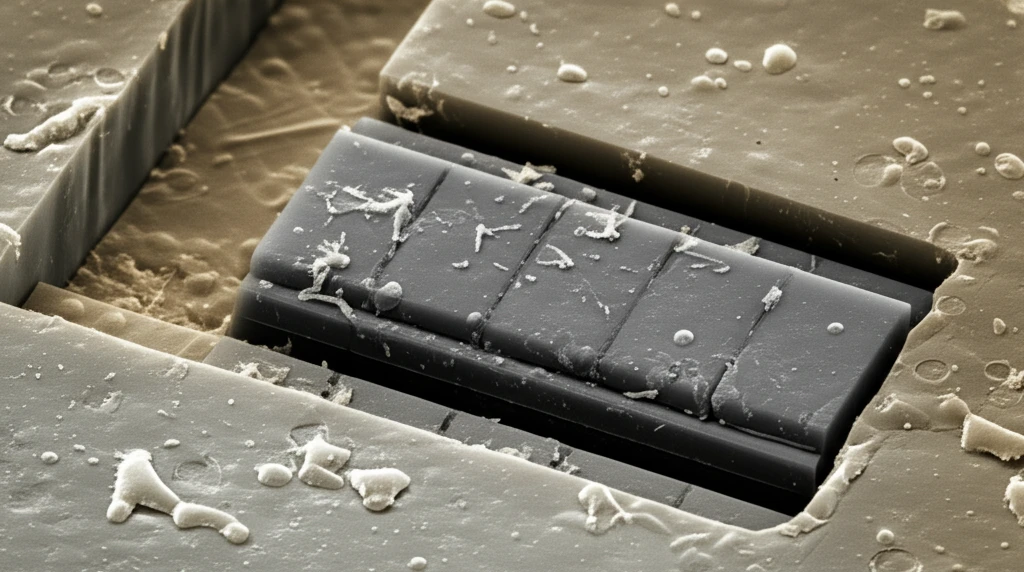
Electroless plating is an attractive method for applying these barrier layers, offering uniform coating thickness even on complex shapes. However, achieving strong adhesion between the electrolessly plated layer and the thermoelectric element can be difficult. Surface treatments like sandblasting have been used to enhance adhesion by increasing surface roughness, but this method can introduce unwanted physical damage. Recent research explores a gentler approach: wet etching. Wet etching uses chemical solutions to selectively remove material from the surface, creating a controlled roughness without the drawbacks of mechanical methods.
A Growing Field With Conflicting Material Demands
Thermoelectric materials exhibit the thermoelectric effect in a strong or convenient form, meaning a temperature difference creates an electric potential and an electric current creates a temperature difference. Good thermoelectric materials must simultaneously exhibit extreme properties: very low thermal conductivity combined with high electrical conductivity and a high Seebeck coefficient. This combination of opposing requirements is what makes practical thermoelectric performance so demanding. Analysts now track the sector through dedicated market reports, and by 2023 electrical and electronic applications were expected to account for a substantial share of the global thermoelectric materials market.
The Figure of Merit as the Standard Benchmark
The standard approach evaluates thermoelectric materials through the figure of merit (ZT), which scores how well they balance the competing property requirements discussed above. Thermoelectric materials convert heat directly into electrical energy and vice versa by leveraging the Seebeck and Peltier effects, making them useful for waste heat recovery, power generation, and solid-state refrigeration. Near-room-temperature materials are especially expected to be useful for energy harvesting, with one prominent application being wearable thermoelectric modules that use body heat to power mobile devices and sensors. Peltier devices nevertheless carry known application limitations that constrain how far these approaches can be pushed.
Foundations Built on Seebeck and Peltier
The historical significance of the field rests on the discovery of the Seebeck and Peltier effects, which remain the foundational phenomena behind power generation and cooling with these materials. Materials are selected according to criteria based on their figure of merit, a framework that has shaped the field since its early development. From a sustainability standpoint, thermoelectric materials offer a direct pathway to convert waste heat into electricity, embodying the principle of maximizing resource utilization and minimizing energy loss.
The Science Behind Wet Etching for Enhanced Thermoelectric Performance
A study published in the Journal of Nanoscience and Nanotechnology details a novel wet etching method to improve the electroless nickel-phosphorus (Ni-P) plating on bismuth-telluride (Bi-Te) thermoelectric elements. The research focuses on creating a reliable and efficient fabrication process for thermoelectric modules, addressing common issues related to bond strength and durability. The team, led by Sung Hwa Bae from Kyungpook National University, investigated the impact of wet etching on the surface properties of Bi-Te elements and the resulting adhesion of the Ni-P plating.
- Improved Adhesion: Wet etching significantly increased the surface roughness of the Bi-Te thermoelectric element, creating an anchoring effect that enhanced the adhesion of the Ni-P plating.
- Enhanced Bond Strength: Thermoelectric modules fabricated using the wet etching method demonstrated excellent bond strength, with values around 10 MPa.
- Heat Treatment Stability: The Ni-P plating exhibited remarkable adherence, even after heat treatment at 200°C for 24 hours, indicating its suitability for high-temperature applications.
- Uniform Plating: The electroless plating method ensured a uniform thickness of the Ni-P layer, crucial for consistent performance of the thermoelectric module.
Research Momentum Around Waste Heat Recovery
Coverage of the latest research highlights thermoelectric materials as valuable tools for capturing waste heat and turning it into usable electricity, especially in industries and vehicles where engines generate significant heat. The same advances are tracked across engineering and technology outlets, which follow the steady stream of innovations and breakthroughs in the field. A recent short review characterizes thermoelectric materials as a promising green energy solution in the form of solid-state cooling and power generation. That review cautions, however, that low energy conversion efficiency still restricts the use of these materials in real-world applications.
Reliability and Durability as Persistent Obstacles
A key counterargument to thermoelectric hype concerns reliability and durability, which are cited as limiting the practical application of thermoelectric materials and devices. A dedicated review highlights this issue and seeks to bridge the gap between thermoelectric research and actual applications by discussing durability in depth. While the underlying thermoelectric effect itself is well established, the energy conversion process depends on carefully balancing several competing material properties, so selection and characterization remain critical.
Benchmarking Materials by the Figure of Merit
Comparative analysis of thermoelectric materials rests on the figure of merit and its measurement. In the Seebeck effect, a temperature difference applied to a material generates a voltage, while the reverse Peltier effect is usually used for cooling, and both feed into how candidates are ranked. Comparative studies increasingly focus on alternative systems, such as the Te-free and Mg-free thermoelectric materials compared across key parameters in a recent analysis, which visualizes trade-offs using performance charts.
Future Directions and Implications
This research demonstrates the potential of wet etching as a viable and effective method for enhancing the fabrication of thermoelectric modules. By carefully controlling the etching process, it is possible to create a surface roughness that promotes strong adhesion of electrolessly plated layers without causing physical damage to the thermoelectric material. This approach can lead to more durable and efficient thermoelectric devices, which are essential for various applications, including waste heat recovery, automotive thermoelectric generators, and portable power sources. Future studies could focus on optimizing the etchant composition and etching parameters to further improve the performance and reliability of thermoelectric modules.
Interfaces, Eco-Friendly Candidates, and Market Traction
Expert commentary, including a review by Medlin and Snyder, emphasizes the role of interfaces in bulk thermoelectric materials as a central research direction. Neutron analysis has helped explain the dynamics behind the best-performing thermoelectric materials, and new materials could help concentrate solar energy for power generation and recover waste heat from industrial processes. Related work reports an inverse-perovskite material, Ba3BO (B = Si and Ge), as an environmentally benign, high-performance thermoelectric candidate with low lattice thermal conductivity. Market analysts value the thermoelectric materials market at $0.8 billion in 2026 and project growth to $1.84 billion by 2035, advancing at a 9.70% CAGR.
Steady Growth, Divergent Forecasts
Market analysts broadly project steady growth for thermoelectric materials, although their specific forecasts differ. SNS Insider valued the market at $0.67 billion in 2023 and expects it to reach $1.77 billion by 2032, growing at a CAGR of 11.49% from 2024 to 2032. Spherical Insights, by contrast, projects growth from $1.05 billion in 2024 to $2.85 billion by 2035, at a CAGR of 9.5% over the forecast period. Both outlooks attribute momentum to rising demand for energy-efficient systems.
Efficiency and Cost as the Defining Barriers
A review of the fundamentals, applications, and challenges of thermoelectric materials notes that research in the field is mainly focused on improving efficiency and developing cheap materials. These twin goals respond to the systemic difficulty of making thermoelectric conversion efficient enough and affordable enough for widespread deployment. The same review positions efficiency and cost as the central challenges to broader adoption of the technology.
Geometry, AI, and Accelerating Discovery
Real-world integration is limited by factors such as the 3D geometry of thermoelectric materials, which a recent study confirms has a significant impact on the electrical current they can generate. On the discovery side, machine learning has been used to identify a new class of thermoelectric materials. The model behind that result was made available to the research community and continues to be reused by researchers around the world to guide and accelerate their work.