
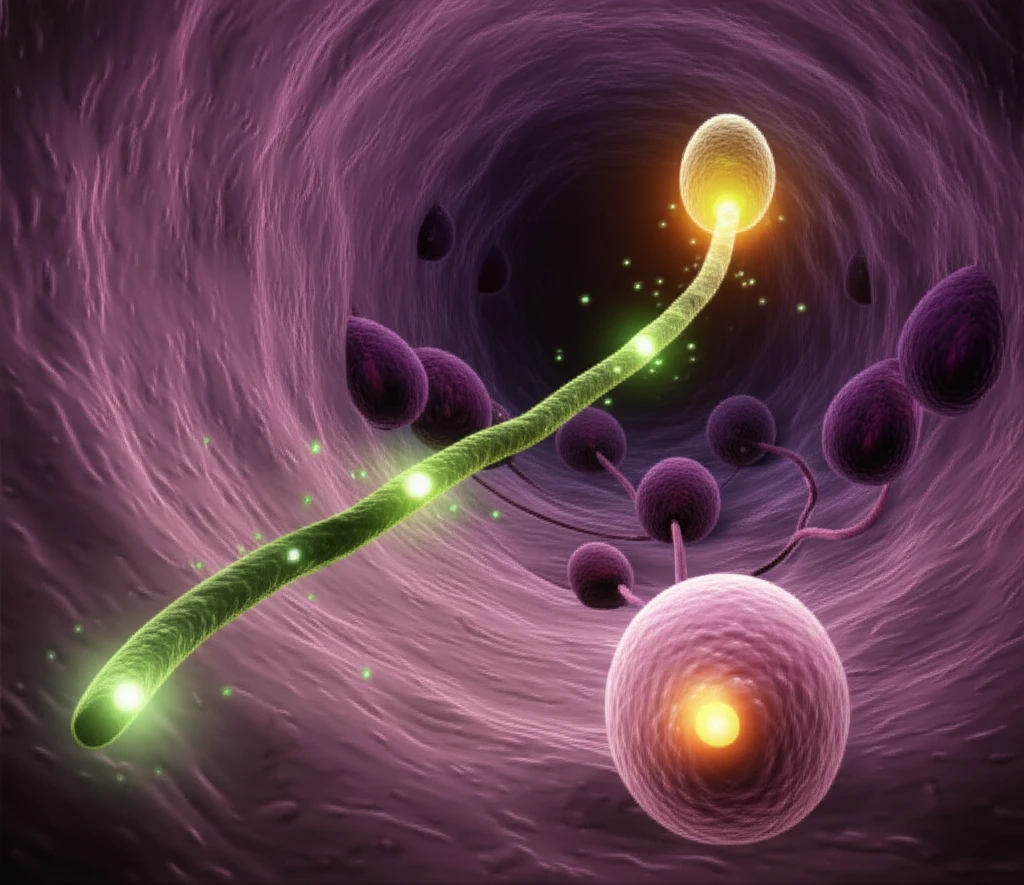
Microscopic view of pollen tube guidance in a flower, showcasing molecular signals.

The Silent Signals: How Plants Control Reproduction with Molecular Messages

"Unlocking the Secrets of Pollen Tube Guidance and Fertilization"


Sexual reproduction in flowering plants relies on a unique double fertilization system, a process distinct from that of animals. Pollen, acting as the male gametophyte, carries two immobile sperm cells, serving as the vehicle for male-female interaction. When pollen lands on a flower's stigma, it germinates, forming a rapidly growing pollen tube.

This pollen tube navigates through the flower, delivering sperm cells to the female gametes within the ovules. The communication between the pollen tube and the ovule is carefully orchestrated, both in time and space, to guarantee successful fertilization. But how do these pollen tubes accurately reach their destination and release sperm cells at the correct moment?

Elegant research over the past two decades has revealed that interactions between peptides released from female gametes and receptors on the pollen tube surface play a vital role in attracting and guiding pollen tubes. These molecular conversations are crucial for plant reproduction, ensuring the continuation of plant species.

Peptide Signals: The Language of Plant Reproduction

Microscopic view of pollen tube guidance in a flower, showcasing molecular signals.

Small secreted peptides act as signaling molecules, influencing various stages of pollen tube development, including self-incompatibility responses, ovule guidance, and reception by the female gametophyte. These peptides, synthesized and released into the extracellular space, bind to receptors on neighboring cells, triggering specific intracellular signaling reactions. Understanding these interactions is crucial for unraveling the mysteries of plant fertilization.

Receptor-like kinases (RLKs), transmembrane proteins, are central to plant development, responding to environmental cues, hormones, and self-incompatibility signals. Recent studies have identified pollen tube-specific RLKs that interact with female-released peptides, acting as sensors to guide pollen tube growth. The discovery of these RLKs opens new avenues for understanding how plants control fertilization at the molecular level.

  • RALF Peptides: Rapid alkalinization factor (RALF) peptides and their receptors, such as Buddha's Paper Seal 1 and 2 (BUPS1/2), are essential for maintaining normal pollen tube growth.
  • BUPS1: BUPS1 plays a key role in preventing premature pollen tube rupture and sperm discharge, ensuring successful fertilization.
  • CrRLK1L Family: BUPS1/2 belong to the CrRLK1L family of RLKs, characterized by extracellular malectin domains, indicating their role in cell wall interactions.
Researchers have found that RALF4/19, generated by pollen tubes, binds to BUPSs and ANXs on the pollen tube surface, ensuring proper growth as the tube navigates to the ovules. Upon reaching the female gametophytes, ovule-expressed RALF34 competitively binds to BUPS1/2 and ANX1/2, triggering pollen tube rupture and sperm release. These findings demonstrate the intricate coordination of peptide signaling in plant fertilization.

The Future of Plant Reproduction Research

These studies highlight the essential role of peptide signaling in ensuring successful plant fertilization, and it is now clear that these processes are essential for the double fertilization processes. This occurs through RALF-mediated signaling by interacting with multiple receptors.

Future research will focus on investigating the downstream signaling networks and cellular responses that lead to pollen tube rupture. Specifically, scientists aim to decipher the role of AUX in coordinating secreted peptides and their receptors to trigger downstream cellular events. Further insight into the origins and functions of ROSs in growing pollen tubes will enhance complete understanding of ANX signaling pathways.

Unraveling these complex molecular mechanisms promises not only to deepen our understanding of plant biology but also to provide insights for improving crop yields and ensuring food security in a changing world. The silent signals of plant reproduction hold immense potential for future agricultural advancements.

About this Article -

This article was crafted using a human-AI hybrid and collaborative approach. AI assisted our team with initial drafting, research insights, identifying key questions, and image generation. Our human editors guided topic selection, defined the angle, structured the content, ensured factual accuracy and relevance, refined the tone, and conducted thorough editing to deliver helpful, high-quality information.See our About page for more information.

This article is based on research published under:

DOI-LINK: 10.1016/j.molp.2018.02.010, Alternate LINK

Title: Time Bomb For Pollen Tubes: Peptide Ralf-Mediated Signaling

Subject: Plant Science

Journal: Molecular Plant

Publisher: Elsevier BV

Authors: Xiaomin Peng, Shanshan Li, Hao Wang

Published: 2018-04-01

Everything You Need To Know

1

What is the basic process of sexual reproduction in flowering plants?

In flowering plants, sexual reproduction involves a unique double fertilization system. This process differs from that of animals. The male gametophyte, pollen, carries sperm cells. When pollen lands on a flower's stigma, it germinates into a rapidly growing pollen tube. The pollen tube then navigates to the female gametes within the ovules, where fertilization occurs. This ensures the continuation of plant species.

2

How do peptide signals contribute to plant fertilization?

Peptide signaling plays a vital role in plant fertilization. Small secreted peptides act as signaling molecules, influencing various stages of pollen tube development. These peptides, released into the extracellular space, bind to receptors on neighboring cells, triggering specific intracellular signaling reactions. For example, RALF peptides, such as RALF4/19, interact with receptors like BUPS1/2 and ANXs. This interaction ensures proper pollen tube growth, guiding it to the ovules.

3

What are Receptor-like kinases (RLKs), and what is their significance?

Receptor-like kinases (RLKs) are transmembrane proteins crucial for plant development, responding to various signals. They are particularly important in pollen tube guidance. Pollen tube-specific RLKs interact with female-released peptides. This interaction helps guide pollen tube growth. Examples of RLKs include BUPS1/2, which belong to the CrRLK1L family and are essential for maintaining normal pollen tube growth. Understanding these RLK interactions opens new avenues for understanding how plants control fertilization at the molecular level.

4

What are RALF peptides, and how do they function in plant reproduction?

RALF peptides are signaling molecules involved in pollen tube development and fertilization. RALF4/19, produced by pollen tubes, binds to receptors like BUPSs and ANXs. This interaction ensures proper pollen tube growth. Upon reaching the female gametophytes, ovule-expressed RALF34 competitively binds to BUPS1/2 and ANX1/2, triggering pollen tube rupture and sperm release. The RALF-mediated signaling ensures the successful double fertilization process, which is essential for plant reproduction.

5

What is the role of BUPS1/2 in pollen tube development and fertilization?

BUPS1/2, which belong to the CrRLK1L family of RLKs, are crucial for pollen tube development. BUPS1 plays a key role in preventing premature pollen tube rupture and sperm discharge. This is essential for successful fertilization. RALF4/19, produced by pollen tubes, interacts with BUPS1/2 to ensure the proper growth of the pollen tube towards the ovules. Upon reaching the female gametophytes, ovule-expressed RALF34 competitively binds to BUPS1/2, triggering pollen tube rupture and sperm release.

Newsletter Subscribe

Subscribe to get the latest articles and insights directly in your inbox.