
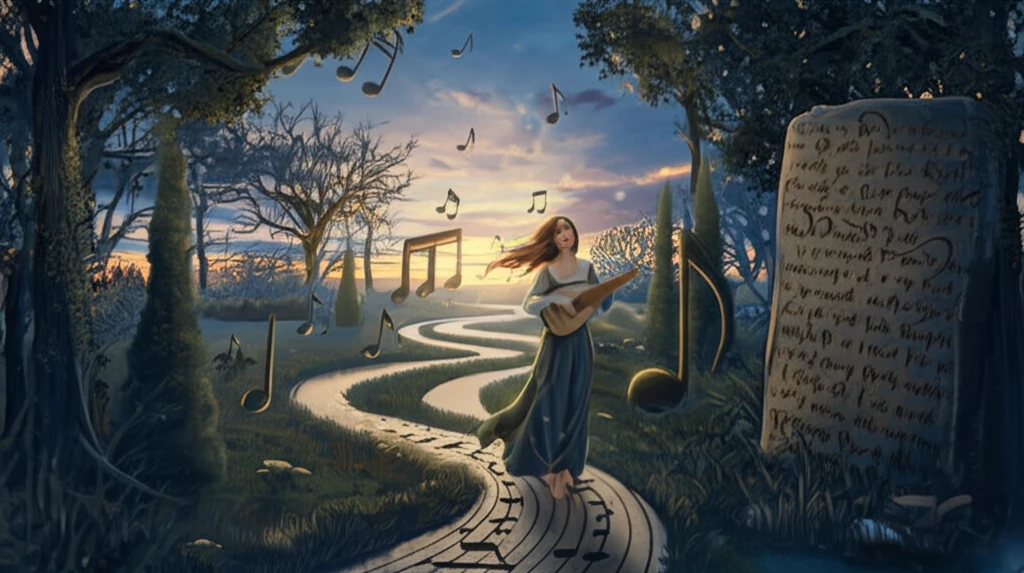
The Secret Language of Love: Unlocking the Hidden Meanings in Medieval Song

"Dive into the poetic world of Clara Hätzlerin's songbook and discover how metaphors reveal the intricate dance of love, loss, and longing in the Middle Ages."
Imagine a world where love wasn't just spoken, but sung in elaborate metaphors and veiled wordplay. Welcome to the enchanting realm of medieval love songs, where every verse holds a secret, and every image sparks a conversation. The Liederbuch of Clara Hätzlerin, a renowned collection from the 15th century, provides a fascinating window into this world.
This article delves into the captivating research of Cordula Kropik, who masterfully deciphers the intricate language of metaphor within Hätzlerin’s songbook. Kropik's analysis isn't merely about dusty old texts; it's about uncovering the social, emotional, and artistic currents that shaped medieval society. We'll explore how these songs weren't just pretty melodies, but sophisticated expressions of love, loss, social commentary, and the ever-present dance between tradition and innovation.
Prepare to be transported back in time as we unravel the hidden meanings woven into these poetic exchanges. Discover how metaphors of agriculture, precious jewels, and even religious devotion, reveal the complexities of medieval relationships and the enduring power of song to capture the human experience.
Love Songs Across the Ages
A love song, by its broadest definition, is a song about love, falling in love, heartbreak after a breakup, and the feelings that these experiences bring. Love songs can be found across a wide variety of music genres, demonstrating their enduring universality. In the medieval period, songs dealing with chivalric love expressed ideals of courtly love and conveyed how pure love could inspire the protagonist to become a better person. Guillaume de Machaut's medieval love songs, as noted by The New Yorker, rely on the codes of a long-vanished society, yet their subtle, self-aware disquisitions on courtly love continue to resonate with modern audiences.
Modern Performance and Recording of Medieval Songs
Contemporary approaches to medieval love songs often involve modern performers interpreting and recording these works for new audiences. Canadian art song tenor Jon Vickers recorded a collection titled '6 Medieval Love Songs,' composed by Jean Coulthard and released through NAXOS of America in 2012. These recordings, available on platforms such as YouTube Music and Spotify, represent a standard method of preserving and disseminating medieval musical heritage through contemporary classical performance. However, such approaches risk filtering medieval texts and musical idioms through modern harmonic and vocal sensibilities, potentially obscuring the original character of the compositions.
Medieval Music and the Roots of Romantic Tradition
Medieval music encompasses the sacred and secular music of Western Europe during the Middle Ages, spanning approximately the 6th to 15th centuries. It is the first and longest major era of Western classical music, followed by Renaissance music, with both eras collectively termed 'early music' by musicologists. Medieval wedding music has documented origins, instruments, and influence on modern celebrations, with specific traditional songs carrying cultural significance. Professor Elizabeth Eva Leach of St Hugh's College, Oxford, has researched how people in the Middle Ages sang about their relationships and how these expressions have continued through history to influence today's expressions of love. Valentine's Day itself has its roots in the medieval European tradition, linking romantic customs directly to this period.
Metaphor as a Mirror: Reflecting Medieval Society
Kropik’s research centers on the idea that metaphors aren’t just decorative flourishes; they're essential keys to understanding the inner workings of the Liederbuch. They reveal how these songs were both responsive to and shaped by the cultural landscape of their time. For example, the frequent use of agricultural metaphors—planting, harvesting, and fertile fields—wasn't accidental. It reflected the deeply agrarian nature of medieval life and how that shaped people's understanding of relationships.
- The agricultural metaphors in the songs highlight the close relationship between rural life and the expression of love.
- The recurring theme of the 'abgemäht' reflects anxieties related to betrayal and the impermanence of relationships.
- Religious allegories, with love and devotion expressed in worshipful terms, highlight the influence of religion on everyday life.
- Interplay between tradition and modernity reveals shifts in societal values.
Rediscovering Medieval Secular Love Songs
Among the most significant late medieval secular songs is 'Bryd one breare,' composed between 1290 and 1320. This song is notable because it was written in Middle English, which was uncommon at the time — most songs that were written were of a religious nature and composed in Latin. The ensemble Asteria has devoted significant attention to performing medieval love songs from France and the Court of Burgundy, including works such as 'Quant la doulce jouvencelle' and 'Deuil Angoisseux.' Their recordings, documented across YouTube and Deezer, represent ongoing scholarly and performative interest in bringing these repertoire pieces to modern listeners.
Limitations of Interpretive Perspective
One challenge in studying and interpreting medieval love songs is the limitation of the observer's own point of view. George Eliot's parable of the pier glass, as explored in critical essays on Middlemarch, illustrates how individual perspective shapes understanding — a light's movement appears different depending on where one stands, yet all perspectives are valid within their own frame. When applied to medieval song, this suggests that modern listeners inevitably interpret courtly love texts through contemporary frameworks, potentially missing or distorting original meanings. Scholars must acknowledge these interpretive limitations rather than assuming a transparent, unmediated access to medieval emotional and cultural codes.
Medieval Love Songs from the Court of Burgundy
The ensemble Asteria released an album titled 'Le Souvenir De Vous Me Tue,' which collects medieval love songs from the Court of Burgundy. This recording, available on Spotify and comprising 13 tracks, allows for comparative listening across a focused regional repertoire. The Court of Burgundy was a major cultural center in the late medieval period, and its love song tradition can be compared with contemporaneous traditions from France, England, and the troubadour regions of southern France. Such comparisons reveal how courtly love conventions were adapted across different linguistic and cultural contexts within medieval Europe.
A Timeless Echo: The Enduring Power of Song
Cordula Kropik's research offers a compelling reminder that even seemingly simple love songs can be profound sources of historical and cultural insight. By unlocking the secret language of metaphor, we gain a deeper understanding of the complexities of medieval life and the enduring human quest for love, connection, and meaning. So next time you hear a song, listen closely – you might just be surprised by the hidden stories it has to tell.
The Love Song as Literary and Musical Form
T.S. Eliot's 'The Love Song of J. Alfred Prufrock,' published in The Poetry Foundation's Poetry Magazine, stands as one of the most famous love songs in the English literary canon, despite its deeply ironic and ambivalent treatment of romantic longing. Prufrock's internal monologue — with its famous opening imagery of yellow fog rubbing against window-panes — inverts the conventions of traditional love song, replacing confident courtship with paralysis and self-doubt. This modernist engagement with the love song form demonstrates how the medieval tradition of expressing romantic longing continued to shape literary and musical creation centuries later. The tension between the idealized courtly love of medieval song and the anxious, fragmented modern subject reveals the enduring power and adaptability of the love song as a genre.
Tracking Global Interest in Love Songs
Tools like Google Trends allow researchers to measure public interest in love songs across different languages and regions over time. For example, interest in Telugu love songs has been documented at scale, with curated playlists on Spotify attracting hundreds of thousands of saves — a Spotify playlist of Telugu Love Songs containing 100 items has garnered over 371,000 saves. Such data points suggest that love song traditions, whether medieval or modern, continue to generate significant audience engagement globally. Future research could leverage these digital analytics tools to trace how interest in medieval love songs specifically fluctuates and compares with other musical traditions.
Medieval Courtly Love and Its Cultural System
Courtly love emerged on the medieval stage after centuries of strategic marriages, representing a significant cultural shift in how romantic relationships were conceptualized and expressed. The system of courtly love imposed specific codes of behavior on both lover and beloved, creating an elaborate framework that governed romantic expression in song, poetry, and social conduct. Understanding this broader cultural context is essential for interpreting the 'secret language' embedded in medieval love songs, as the songs operated within a shared system of symbolic meaning that modern listeners may not immediately recognize. The challenge for contemporary scholarship lies in reconstructing these systemic codes without imposing modern assumptions about romance and individual expression.
Emotional Resonance of Love Songs Then and Now
The song 'Torn Between Two Lovers' has been described as a fascinating case study in perspective — if you have ever been the one cheated on, the song makes us uncomfortable decades after its release. This enduring emotional impact demonstrates how love songs, whether medieval or modern, tap into universal human experiences of longing, jealousy, and heartbreak. In the medieval world, courtly love imposed specific 'dos and don'ts' of romantic engagement that shaped both social behavior and musical expression. The continuity between medieval courtly love conventions and modern love song traditions suggests that the fundamental human emotions driving love song creation remain remarkably consistent across centuries.