
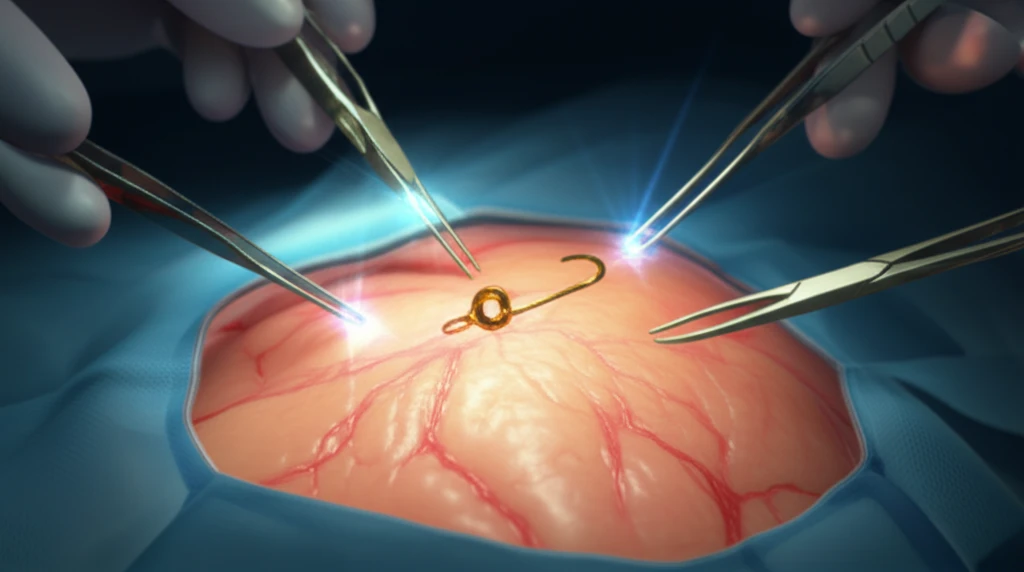
The KING Closure: A Revolutionary Technique for Safer Gastrotomy Closures

"Discover how the single loop-and-clips technique (KING closure) is transforming gastrotomy closure after transgastric ovariectomy, offering a survival advantage in experimental settings."
Natural Orifice Transluminal Endoscopic Surgery (NOTES) is changing surgery, allowing surgeons to operate through natural openings in the body. But to really take off, NOTES needs reliable ways to close up the surgical sites afterward. A weak closure can lead to major problems, making a strong closure technique a must-have.
One promising solution is the 'KING closure,' a technique that uses a single loop and clips to close gastrotomies—surgical openings in the stomach. Researchers have been putting it to the test, comparing it against standard closure methods to see if it really holds up.
This article dives into a study that explores how well the KING closure works in pigs undergoing transgastric ovariectomies (ovary removal through the stomach). We'll look at how it's done, what the results were, and what it could mean for the future of NOTES and other procedures.
KING Closure: A Step-by-Step Look at the Technique
The KING closure method was tested on pigs and works by first making a small incision in the stomach using a percutaneous endoscopic gastrostomy (PEG) technique. After this, surgeons performed a peritoneoscopy to remove the ovaries with a double-channel endoscope. The critical part comes next: closing the stomach incision.
- An endoloop is positioned around the gastrotomy site.
- Clips are strategically placed to secure the loop.
- A grasper pulls the incision edges together inside the loop.
- The loop is tightened, cinching the edges closed.
The Future of Gastrotomy Closure: Safer Procedures on the Horizon
The single loop-and-clips technique (KING closure) offers a promising alternative to traditional gastrotomy closure methods. The study showed that the KING closure had fewer complications, like abscesses and peritonitis, compared to using clips alone.
While this research is a significant step forward, it's important to remember that it was performed on pigs. More studies are needed to confirm if the KING closure is as safe and effective in humans. But, the initial results are encouraging, suggesting that this technique could lead to fewer complications and better outcomes for patients undergoing NOTES procedures.
As NOTES and other minimally invasive surgeries continue to evolve, innovations like the KING closure will be crucial for making these procedures safer and more accessible.