
The Inverted Unfamiliar: How Contemporary Theatre Challenges Our Expectations

"Explore the evolution of modern theatre and how it disrupts traditional norms, inviting audiences to embrace new perspectives."
Contemporary theatre often faces accusations of straying from tradition. Critics and casual viewers alike question its deviations, yet examining its historical evolution reveals a fascinating shift. Over the 20th century, reciprocal influences among various art forms have allowed theatre to evolve, challenging its reliance on dramatic texts and reshaping its modes of representation.
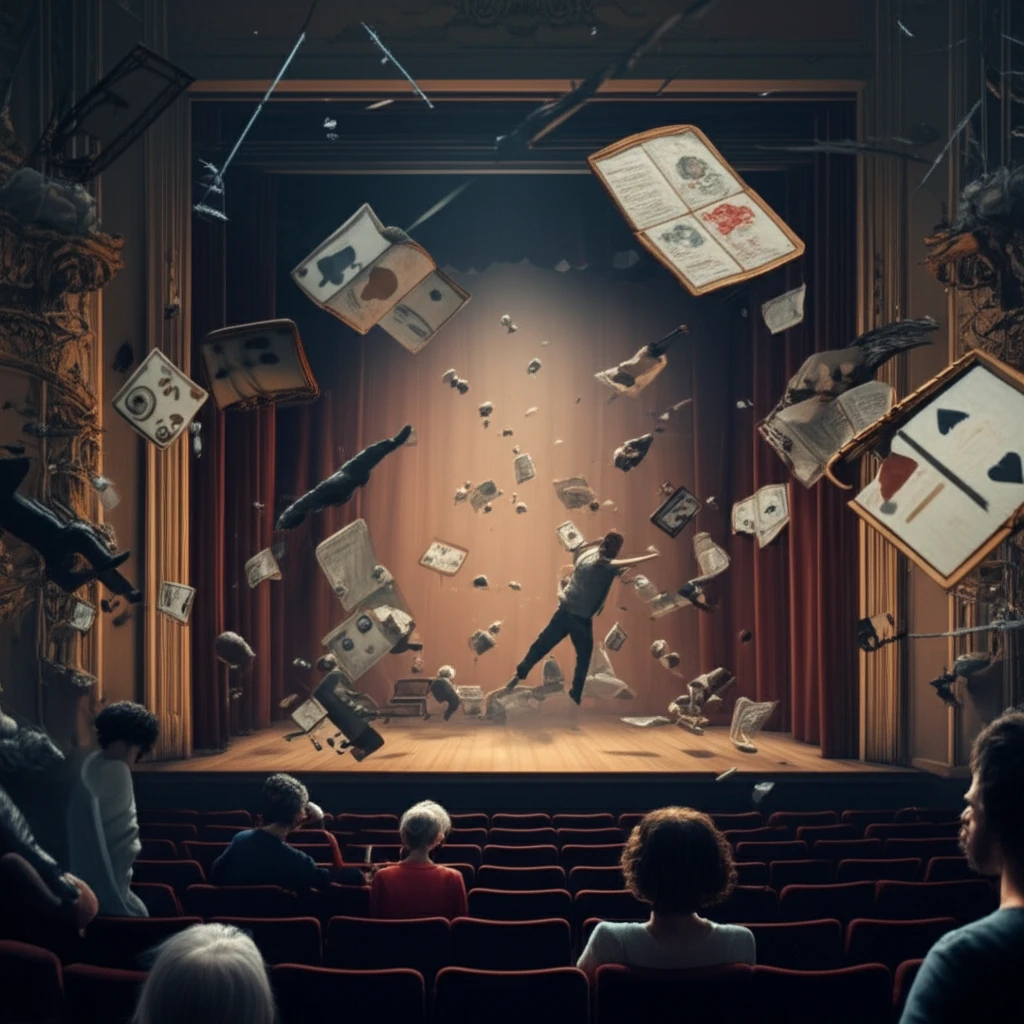
This evolution introduces a unique dynamic: the disappointed expectations of spectators become an integral part of the dramatic experience. Audiences are no longer passive recipients but active participants, challenged to confront their own displacement and estrangement – a concept known as "ostranenie" – when facing theatrical representations conceived as works of art.
This article explores this "inverted unfamiliarity," examining how contemporary theatre uses estrangement to prompt critical engagement and redefine the relationship between performance and audience.
Brecht, Aristotle, and the Subversion of Expectations
When discussing estrangement in theatre, the "V-effect," or Brechtian distanciation, immediately comes to mind. This concept stems from a critical reflection on the Aristotelian notion of representation – the very foundation upon which classical theatre is built. Brecht challenged what he saw as a diluted, or even distorted, version of Aristotelian tragedy.
- Brecht's Critique: Brecht sought to dismantle the Aristotelian concept of representation, not just tragedy itself.
- The Goal: To disrupt the passive acceptance of the spectator and encourage critical questioning.
- Method: By creating a sense of distance, Brecht aimed to make recognition problematic, forcing the audience to actively engage with the performance.
- Political Dimension: For Brecht, this aesthetic act had political implications, aiming to disalienate the spectator by providing a new, critical perspective on familiar subjects.
The Spectator's New Territory
Contemporary theatre, therefore, invites the spectator on a journey of re-evaluation. By challenging conventional expectations and embracing unconventional forms, it prompts a deeper engagement with the art form. The audience is no longer passively seated but actively exploring, constantly redefining their understanding of theatre. In this sense, ostranenie becomes the spectator's new territory, a space for critical reflection and renewed appreciation.