
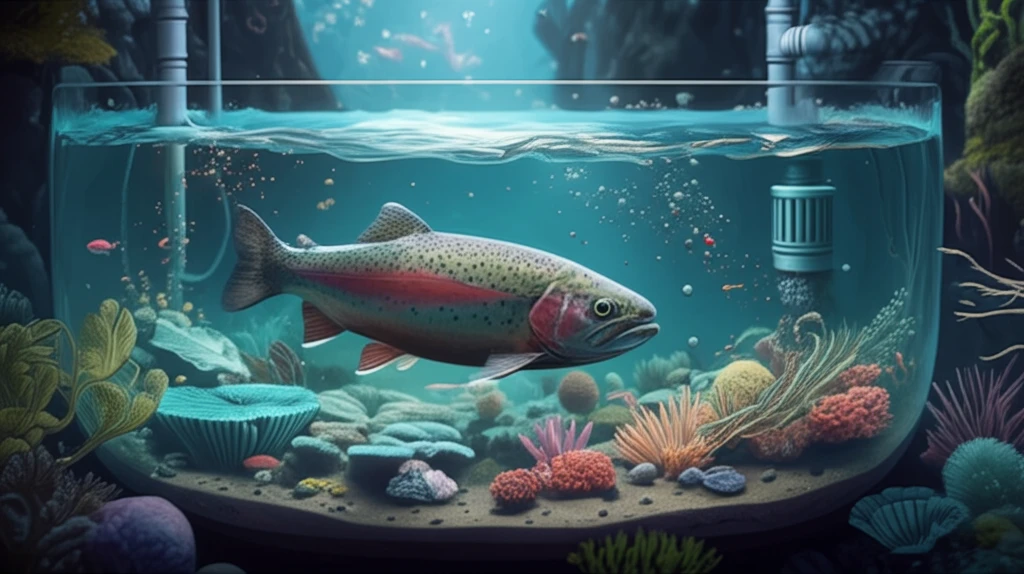
The Hidden Dangers in Your Fish Tank: Micro Particles and Your Trout's Health

"Uncover the surprising link between tiny particles, bacterial activity, and the well-being of rainbow trout in aquaculture. Learn how to maintain healthier fish and a cleaner system."
Recirculating aquaculture systems (RAS) are innovative setups designed to maximize water reuse, but this intensity can lead to an unintended consequence: the build-up of micro particles. These particles, smaller than 20 micrometers, come from various sources, including fish waste, uneaten feed, and sloughed-off material from biofilters. While these systems have filtration units, micro particles are often too small to be effectively removed, leading to their accumulation over time.
The problem with accumulating micro particles is their potential to negatively impact water quality. Suspended organic solids act as a feast for bacteria, driving up the biochemical oxygen demand (BOD) and carbon dioxide levels in the water. Some even speculate that these particles can cause physical harm to fish gills. It's a complex issue that demands a closer look.
Now, a groundbreaking study sheds light on the real-world conditions of micro particle accumulation in Danish rainbow trout farms. Unlike previous studies conducted in controlled, experimental settings, this research investigates commercial-scale operations to understand the true scope of the issue.
Aquaculture by the Numbers
Aquaculture has grown into a massive global industry, with production statistics compiled by organizations such as the FAO. China leads worldwide aquaculture production, recording 62.5 million tonnes in 2020 alone. Shrimp aquaculture accounts for approximately 35% of aquaculture export revenue globally. These figures underscore the scale of an industry whose practices—from feed inputs to water management—directly affect the health of farmed species, including trout.
Sustainability Standards and Their Shortcomings
Sustainability standards, including organic aquaculture certifications, are designed to assure improved environmental performance in the aquaculture sector. However, standard setters face limitations in encompassing producers with different capabilities, which reduces the scope and impact of these certifications. Organic aquaculture standards have been criticized for not requiring the retention of natural behavior, unlike terrestrial organic production. Organizations like WWF have initiated Aquaculture Dialogues to identify key impacts and develop standards for reducing them, but gaps remain.
From Ancient Ponds to Modern Farms
Aquaculture has roots stretching back thousands of years. The earliest confirmed records place the practice's origin in China around 2500 BCE, though some accounts suggest co-evolution of rice farming and carp culture as early as 8000 BCE among the Hemudu culture in the Yangtze River Basin. Artificial lakes created by river flooding were used to contain fish such as carp around 3000 BC. These foundational practices evolved over millennia into the sophisticated aquaculture systems used today, where managing water quality and particulate matter has become critical to fish health.
The Microscopic Culprits: Understanding Micro Particle Dynamics
The study, conducted across seven commercial rainbow trout farms in Denmark, analyzed water samples from twenty separate RAS units. The aim was to measure the levels of micro particles (numbers, volume, and surface area) and bacterial activity, alongside key water quality indicators. This comprehensive approach allowed researchers to paint a detailed picture of the factors at play in these systems.
- High Variability: Even seemingly similar RAS units within the same farm showed drastically different levels of micro particles.
- Bacterial Hotspots: Micro particles provide ample surface area for bacteria to colonize, leading to increased bacterial activity.
- Filter Effects: Biofilters tend to trap particles, while drum filters seem to reduce particle volume but increase particle numbers and surface area.
- Commercial Scale: The study provides a crucial baseline for micro particle levels in real-world trout farms.
Emerging Research in Aquaculture Science
Current aquaculture research spans multiple fronts, from pathogen identification to nutritional optimization. Studies on tropical aquaculture have identified hemolysin-producing bacteria as a concern, where this pore-forming toxin can damage cell membranes and kill host cells. Research published through ResearchGate emphasizes aquaculture's vital role in global food security, with the FAO noting its continuous potential for economic development. Understanding how micro particles interact with pathogens and fish biology remains an active area of investigation.
Addressing Aquaculture's Critics
Aquaculture faces criticism despite its growth, particularly around environmental impacts and the practice of feeding fish to fish. According to Eurofish, concerns about aquaculture are often unfounded, and the industry is now assessed in a more differentiated manner than in the past. The Nature Conservancy notes that aquaculture in marine environments allows for three-dimensional farming, and shifting protein production from land-based meat to farmed seafood could spare land area equivalent to twice the size of India. These counterpoints are relevant when evaluating whether micro particle contamination represents a genuine or overstated risk.
Aquaculture Systems Compared
Aquaculture encompasses diverse farming approaches, from monoculture—cultivating a single species in a controlled system—to polyculture, which raises multiple species together. A comparative study on water quality found meaningful differences between these approaches, particularly regarding nutrient cycling and particulate accumulation. Aquaculture is broader than pisciculture, with aquaculture covering cultivation of animals and plants while pisciculture focuses specifically on fish, fulfilling more than 70% of the world's fish demand. These system differences directly influence how micro particles are generated, dispersed, and managed.
Implications for Sustainable Aquaculture
This study underscores the need for careful management of micro particle levels in recirculating aquaculture systems. By understanding the dynamics of these particles and their relationship with bacterial activity, fish farmers can implement strategies to improve water quality and promote the health and well-being of their trout. Further research is needed to determine optimal particle levels and effective methods for their control, ensuring the long-term sustainability of aquaculture practices.
Expert Insights on Aquaculture Practices
Expert analysis of freshwater aquaculture practices has identified climate-smart approaches that support increased productivity, income, and resilience to climate change. According to correspondence and cluster analysis of expert opinions, ten of fourteen selected practices showed positive outcomes. Independent consulting firms like AquaSol provide technically rigorous assessments for investors and legal entities facing aquaculture-related decisions. These expert perspectives help contextualize whether micro particle concerns represent operational challenges or systemic risks requiring industry-wide response.
Innovation Pipelines in Aquaculture
The aquaculture industry is experiencing a paradigm shift driven by sustainability and technological innovation, particularly in water quality monitoring and chemical management. Market projections indicate strong growth through 2035 across fish, crustacean, and mollusca segments. Feed innovation represents a critical frontier, with research advancing alternatives to traditional fishmeal and fish oil replacements. Water quality monitoring technologies are also advancing, responding to increasing demand for sustainable production and efficient management practices—capabilities that are essential for detecting and mitigating micro particle contamination.
The Bigger Picture in Sustainable Aquaculture
When practiced well, aquaculture is among the most resource-efficient food production methods, with some forms like oyster cultivation actively restoring coastal ecosystems. However, the industry faces significant challenges that must be addressed for sustainable growth. Systems designed for aquaculture must accommodate vastly different life forms, from microscopic algae to large shellfish, requiring adaptable management approaches. Innovators like Lorna Mudegu are working to revolutionize sustainable aquaculture by addressing challenges in fish farming, including environmental monitoring and resource management.
Aquaculture's Role in Global Food Systems
Fisheries and aquaculture have a lower environmental impact than ruminant meat production, with inland fisheries having a particularly low carbon footprint compared to other food sources, according to the FAO's State of World Fisheries and Aquaculture. World Bank research highlights that realizing aquaculture's sustainable growth potential requires transitioning from small-scale production to more intensive practices. Case studies across multiple industries examine how financial systems have supported or hindered sector development, offering lessons for investment in sustainable aquaculture. These systemic considerations shape how the industry addresses emerging challenges like micro particle contamination in farming systems.