
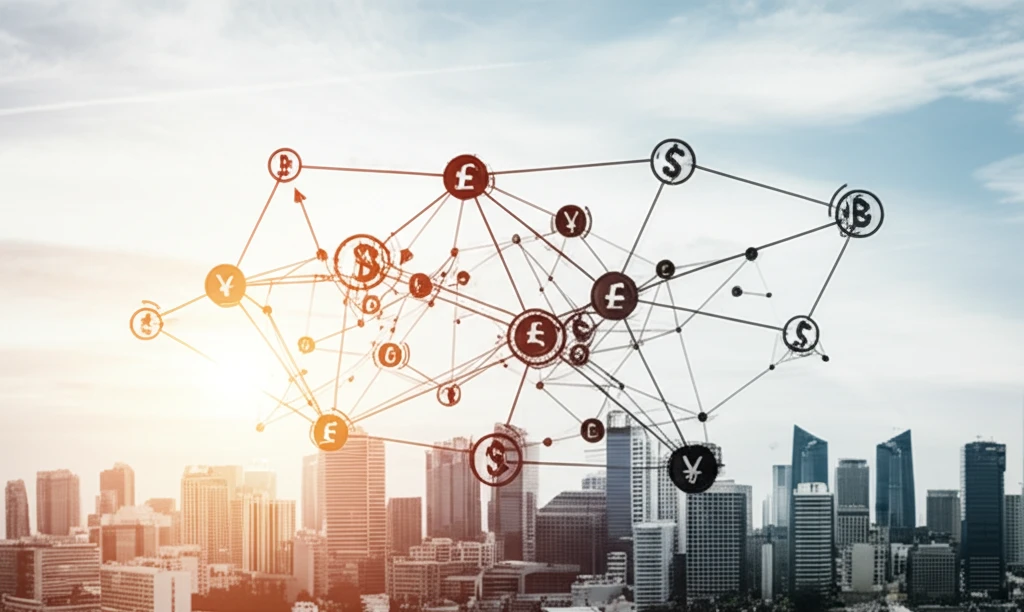
Interconnected nodes with currency symbols, representing a simplified exchange mechanism.

The Hidden Code of Exchange: How 'Graphical Mechanisms' Could Simplify Our Financial World

"Uncover the surprising ways that simplifying trade through 'graphical mechanisms' could lead to fairer, more efficient markets—and a new understanding of money itself."


Imagine a world where trading goods is simpler, fairer, and more efficient. For decades, economists have explored ways to achieve this, often getting tangled in complex models. Now, a new approach called 'graphical exchange mechanisms' offers a refreshing perspective. This isn't just about abstract theories; it's about designing systems that could genuinely change how we exchange value.

At its core, a graphical exchange mechanism is a way to streamline how we offer and receive goods in a market. Think of it as a system that accepts a variety of offers, redistributes everything fairly, and ensures everyone gets what they deserve. The beauty of these mechanisms lies in their potential to uncover inherent prices that balance what people offer and what they get back.

This article explores the fascinating world of these mechanisms. We'll break down how they work, why they matter, and how they could pave the way for a more transparent and user-friendly financial landscape. Get ready to discover how simplifying complexity can lead to profound insights about markets, money, and the future of trade.

What are 'Graphical Exchange Mechanisms'?

Interconnected nodes with currency symbols, representing a simplified exchange mechanism.

Graphical Exchange Mechanisms are trading systems designed with simplicity and fairness in mind. They operate on a few core principles, ensuring that everyone involved has a clear and equitable experience. Unlike traditional markets, which can be complex and opaque, these mechanisms aim to create a transparent environment where trade is straightforward and efficient.

The key idea is to accept diverse offers of commodities, redistribute them fairly, and identify unique prices that equalize the value of offers and returns for each participant. In essence, they are designed to be both fair and convenient, leading to a natural emergence of prices.

  • Fairness: Ensuring everyone receives equitable value.
  • Convenience: Making the exchange process easy and user-friendly.
  • Transparency: Uncovering clear and understandable prices.
One of the critical aspects of these mechanisms is how they handle complexity. Economists measure this complexity in terms of the time it takes to exchange goods, the difficulty in determining exchange ratios, and the dimension of the message space. By minimizing these factors, graphical exchange mechanisms aim to create systems that are not only efficient but also easy to understand and navigate.

The Future of Exchange: Simple, Fair, and Efficient?

Graphical exchange mechanisms offer a promising path toward simplifying and streamlining trade. By focusing on fairness, convenience, and minimal complexity, these systems have the potential to reshape our understanding of markets and money. As we continue to explore and refine these mechanisms, we may well uncover new ways to create more efficient, transparent, and equitable financial landscapes for everyone.

About this Article -

This article was crafted using a human-AI hybrid and collaborative approach. AI assisted our team with initial drafting, research insights, identifying key questions, and image generation. Our human editors guided topic selection, defined the angle, structured the content, ensured factual accuracy and relevance, refined the tone, and conducted thorough editing to deliver helpful, high-quality information.See our About page for more information.

This article is based on research published under:

DOI-LINK: https://doi.org/10.48550/arXiv.1512.04637,

Title: Graphical Exchange Mechanisms

Subject: cs.gt econ.th math.co

Authors: Pradeep Dubey, Siddhartha Sahi, Martin Shubik

Published: 14-12-2015

Everything You Need To Know

1

What are 'Graphical Exchange Mechanisms' and what problems are they trying to solve in financial markets?

'Graphical Exchange Mechanisms' are trading systems designed to simplify and make trade fairer, aiming for a transparent environment where exchange is straightforward and efficient. They address the complexities and opaqueness often found in traditional markets. The goal is to accept diverse offers of commodities, redistribute them fairly, and identify unique prices that equalize the value of offers and returns for each participant. They also minimize the time it takes to exchange goods, the difficulty in determining exchange ratios and the dimension of the message space. This can lead to a natural emergence of prices.

2

How do 'Graphical Exchange Mechanisms' ensure fairness and convenience for participants?

'Graphical Exchange Mechanisms' ensure fairness by aiming for equitable value distribution among all participants. Convenience is achieved by making the exchange process user-friendly and easy to navigate. These mechanisms are designed to minimize complexity, which translates to reduced time and effort required for trading. Transparency in pricing is also a key aspect, providing clear and understandable exchange rates. By optimizing these factors, 'Graphical Exchange Mechanisms' strive to create a trading environment that is both fair and convenient for everyone involved.

3

In what ways do 'Graphical Exchange Mechanisms' differ from traditional market systems, and what advantages do they offer?

Traditional market systems can often be complex and opaque, leading to inefficiencies and difficulties in determining fair prices. 'Graphical Exchange Mechanisms' differ by prioritizing simplicity, fairness, and transparency. Unlike traditional markets, these mechanisms aim to create an environment where trade is straightforward, and the inherent prices that balance what people offer and what they get back are easily uncovered. By minimizing complexity and ensuring equitable value distribution, 'Graphical Exchange Mechanisms' offer advantages such as reduced transaction times, easier navigation, and a clearer understanding of market dynamics. However, it doesn't mention topics such as scalability and security which are also important.

4

How might 'Graphical Exchange Mechanisms' reshape our understanding of money and financial landscapes?

By simplifying trade and promoting transparency, 'Graphical Exchange Mechanisms' have the potential to reshape our understanding of markets and money. They offer a more efficient and equitable financial landscape by focusing on fairness, convenience, and minimal complexity. The natural emergence of prices within these systems could lead to a new perspective on how value is determined and exchanged. The article suggests the current systems can be complex and opaque, so simplification can lead to more efficient, transparent, and equitable financial landscapes for everyone. What the article does not mention are details of governance in a large market, which is relevant in that context.

5

What are the key factors used to measure complexity in traditional exchange systems, and how do 'Graphical Exchange Mechanisms' address them?

Complexity in traditional exchange systems is measured in terms of (1) the time it takes to exchange goods, (2) the difficulty in determining exchange ratios, and (3) the dimension of the message space. 'Graphical Exchange Mechanisms' address these factors by minimizing them. By streamlining the exchange process and ensuring clear and understandable prices, 'Graphical Exchange Mechanisms' aim to reduce the time and effort required for trading. Reducing these complexities will, in turn, lead to systems that are more efficient, transparent, and easier to navigate. But the article does not talk about the implementation details of these 'Graphical Exchange Mechanisms' or how they scale.

Newsletter Subscribe

Subscribe to get the latest articles and insights directly in your inbox.