
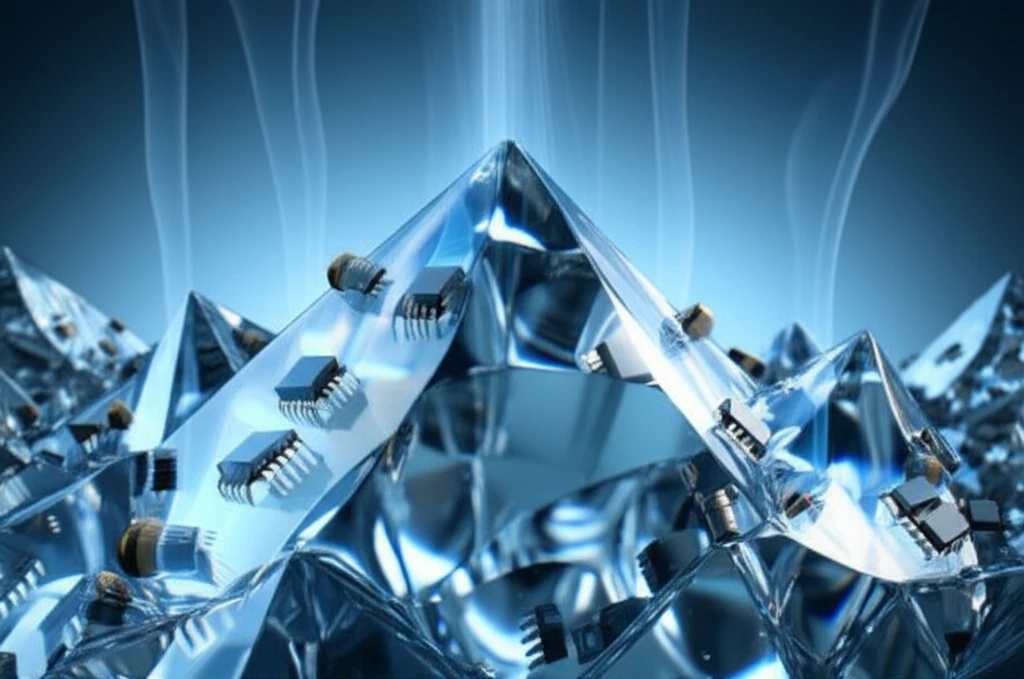
Surreal illustration of Boron Arsenide cooling electronic components.

The Future is Cool: Boron Arsenide Takes Center Stage in Thermal Conductivity

"Unlock the secrets of Boron Arsenide, the revolutionary material poised to redefine thermal management in electronics and beyond!"


In our increasingly tech-driven world, the challenge of heat management is becoming critical. As devices shrink and computing power surges, dissipating the resulting heat becomes a major hurdle. Traditional materials are struggling to keep up, creating a pressing need for innovative solutions.

Enter Boron Arsenide (BAs), a compound gaining increasing attention for its exceptional thermal properties. Recent breakthroughs in materials science are highlighting its potential to revolutionize industries ranging from electronics to energy management. With the ability to conduct heat at rates comparable to diamond, BAs promises to keep our devices cooler and more efficient.

This article delves into the science behind Boron Arsenide, its synthesis challenges, and the potential applications that could redefine the future of thermal management. Join us as we explore how BAs is poised to become a game-changer in the quest for cooler, more efficient technology.

Boron Arsenide: The Heat-Dissipating Superhero?

Surreal illustration of Boron Arsenide cooling electronic components.

Boron Arsenide (BAs) is a chemical compound formed from boron and arsenic. What makes it special is its ability to conduct heat at an exceptionally high rate. For years, scientists have theorized its potential, but synthesizing it in a pure, defect-free form has been a significant challenge.

The secret to BAs's thermal conductivity lies in its unique crystal structure, which allows phonons (vibrational energy packets that carry heat) to travel through the material with minimal resistance. This results in a thermal conductivity that rivals diamond, one of the best-known heat conductors.

  • Superior Thermal Conductivity: BAs exhibits thermal conductivity comparable to diamond, making it ideal for dissipating heat in electronic devices.
  • Potential for Miniaturization: Its heat-dissipating properties allow for the creation of smaller, more powerful electronic components.
  • Energy Efficiency: By efficiently removing heat, BAs can contribute to the development of more energy-efficient technologies.
  • Versatile Applications: Beyond electronics, BAs can be used in various applications, including LED lighting, thermoelectric devices, and high-power lasers.
Despite its potential, creating BAs with high purity and minimal defects has been a major hurdle. Defects and impurities disrupt the flow of phonons, significantly reducing thermal conductivity. Recent breakthroughs have successfully overcome these challenges, paving the way for practical applications.

A Cool Future with Boron Arsenide?

Boron Arsenide is more than just a lab curiosity; it's a material poised to revolutionize how we manage heat in technology. As electronics continue to shrink and demands for processing power increase, BAs offers a promising solution to keep things cool. While challenges remain in terms of cost-effective production and integration, the future looks bright for this thermal superhero.

About this Article -

This article was crafted using a human-AI hybrid and collaborative approach. AI assisted our team with initial drafting, research insights, identifying key questions, and image generation. Our human editors guided topic selection, defined the angle, structured the content, ensured factual accuracy and relevance, refined the tone, and conducted thorough editing to deliver helpful, high-quality information.See our About page for more information.

This article is based on research published under:

DOI-LINK: 10.1126/science.361.6402.564-m, Alternate LINK

Title: Moving The Heat Aside With Bas

Subject: Multidisciplinary

Journal: Science

Publisher: American Association for the Advancement of Science (AAAS)

Authors: Brent Grocholski

Published: 2018-08-09

Everything You Need To Know

1

What is Boron Arsenide and why is it important?

Boron Arsenide (BAs) is a chemical compound composed of boron and arsenic. Its significance stems from its exceptional thermal conductivity, rivaling that of diamond. This makes BAs crucial for efficiently dissipating heat in electronic devices, addressing a critical challenge as technology advances and devices shrink. The superior thermal properties of BAs allow for more efficient and powerful electronics, paving the way for miniaturization and improved energy efficiency.

2

How does Boron Arsenide conduct heat so effectively?

The remarkable heat conduction of Boron Arsenide is attributed to its unique crystal structure. This structure facilitates the unimpeded movement of phonons, which are vibrational energy packets responsible for carrying heat. The structure of BAs allows phonons to travel with minimal resistance, leading to the high thermal conductivity that makes it an ideal material for thermal management. This efficient transport of heat sets BAs apart from traditional materials and enables it to outperform other heat conductors.

3

What are the main applications of Boron Arsenide?

Boron Arsenide has the potential to revolutionize multiple areas. Its primary application is in electronics, where it can keep components cooler and enable miniaturization. Beyond electronics, BAs can be utilized in LED lighting, thermoelectric devices, and high-power lasers. These diverse applications highlight the versatility of Boron Arsenide and its potential to enhance the performance and efficiency of various technologies.

4

What challenges have scientists faced in utilizing Boron Arsenide?

A major hurdle in the use of Boron Arsenide has been the synthesis of BAs with high purity and minimal defects. Defects and impurities within the material disrupt the flow of phonons, which reduces its thermal conductivity. Recent breakthroughs have successfully overcome these challenges, opening the door to practical applications. Cost-effective production and integration of BAs into existing technologies remain ongoing considerations.

5

How could Boron Arsenide affect the future of technology?

Boron Arsenide is poised to reshape the future of technology by offering a superior solution to thermal management. As electronics continue to evolve and demands for processing power increase, BAs provides a means to keep devices cool, allowing for greater efficiency, miniaturization, and improved performance. Its versatility extends beyond electronics, with applications in energy management and other fields, making it a key material for innovation.

Newsletter Subscribe

Subscribe to get the latest articles and insights directly in your inbox.