
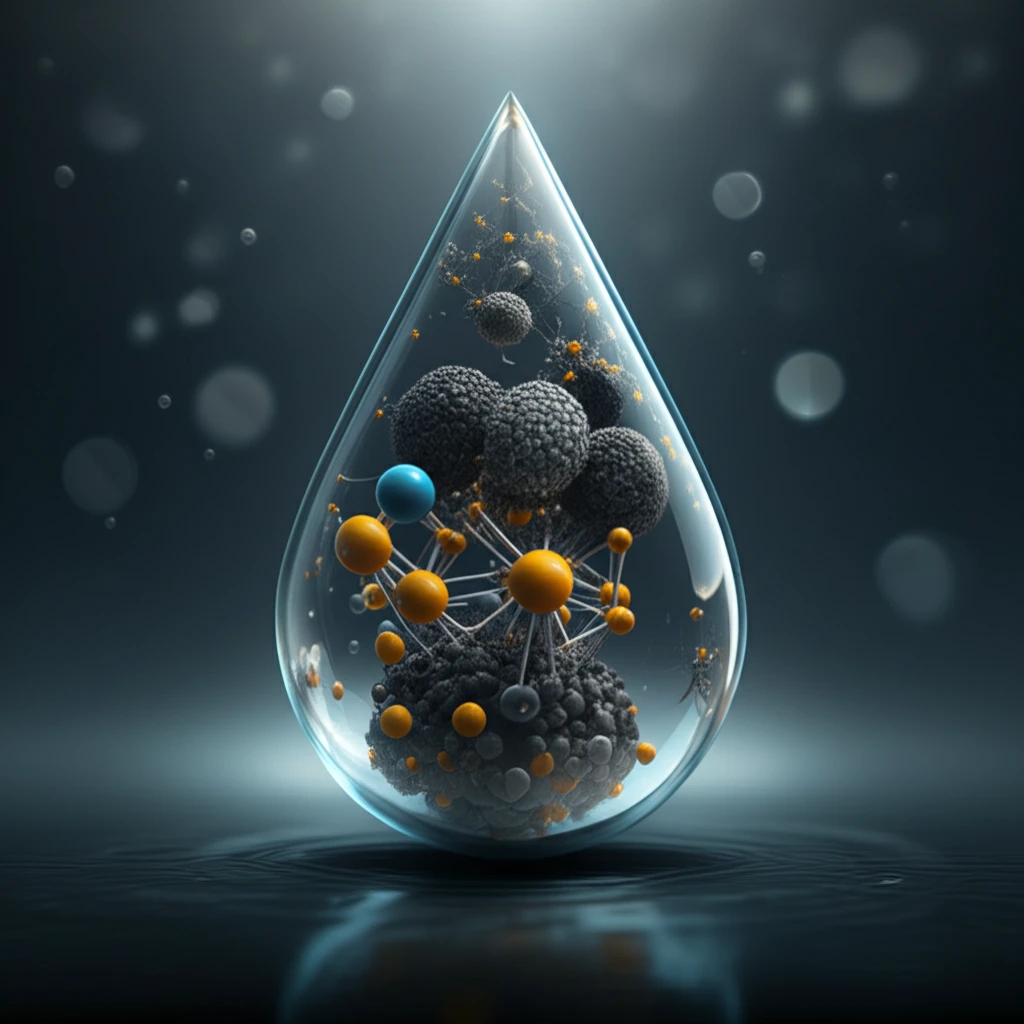
The Future is Clear: How Nanotechnology is Revolutionizing Water Purification

"Discover how nickel-activated carbon-TiO2 composites are paving the way for cleaner, more sustainable water solutions, using cutting-edge photocatalysis."
Clean water is essential for life, yet billions lack access to it. Traditional water purification methods often fall short in removing persistent pollutants, driving the need for innovative solutions. Nanotechnology offers a promising path forward, and one area showing real potential is the use of composite materials in photocatalysis.
Photocatalysis, using materials like titanium dioxide (TiO2), harnesses light to break down pollutants. However, pure TiO2 has limitations, primarily its need for ultraviolet (UV) light, which makes up only a small portion of sunlight. Researchers are exploring ways to enhance TiO2's efficiency and broaden its applicability, leading to the development of advanced composite materials.
One such innovation involves combining TiO2 with activated carbon and nickel, creating a powerful composite material. This combination leverages the strengths of each component, resulting in a more effective and versatile photocatalyst for water purification.
Global Adoption and Market Growth
Water purification has become mainstream globally, with adoption reaching 1.2 billion units in 2023 and 62% of Indian households now using purifiers. Health outcomes and technology choices vary sharply across regions and models, underscoring the uneven impact of these devices. Growing worldwide demand is driving rapid expansion in the water purification industry, with energy-efficient, low-waste systems gaining popularity. Advanced data analysis tools are also emerging to better manage water resources and forecast filtration performance amid degrading water quality.
Proven Methods and Their Constraints
Traditional water purification relies on eight established methods, each designed to remove different ranges of contaminants and suited to different situations. These include filtration, chemical treatment, and distillation, supported by standardized examination protocols such as the 2540 Solids method for water and wastewater analysis. Portable water filters offer a practical alternative to purchasing single-use plastic bottles, particularly for travelers facing questionable tap water quality. However, these conventional techniques have inherent limitations in addressing emerging contaminants, driving interest in advanced purification and desalination technologies.
From Ancient Sanskrit to Chlorine Discovery
Water purification has ancient roots, with early Sanskrit writings from around 2000 BC outlining methods for purifying water. The history evolved from simple sand, gravel, and charcoal filter systems to more sophisticated chemical approaches over millennia. A key milestone came when Swedish chemist Carl Wilhelm Scheele discovered chlorine in 1774, which eventually enabled chlorination as one of the earliest widespread purification methods. Chlorination releases hydrochloric acid that reacts with and kills microorganisms, fundamentally transforming public health outcomes.
Unlocking the Power of Ni/Activated Carbon-TiO2 Composites
A recent study published in the Asian Journal of Chemistry details the creation and characterization of a novel nickel/activated carbon-TiO2 composite material. The research focuses on how this composite can efficiently degrade organic dyes, a common type of water pollutant. The composite is created by coating activated carbon with nickel, then supporting TiO2 on this modified carbon. This unique structure enhances the photocatalytic activity of TiO2, making it more effective at breaking down pollutants.
- Enhanced Adsorption: Activated carbon's porous structure provides a large surface area for pollutant adsorption, bringing contaminants into close contact with the TiO2.
- Improved Light Utilization: The addition of nickel and the composite structure may enhance the material's ability to utilize a broader spectrum of light, not just UV.
- Reduced Electron-Hole Recombination: Nickel acts as an electron trap, reducing the recombination of electron-hole pairs, which are crucial for the photocatalytic process.
- Synergistic Effect: The combination of all three materials creates a synergistic effect, where the overall performance exceeds the sum of their individual capabilities.
Innovation Trends and Lab-to-Industry Gaps
Current water purification research is driving innovation across multiple fronts, with prominent trends including carbon-based purification, nanofiltration, membrane technology, and bio-based water remediation. Despite these advances, studies suggest that Nobel Prize-level materials have yet to make the transition from laboratory to industrial-scale applications. Researchers continue exploring cost-effective solutions, with some recommending a 5-minute boiling technique as a practical method for drinking water purification in resource-limited settings. Water quality monitoring technologies are also being developed to provide real-time assessment of purification effectiveness.
Deployment Challenges in Crisis Contexts
While advanced purification technologies exist, significant challenges remain in deploying them effectively in disaster-prone and resource-limited regions. UV water purification, which exposes water to ultraviolet-C light at 260–280 nm wavelengths to damage microbial DNA and RNA, represents one proven approach but requires reliable power and maintenance infrastructure. In flood-hit areas across Assam, clean drinking water became scarce despite available technologies, highlighting the gap between innovation and accessibility. Institutions like Tripura University have developed specialized technologies specifically designed for difficult and disaster-prone locations to bridge this divide.
RO vs. UV vs. Distillation: A Technical Comparison
Different water purification technologies offer varying levels of effectiveness, energy consumption, and cost profiles. Reverse osmosis stands out for industrial applications, offering 95–99% total dissolved solids removal at an energy cost of 3–6 kWh per 1,000 gallons and approximately $0.002–$0.005 per gallon. UV-based systems achieve 99.99% removal of waterborne pathogenic bacteria and viruses without chemicals, though they address different contaminant profiles than RO. Technical comparisons across deionization, distillation, and membrane filtration reveal that no single approach is universally optimal—each has distinct strengths depending on specific contaminants and application requirements.
A Sustainable Future?
The development of Ni/activated carbon-TiO2 composites represents a significant step forward in nanotechnology-driven water purification. By combining the strengths of different materials, scientists are creating more efficient, sustainable, and cost-effective solutions for tackling water contamination. While further research and development are needed, this technology holds immense potential for providing clean water to communities around the globe.
Matching Technology to Water Quality
Safe Total Dissolved Solids levels remain a critical benchmark for drinking water quality, with complete water analysis costing between ₹1,500–3,000 and government lab testing available for ₹500–1,000. Activated carbon, particularly from coconut shell sources, continues to serve as a reliable and natural purification medium trusted by industry experts. Modern multi-stage systems combine 5-stage purification processes with mineral fortification technology, representing the integration of established filtration methods with contemporary health-focused innovations. Experts emphasize the importance of matching purification technology to local water quality conditions rather than adopting a one-size-fits-all approach.
Nanotechnology, IoT, and Sustainable Systems
The future of purified water systems is being shaped by sustainability and efficiency, as industry leaders emphasize minimizing environmental impact alongside purification. Smart nanomaterials integrated with IoT devices represent a key trend in nanotechnology for water purification, enabling real-time monitoring and adaptive purification capabilities. The development of biodegradable nanomaterials is also gaining traction as an eco-friendly approach to reduce the environmental footprint of purification technologies. Market outlooks through 2030 reflect broader global trends toward desalination growth and government-led initiatives to expand access to clean water.
Waste, Health Trade-offs, and Customization
Water purification systems represent more than convenience—they are essential for health and sustainability, serving as long-term investments in better living. However, significant systemic challenges persist, including the fact that traditional RO systems waste 3–4 gallons of water for every gallon purified, a major drawback even as recent models have improved efficiency. Certain purification approaches like copper water purifiers carry their own disadvantages, with copper ions that may not suit all health profiles or water conditions. The need for customizable water enhancement solutions that can adapt to stand-alone or broader purification setups reflects the growing recognition that diverse water sources require tailored approaches.
Off-Grid Solutions and Consumer Accessibility
Real-world water purification extends beyond household systems to include survival scenarios and off-grid applications where access to conventional infrastructure is limited. Portable water purification tablets, canteens, and survival filters serve as critical tools for emergency preparedness and remote locations. Solar distillation offers a practical off-grid solution, with studies showing it effectively reduces pH, total dissolved solids, and electrical conductivity through solar evaporation. Consumer-grade systems employing patent-pending 4-stage ultra reverse osmosis technology demonstrate how advanced purification methods are being adapted for accessible home use.