
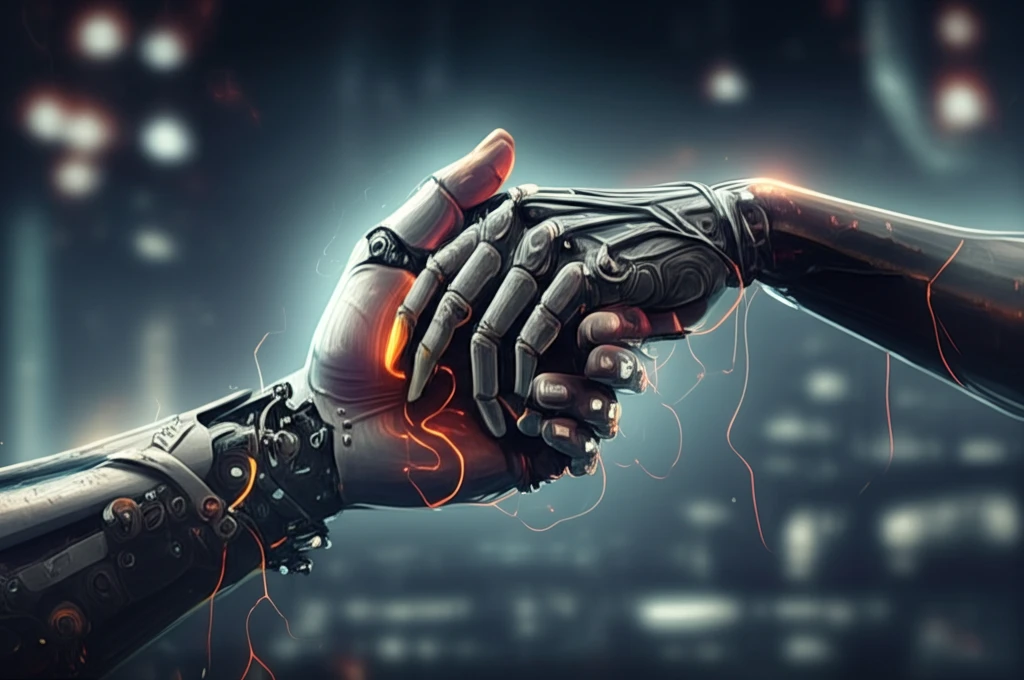
The Comfort Code: How Variable Stiffness Can Revolutionize Hand Exoskeletons

"Unlocking the secrets of optimal hand exoskeleton design with variable stiffness profiles to enhance comfort and performance."
Imagine a glove that enhances your hand's strength and dexterity, assisting with tasks from delicate surgeries to heavy lifting. That's the promise of hand exoskeletons, wearable robots designed to augment human capabilities. However, a significant hurdle remains: discomfort. Traditional exoskeletons often create concentrated pressure points, leading to pain and limiting their usability. The key to unlocking the full potential of these devices lies in understanding and optimizing the interface between the machine and the human hand.
The challenge is that the human hand is not uniformly rigid. Its bony prominences and soft tissues have varying degrees of stiffness. When a rigid exoskeleton applies force, it can create pressure hotspots, especially on the dorsal (back) surface of the hand. This is where the robot typically attaches, bearing the brunt of reaction forces from the fingers. The result is often discomfort, which can lead users to abandon the device, regardless of its potential benefits.
Researchers are pioneering a new approach: variable stiffness profiles. Instead of a uniformly stiff interface, they propose designing exoskeletons with contact points that adapt to the hand's natural stiffness variations. The goal is to distribute pressure more evenly, minimizing discomfort and improving the overall experience.
A Growing Market Driven by Rehabilitation Demand
The exoskeleton market is rapidly advancing in rehabilitation and assistive care for people living with spinal cord injury, stroke, and mobility-limiting conditions, with adoption accelerating faster than earlier projections suggested. Exoskeleton-related patents filed globally increased by 40% from 2020 to 2023, with growth concentrated in sensor integration and AI control. As the number of stroke patients continues to rise year over year, demand for rehabilitation medical machinery is intensifying, and hand exoskeletons are playing an increasingly indispensable role in the rehabilitation process.
Design Promise Meets Practical Shortcomings
Hand exoskeletons have been designed over the past decade to rehabilitate or enhance impaired hand movements, yet persistent limitations around weight and cost continue to hinder adoption. Many designs fail to meet actual user needs — a problem especially evident in pediatric applications, where children with neuromotor disorders experience hand impairments that limit independence in daily tasks and the acquisition of new skills. By necessity, hand exoskeletons must also incorporate the wrists due to the complexity and degrees of freedom involved, adding further mechanical bulk. Current control approaches, such as Bi-LSTM-based motion classification for real-time motor control, show technical promise but do not yet fully resolve these ergonomic and accessibility barriers.
From Military Concepts to Modern Wearables
Exoskeleton-like devices were developed throughout the middle of the 20th century, marking a period of exploration into the possibilities and challenges of wearable assistive technologies for human augmentation and rehabilitation. One of the earliest landmark projects was the Hardiman exoskeleton developed by General Electric, which aimed to amplify human strength. Over the past 50 years, researchers have documented the development milestones of lower-limb exoskeletons as well as the neuromuscular interactions between the device and the wearer, tracing a long arc from early experimental prototypes to today's increasingly refined systems.
Neurorobotic Systems and Accessible Design
Researchers at the Medical University of Vienna, in collaboration with ETH Zurich, the Technical University of Munich, and Medical Faculty Belgrade, have developed a wearable neurorobotic system that combines electrical neurostimulation with hand exoskeletons to improve touch and motor function in patients. In a parallel track aimed at broader accessibility, researchers have developed a low-cost hand exoskeleton that functions like a wearable robotic glove, helping users strengthen and support natural hand movements for long-term rehabilitation. Mechanical analyses of hand exoskeleton designs continue to examine how devices can account for the constraints imposed by healthy human biomechanics and compensate for functional deficits in affected hands.
Inherited Designs and Unresolved Tradeoffs
Development of hand exoskeletons often begins with inheriting mechanical designs from prior research, as in the case of a system built from a graduating Master's student's design funded under NSF Award #1532239, illustrating how iterative and incremental the engineering process can be. Even as new multimodal hand exoskeletons emerge — combining force, pressure, and thermal feedback for enhanced robotic teleoperation and VR applications — the field continues to grapple with whether these sophisticated capabilities translate into practical, everyday usability. The tension between adding sensory richness and keeping devices wearable, affordable, and user-friendly remains an unresolved challenge in the field.
Degrees of Freedom, Accuracy, and Adaptability
The Haptikos hand exoskeleton offers 24 degrees of freedom per hand with sub-millimeter motion accuracy and 8 hours of continuous usage — capabilities its developers describe as unmatched in the industry. Adaptive mechatronic exoskeleton architectures for finger rehabilitation have been validated across subjects with different hand sizes, testing force sensor accuracy as a key performance metric. Soft exoskeleton designs have introduced novel tendon routing folded laterally on both sides of the hand, adding clenching forces when activated to improve hand closing and opening support.
Adaptability and Training Are Key
Effective hand exoskeletons should assist all fingers independently, and linkage-based kinematics with intentional misalignment between mechanical and anatomical finger joints can allow devices to adapt automatically to different hand sizes. Research from Stanford has demonstrated that the benefits people can reap from exoskeletons rely heavily on having sufficient time to train with the device, underscoring that engineering alone is not enough. Expert communities — including those behind initiatives like the EduExo and winners of the Wearable Robotics Innovation Challenge — continue to push the boundary of what these devices can achieve in practice.
Lightweight, Brain-Controlled, and Industry-Ready
Scientists are developing lightweight and portable hand exoskeletons that can be controlled with brainwaves, a development led by researchers at EPFL that points toward a future of more intuitive human-machine interfaces. Industrial use cases are expanding rapidly, with robotic exoskeletons spanning multiple classes, markets, and applications across sectors. While expert commentary suggests that some aspects of the exoskeleton future are arriving sooner than expected, questions remain about the pace and equity of adoption across different populations and industries.
Barriers Beyond the Technology
While the technical capabilities of hand exoskeletons are advancing rapidly, the path to widespread adoption involves systemic challenges that extend beyond engineering. Issues of cost, clinical validation, regulatory approval, insurance reimbursement, and equitable access remain significant hurdles for translating laboratory prototypes into everyday tools. Without coordinated effort across industry, healthcare systems, and policymakers, the gap between what these devices can do in controlled settings and what they actually deliver to patients in routine clinical or home use is likely to persist.
Training, Comfort, and Usability Matter Most
Variable admittance control strategies, refined through digital twin simulations and tested on real exoskeletons, represent a promising approach to making hand exoskeletons feel more natural and comfortable during use. Real-world testing with senior users has shown that lightweight, wearable exoskeletons can make walking assistance feel genuinely easier and more comfortable in outdoor settings. Novel torque-controlled designs like HandeXos-gamma, which use series-elastic actuators for compliant actuation and combine surface EMG with intention-decoding algorithms, point toward a future where exoskeletons respond intuitively to the user's own motor intent rather than imposing rigid motion patterns.
Decoding the Hand: Measuring and Modeling Stiffness
The first step in creating a comfortable exoskeleton is understanding the hand's stiffness landscape. Researchers at the University of Texas at Austin, the University of Washington, and Oculus & Facebook have undertaken detailed studies to map the spatial stiffness distribution of the hand dorsum. Their approach involves a combination of experimental measurements and computational modeling.
- The stiffness of the hand dorsum varies significantly across its surface.
- The regions above the metacarpal bones are generally stiffer than the areas in between.
- Increasing grasp force leads to an increase in measured dorsum stiffness.
The Future of Comfortable Robotics
This research marks a significant step towards creating more comfortable and usable hand exoskeletons. By understanding and adapting to the hand's natural stiffness variations, engineers can minimize pressure points and improve the overall user experience. The implications extend beyond exoskeletons, potentially informing the design of other wearable devices, prosthetic sockets and any application where a close human-machine interface is critical. As robotics and wearable technology become increasingly integrated into our lives, ensuring user comfort will be paramount to their success.