
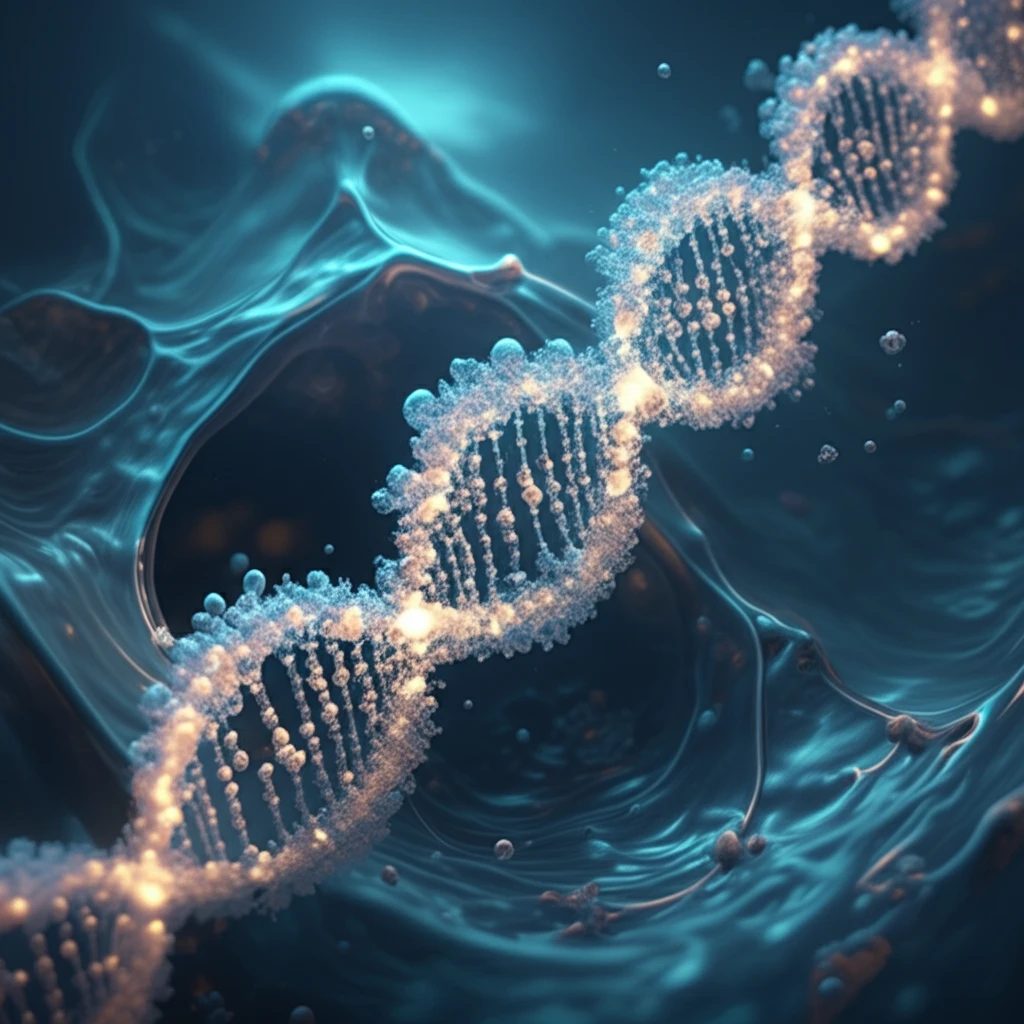
The Collagen Comeback: How Type III is Revolutionizing Skin Health and Beyond

"Unlocking the secrets of human collagen type III: From high-resolution structures to potent cell adhesion, discover the breakthrough that could redefine regenerative medicine."
Collagen, the most abundant protein in the animal kingdom, serves as the very scaffolding upon which our bodies are built. It's the key structural component of everything from our skin and tendons to our ligaments and bones. Within this diverse family of proteins, collagen type III (hCOL3A1) stands out for its unique role and distribution in the body.
Human collagen type III is a fibril-forming collagen predominantly found in extensible connective tissues like the skin, vascular system, and internal organs. More than just a structural component, hCOL3A1 is critically involved in vital processes such as wound healing, the formation of collagen fibrils, and maintaining cardiovascular health. Its importance in tissue repair and maintenance makes it a prime target for regenerative medicine and biomaterial development.
Recent research has focused on the charged residues within hCOL3A1, which are believed to be vital for collagen binding and recognition. Scientists have discovered that a specific triple-helix fragment of hCOL3A1, known as Gly489-Gly510, contains multiple charged residues and charged triplets, making it a region of significant interest. This discovery has paved the way for high-resolution structural analysis and the development of innovative applications.
Type III's Wide Reach Across Body Tissues
Type III collagen is found in the skin, blood vessels, organs and the intestinal wall, giving it a footprint that extends well beyond aesthetics. Scientists have identified many different collagen types, but types I and III are generally considered the most important for skin. This broad distribution is why type III is frequently framed as more than a beauty ingredient.
Supplementation and the Limits of Evidence
Collagen supplements, creatine and protein intake are all part of the current conversation around collagen loss, with honest assessments of what the evidence actually supports versus what sounds good on a label. Beyond the basics, the returns diminish unless foundational habits like sleep are addressed. Lifestyle habits are described as working alongside collagen supplementation, underscoring that no single product operates in isolation.
A Biopolymer Built From Three Amino Acids
Collagen is a biopolymer composed of various isoforms that share a triple-helical structure, and it is the primary component of the extracellular matrix. The molecule contains unusually high amounts of glycine, proline and hydroxyproline, three amino acids that give collagen its unique structure. This amino acid composition helps explain why collagen behaves so differently from other proteins.
Decoding the Structure: A High-Resolution Breakthrough
A team of researchers has successfully solved the crystal structure of the Gly489-Gly510 fragment of hCOL3A1 at a high resolution of 1.50 Å. This breakthrough provides unprecedented insights into the conformation of the triple-helix region, revealing critical details about its stability and potential interactions. The study identified strong interchain and interhelical hydrogen bonds, as well as flexible bending within the triple helix, all of which contribute to its unique properties.
- High-Resolution Imaging: Visualizing collagen structure at 1.50 Å.
- Hydrogen Bonds: Detailed mapping of interchain support.
- Helix Flexibility: Observing Gly489-Gly501 bending for cell interaction.
Recombinant Human Collagen as a Cutting-Edge Biomaterial
Recombinant human collagen, developed through advanced recombinant DNA technology, has emerged as a cutting-edge biomaterial with diverse applications in medicine. It is being developed specifically to address significant limitations of animal-derived collagen. Type III recombinant human collagen has been used to construct a series of highly porous scaffolds for tissue regeneration.
When the Type I/III Ratio Signals Trouble
The type I/type III collagen ratio has been linked to pathology, not just to youthful skin. An increased ratio is associated with hemorrhage in brain arteriovenous malformations, and the ratio has also been tied to diverticulitis of the colon in young patients. These findings complicate a purely cosmetic narrative around collagen supplementation.
Marine Versus Bovine Sources
Because type III collagen is found in the skin, blood vessels, organs and the intestinal wall, bovine collagen is considered a sensible choice for people wanting connective tissue support beyond beauty goals. Marine collagen, by contrast, is often pitched primarily toward skin-focused benefits. The choice between sources therefore hinges on whether the goal is beauty alone or broader structural support.
The Future of Collagen Type III: New Horizons in Medicine and Materials
The detailed structural insights and functional characterization of hCOL3A1’s Gly489-Gly510 region pave the way for exciting new applications in regenerative medicine and biomaterials. The T16 recombinant protein, with its strong cell adhesion activity and lack of cytotoxicity, holds immense potential for developing advanced wound healing therapies, tissue engineering scaffolds, and targeted drug delivery systems. By harnessing the unique properties of collagen type III, scientists are opening up new possibilities for repairing and regenerating tissues, with potential benefits for millions worldwide.
An Honest Read on Perimenopause and Collagen
Dr. Mary Alice Mina's discussion of perimenopause and collagen loss offers an honest take on what the evidence actually supports compared to what sounds good on a label. Collagen supplements, creatine and protein intake all come up in her assessment of the aging process. The takeaway is that everything beyond the basics represents diminishing returns unless sleep and other foundations are in place.
Engineered Collagens and Mimetic Peptides
Beyond supplements, recombinant humanized collagen type III is being characterized for use in highly porous scaffolds for tissue regeneration. Type III collagen mimetic peptides have been designed with anti- or pro-aggregant activities on human platelets, pointing to precise, tunable clinical applications. These engineered approaches mark the next frontier for type III collagen in medicine.
Supporting Ingredients and Lifestyle Realities
Commercial collagen peptides are frequently formulated alongside supporting ingredients such as hyaluronic acid and vitamin C, positioned as providing glowing wellness benefits. Lifestyle habits are expected to work alongside supplementation, and experts caution that results beyond the basics are diminishing returns unless sleep is addressed. The broader challenge is managing expectations in a market saturated with label-friendly claims.
From Hair and Nails to Gut and Vessels
Collagen is marketed for supporting healthy hair, nails, skin, bones and joints, while type III's presence in the skin, blood vessels, organs and intestinal wall extends that reach to internal connective tissue. Type III collagen is also very important for fibroblast function, the cells responsible for producing and maintaining the matrix. For women navigating perimenopause, the real-world concern is visible collagen loss compounded by the difficulty of separating genuine effects from marketing.