
Decoding Peptoids: A Beginner's Guide to the Future of Biomaterials

"Unlock the secrets of peptoids, the innovative biomimetic polymers revolutionizing medicine and materials science."
In the ever-evolving landscape of materials science, a new class of molecules is emerging with the potential to reshape industries ranging from medicine to manufacturing: peptoids. These fascinating compounds, often described as peptidomimetics, are capturing the imagination of scientists and researchers due to their unique properties and versatility.
Imagine a material that can be tailored to mimic the functions of natural proteins but with enhanced stability and design flexibility. That's the promise of peptoids. Unlike peptides, which are chains of amino acids linked by peptide bonds, peptoids feature side chains attached to the nitrogen atom of the amino acid backbone. This seemingly small change results in significant differences in their structure, behavior, and potential applications.
This guide will walk you through the fundamentals of peptoids, explore their key characteristics, and highlight why they're becoming a focal point for innovation. Whether you're a student, a seasoned scientist, or simply curious about the future of biomaterials, understanding peptoids is becoming increasingly essential.
A Growing Molecular Class Backed by Dedicated Infrastructure
Peptoids are described as an easy-to-synthesize and readily optimized class of peptidomimetics that have been studied across oncology applications as biologically amenable compounds and a promising alternative molecular class for anticancer drug development walshmedicalmedia.com. Supporting this expansion, the Peptoid Data Bank is an evolving database of peptoid three-dimensional structures that offers an application programming interface (API), letting researchers query the data with their own code databank.peptoids.org. Published protocols also describe the manual synthesis of oligo-peptoids and analysis of their sequences by mass spectrometry, while a separate line of work developed cyclic peptoid synthesis via consecutive Ugi reactions and reported that peptoids promote recovery of ultrastructure in caries remineralization.
Synthesis Routes and the Challenge of Conformational Control
Peptoids, or N-substituted glycines, are peptidomimetics whose chemistry resembles that of proteins while removing some of their functional limitations peptoidmd.wordpress.ncsu.edu. Automated methods for synthesizing peptoids include in situ activation with PyBOP and PyBroP, and the class offers greater conformational diversity than peptides for drug discovery academia.edu. Controlling that conformation remains a central hurdle: researchers have incorporated backbone chirality to restrict folding, and such peptoids have been selected for high binding affinity and selectivity to the antigen-binding site of therapeutically relevant antibodies, demonstrating the feasibility of this approach.
From Modular Libraries to Shape-Shifting Nanosheets
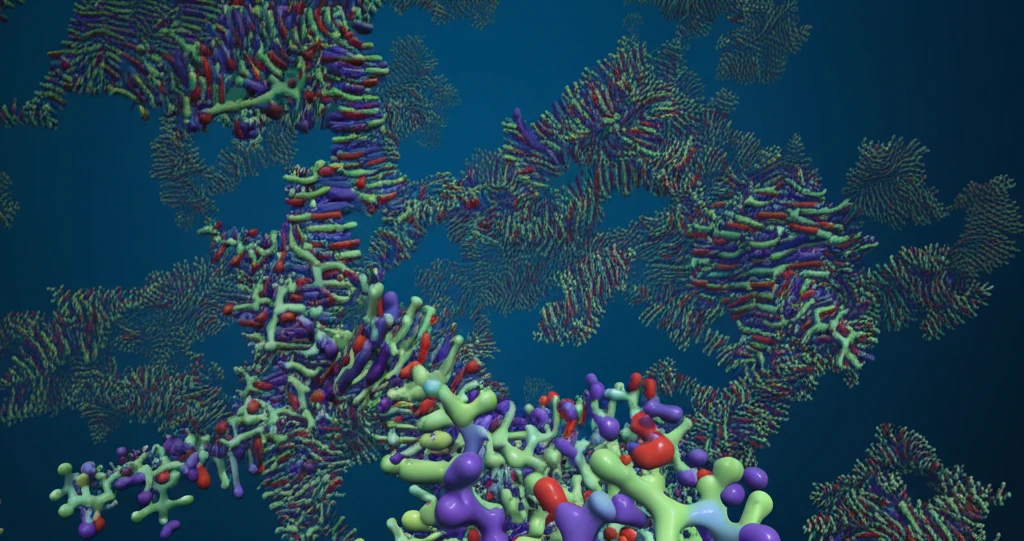
Peptoids were introduced in a landmark PNAS paper describing them as oligomers of N-substituted glycines and proposing the class as a motif for generating chemically diverse libraries of novel molecules pnas.org. Subsequent reviews of peptoids and polypeptoids as biomimetic and bioinspired materials for biomedical applications point to Zuckermann's 2011 account of "Peptoid origins" as a foundational milestone. More recently, an international team of researchers discovered that peptoids unexpectedly change shape when they form a nanosheet, reporting the finding in the Proceedings of the National Academy of Sciences and The Journal of Physical Chemistry Letters foundry.lbl.gov.
What Makes Peptoids Special?
At their core, peptoids are synthetic polymers composed of N-substituted glycine units. This seemingly subtle modification, where the side chains are connected to the nitrogen atom instead of the alpha-carbon, offers several advantages over traditional peptides. Peptoids exhibit enhanced resistance to enzymatic degradation, making them more stable in biological environments. Their synthesis is also often more straightforward, allowing for greater control over their structure and properties.
- Drug Delivery Systems: Peptoids can be engineered to encapsulate and deliver drugs directly to target cells.
- Biomaterials: Their biocompatibility makes them ideal for creating scaffolds for tissue engineering.
- Catalysis: Peptoids can be designed to mimic enzyme active sites, catalyzing specific chemical reactions.
- Antimicrobial Agents: Certain peptoids exhibit potent antimicrobial activity, offering a new approach to combatting drug-resistant bacteria.
An Expanding Review Landscape Across Therapeutics and Materials
Reviews highlight peptoids' versatility and low production cost, which are making them increasingly popular among peptidomimetics as potential neurotherapeutic agents, with diverse applications explored in the context of neurodegenerative disease eurekaselect.com. A separate structure-activity relationship review shows how structural properties such as main-chain length influence peptoids' biological activity against microbes, noting that linear antimicrobial peptides are increasingly designed to be ever shorter for synthetic and pharmacological reasons academia.edu. In biomaterials science, a mini-review surveys recent reports of peptoid self-assembled nanostructures and macromolecular interfaces. The literature continues to accumulate rapidly, with more than 2,200 full-text review articles and related publications indexed on the peptoid topic page of ResearchGate.
Promise Versus Progress: Where Peptoids Still Fall Short
Because peptoids are relatively easy to synthesize, have tremendous sequence diversity, and are more proteolytically stable than peptides and proteins, they have significant potential for use as APIs, drug-delivery agents, and in numerous biomedical applications pharmtech.com. That promise extends to antibiotics, with researchers suggesting peptoids could become an entirely new class of antibiotic drugs that would be hugely important. Yet progress remains uneven: while peptoids have shown promise as antimicrobial agents, their application to vector-borne parasitic diseases is highly underdeveloped, even though treatments for protozoan parasites are often limited in efficacy and drug resistance is an emerging problem escholarship.org.
Peptoids vs. Peptides: Stability at the Price of Folding Control
Peptoids are an emerging class of therapeutic agents that are structurally very similar to peptides but have superior proteolytic stability in vivo compared with standard peptide-based drugs leadingedgeonly.com. Side-by-side comparison of the general molecular structure of a naturally derived peptide versus an artificially produced peptoid illustrates how subtle backbone differences give rise to this behavior. One issue that has arisen is that peptoids often fold to form polyproline type 1 (PPI) helices rather than the PPII helices common among natural peptides students.bowdoin.edu. Peptoids containing chiral monomers, such as N-(S-1-phenylethyl) glycine, often appear helical, with a range of circular dichroism spectra that depend on the side chains used.
The Future is Peptoid
As research into peptoids continues to expand, we can expect to see even more innovative applications emerge. From revolutionizing medicine to creating sustainable materials, these versatile molecules hold immense promise for addressing some of the world's most pressing challenges. Keep an eye on this exciting field – the future of biomaterials may very well be peptoid.
Controlling Conformation and Engineering Targeted Delivery
Considerable efforts have been made to control the conformation of peptoids through steric and electronic interactions involving peptoid amides and nearby side chains, including strategies that regulate amide isomerism in the peptoid backbone hal.science. These design tools support applications such as mitochondria-targeting peptoids, which could facilitate the selective and robust targeted delivery of bioactive compounds such as drugs, antioxidants, and photosensitizers with minimal off-target effects pubmed.ncbi.nlm.nih.gov. Research has also fused an active peptoid to cell-penetrating peptides such as penetratin and the HIV-1 TAT peptide to create cell-compatible delivery systems. On the industrial side, scale-up providers report submonomer and PEG-coupling routes, reactor compatibility, analytical method development, and tech-transfer documentation for advancing peptoid programs.
Hairpin Motifs, Market Growth, and Next-Generation Antimicrobials
Researchers anticipate that strategies for turn motif stabilization will prove fruitful in the future design of biomimetic peptoids, following work that produced the first hairpin-like structure of a linear peptoid in aqueous solution, which displayed a single minimum at 200 nm in its circular dichroism spectrum pmc.ncbi.nlm.nih.gov. Market projections for 2026-2032 segment the peptoids market by type (cyclic and linear), synthesis method (solid-phase and solution-phase), application, and end user 360iresearch.com. Meanwhile, laboratories working on next-generation antimicrobial peptoids report compounds that are highly selective for pathogens over human cells, are biostable, effective at low doses, and rapidly destroy biofilm defenses.
Antiviral Resistance and the Search for an Achilles' Heel
A new approach in antiviral therapy focuses on disrupting the lipid membranes of viruses using peptoids, a strategy the researchers describe as finding an Achilles' heel in viral defenses. Because the mechanism targets the viral membrane rather than a rapidly mutating protein, it could potentially treat a broad range of viruses. Such an approach is significant because it directly addresses the challenge of antiviral resistance, a persistent limitation of existing therapies.
From Leishmania to Nanomaterials: Peptoids in Action
Researchers at Pacific Northwest National Laboratory built coral-shaped nanoparticles by design using engineered peptoids, choosing peptoids over proteins and peptides because they lack the intrinsic complexity caused by backbone folding, allow similar or even larger variations of side chains, and offer higher chemical and thermal stabilities pnnl.gov. Peptoids are also simple and inexpensive to produce with an automated synthesizer and readily available chemicals, and because their side chains are linked to nitrogens in the molecular backbone, they form a structure that resists enzymes pharmacytimes.com. In anti-infective work, scientists have synthesized peptoids containing both lysine and arginine monomers against Leishmania, on the rationale that mixed cationic functionality may enhance biological activity. Other efforts combine synthesis, spectroscopy, and computation, as in a case study validating a peptoid NLO star.