
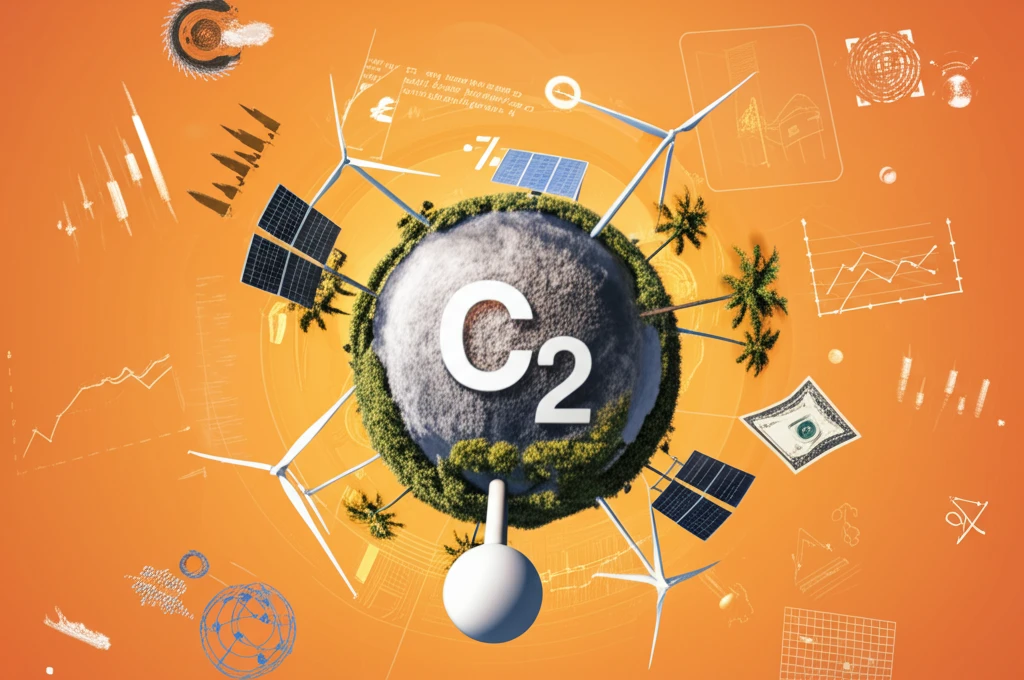
The Climate Crossroads: How Tourism, Finance, and Energy Policies Impact Carbon Emissions

"Navigating the complex relationships between tourism, financial development, and energy consumption to understand and mitigate carbon emissions for a sustainable future."
In today's interconnected world, understanding the dynamics between economic activities and their environmental impact is crucial. Among these activities, tourism, financial development, and energy consumption stand out as significant drivers. Each plays a vital role in shaping carbon emissions, demanding a closer look at their relationships.
Tourism, often celebrated for its economic benefits, has a hidden side. The industry's reliance on transportation, accommodations, and various tourist activities contributes substantially to energy consumption and, consequently, carbon emissions. Meanwhile, financial development, while fostering economic growth, can inadvertently boost energy consumption, further complicating the equation. Financial incentives often drive the investment to construct infrastructures to serve and accommodate the demand of energy sector.
This article will delve into the complexities of these relationships, analyzing how they interact to influence carbon emissions. By examining research findings and real-world examples, we aim to provide insights for policymakers, businesses, and individuals striving to promote sustainable practices and mitigate the environmental impact of economic activities.
Global and U.S. Emissions at a Glance
Global CO2 emissions grew from 6 billion tonnes in 1950 to nearly 24 billion tonnes by 1990, driven primarily by post-war industrialization and energy demand. The U.S. Environmental Protection Agency publishes an annual Inventory of U.S. Greenhouse Gas Emissions and Sinks to track trends by source, economic sector, and greenhouse gas type. The U.S. Energy Information Administration supplements this with environmental data on carbon dioxide emissions broken down by consuming sector, including residential, commercial, industrial, transportation, and electric power. These national tracking efforts underscore the scale of emissions even as the global trajectory continues to climb.
Multiple Methods, No Universal Standard
At present, three accounting methods are in common use for attributing greenhouse gas emissions to cities: territorial-based, production-based, and consumption-based, each yielding different results depending on system boundaries. There is no single correct method for measuring carbon emissions; spend-based, activity-based, and hybrid approaches each have their place depending on data availability, resources, and required precision. The bottom-up method commonly used in global monitoring relies on terrestrial ecosystem models, emission inventory methods, and fire radiation power techniques, each with inherent limitations in coverage and accuracy. These methodological choices are not merely academic — they directly shape policy formation and the comparability of emissions data across jurisdictions.
The Long Arc of Carbon Accounting
The scientific understanding of greenhouse gases dates back to the 19th century, but systematic efforts to measure and track carbon emissions are a relatively recent development, gaining momentum only after the first Earth Day in 1970 and the establishment of international frameworks in subsequent decades. The creation of national emissions inventories and the formation of bodies like the IPCC marked pivotal milestones in turning atmospheric science into policy-relevant data. While the foundational science of the carbon cycle is well established, the infrastructure for granular, real-time emissions monitoring at national and sectoral levels continues to evolve.
Unpacking the Carbon Footprint: How Do Tourism, Finance, and Energy Intertwine?
The relationship between economic growth and various factors like energy consumption and financial development is frequently analyzed. Most studies consider financial development and energy consumption as fundamental elements that influence economic activity and, by extension, carbon emissions. This examination leads to a crucial question: How do these factors interact, and what are the implications for environmental sustainability?
- Energy Consumption: A primary driver of carbon emissions, influenced by economic activity and tourism.
- Financial Development: Can mitigate carbon emissions by promoting cleaner technologies and sustainable practices.
- Tourism: While contributing to emissions through transportation and infrastructure, it can also incentivize environmental conservation.
A Slowdown in Growth, but Not in Total Emissions
Global CO2 emissions from fossil fuel combustion and industrial processes increased by approximately 0.7% in 2025, while the IEA reports that energy-related CO2 emissions rose by around 0.4%, the slowest rate since 2021. Despite the deceleration in growth, total energy-related CO2 emissions reached a new high of nearly 38.4 billion tonnes in 2025, approximately 5% above 2019 levels and coinciding with atmospheric CO2 concentrations of about 427 parts per million. In the prior year, 2024, global CO2 emissions had increased 0.9% to a total of 36.3 Gt CO2, further depleting remaining carbon budgets. Meanwhile, a systematic review of net-zero carbon emissions research identified key themes including the effectiveness of carbon sustainability reports, challenges on the path to net-zero, and broader implications for policy development.
Unresolved Tensions in Climate Policy
Despite broad scientific agreement on the causes of climate change, significant debates persist about the most effective policy levers and whether current decarbonization strategies are sufficient to meet stated targets. Economic and political constraints continue to slow the adoption of aggressive emissions reductions in many regions, and the gap between pledged commitments and actual implementation remains wide. While specific failures are context-dependent, the broader pattern suggests that voluntary and incremental approaches have yet to bend the global emissions curve decisively downward.
Comparing Carbon Footprints Across Choices
The U.S. Environmental Protection Agency provides tools allowing consumers to compare greenhouse gas emissions between gasoline vehicles and electric vehicles based on miles per gallon and annual mileage. Lifecycle analyses of electricity generation reveal significant differences: coal, natural gas, solar, wind, nuclear, and hydropower each carry distinct carbon intensities measured in CO2 per kilowatt-hour. CarbonCrux and other comparison platforms draw on verified data from DEFRA, EPA, and IPCC sources to quantify how different choices — from vehicle type to energy source — translate into measurable emissions differences. These comparisons highlight that decarbonization gains depend not only on technology choice but also on the carbon intensity of the electricity grid powering that technology.
Charting a Sustainable Path Forward: Balancing Economic Growth with Environmental Responsibility
In conclusion, the intricate relationships between tourism, financial development, and energy consumption underscore the complexity of addressing carbon emissions. While tourism and financial development can drive economic growth, they also carry the potential to exacerbate environmental challenges through increased energy demand. To forge a sustainable path forward, policymakers, businesses, and individuals must embrace innovative strategies that prioritize environmental responsibility alongside economic progress. By fostering a holistic approach that integrates sustainable practices into every facet of these interconnected sectors, we can mitigate the environmental impact of economic activities and create a more sustainable future for all.
Expert Skepticism and the Carbon Footprint Debate
A survey of 211 experts published alongside IPCC Assessment Report discussions found that authors are skeptical warming can be limited to below 2 degrees Celsius under current trajectory assumptions. The concept of the carbon footprint has become a widely adopted evaluation criterion for measuring greenhouse gas emissions, yet debates continue over whether corporate-level hourly carbon-free energy matching is truly the most effective approach to reducing system-level emissions — a position challenged by 31 signatories with expertise in energy systems modeling and carbon impact analysis. Meanwhile, opinion research on climate change and the energy transition continues to inform the public discourse, though consensus on specific policy prescriptions remains elusive.
Pathways Forward Remain Uncertain
While emissions growth has slowed in recent years, the trajectory toward net-zero remains deeply uncertain and hinges on the pace of clean energy deployment, policy enforcement, and international cooperation. Emerging technologies in carbon capture, storage, and direct air capture are attracting attention but remain far from the scale needed to offset current emissions. The gap between the ambition of climate pledges and the reality of implementation suggests that the next decade will be critical in determining whether long-term climate targets remain achievable.
Beyond Emissions: Systemic Barriers to Decarbonization
Decarbonization is not purely a technical challenge; it is deeply intertwined with economic structures, political will, and global equity considerations. Developing nations face the dual burden of expanding energy access while limiting emissions growth, often without the financial resources available to wealthier countries. The interconnected nature of global supply chains means that emissions reduction in one region can inadvertently shift production and associated emissions elsewhere, complicating the accounting frameworks discussed earlier.
How Policy Choices Shape Everyday Emissions
For individuals, the practical impact of climate policy often manifests through the choices available in transportation, home energy, and consumption patterns. As electric vehicle options expand and renewable energy becomes a larger share of the grid, the carbon intensity of everyday decisions is shifting — though unevenly across regions and income levels. Ultimately, the effectiveness of tourism, finance, and energy policies in reducing carbon emissions will be measured not just in aggregate tonnes avoided, but in the tangible changes experienced by communities and households navigating the energy transition.