
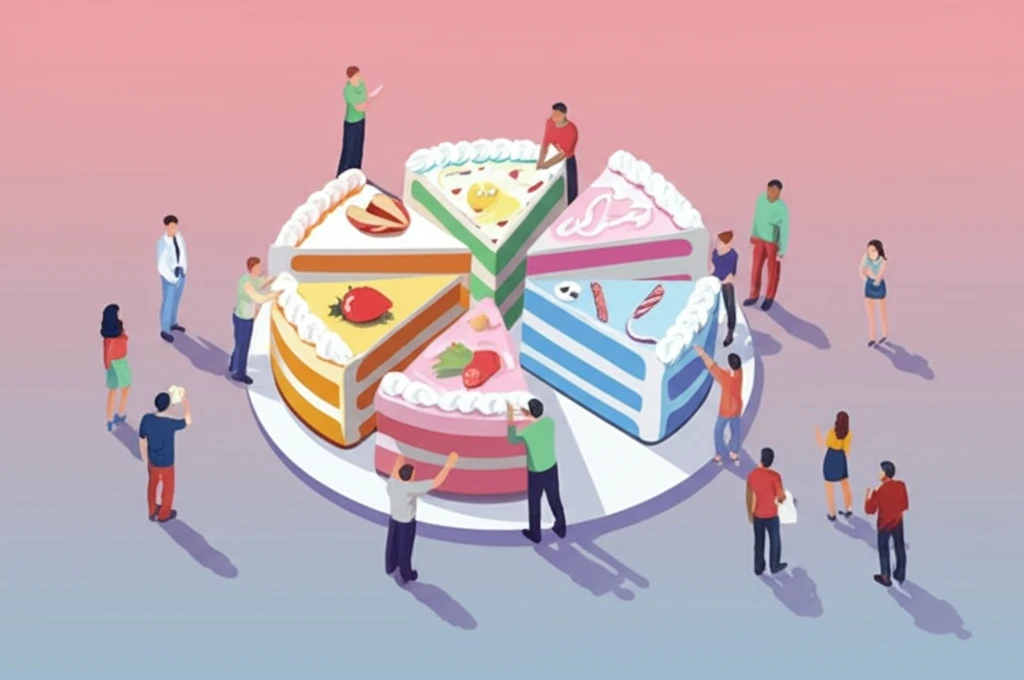
The Cake is a Lie? Unveiling the Secrets of Fair Resource Allocation

"Discover how mathematicians and computer scientists are tackling the complexities of fair division, ensuring everyone gets a piece they'll love."
Imagine a group of siblings inheriting a vast estate, filled with fertile land and potential coal mines. How do you divide it fairly when one sibling is a farmer and the other runs a coal factory? This classic problem highlights the complexities of resource allocation, where 'fairness' isn't always as simple as splitting everything equally. This challenge is at the heart of a field called 'cake-cutting,' a surprisingly deep area of study blending mathematics, economics, and computer science.
Cake-cutting, at its core, deals with dividing a divisible resource (the 'cake') among multiple participants (the 'agents') who may have different values and preferences. While the term conjures images of birthday parties, the principles apply to a wide range of real-world scenarios, from dividing assets in a divorce to allocating time slots on a shared resource. The goal is to find an allocation that satisfies certain fairness criteria, ensuring everyone feels they've received their due.
Traditional methods often fall short when dealing with diverse preferences. Selling the entire resource and splitting the proceeds equally, while straightforward, may not maximize individual satisfaction. This is where the concept of 'strong proportionality' comes in, where each agent receives a piece they value strictly more than their proportional share. However, achieving this while maintaining connected pieces – ensuring each agent receives a single, contiguous chunk of the resource – presents a unique set of challenges.
Defining Fairness in Resource Distribution
The concept of fairness carries significant weight in discussions of resource allocation. According to Merriam-Webster, 'fair' implies a proper balance of conflicting interests, a definition that directly applies to how systems distribute limited resources among competing demands. Large-scale operations like the Washington State Fair, which welcomes over one million guests annually and has run for 125 years, demonstrate the practical challenge of equitable distribution at scale. Managing such events requires careful allocation of space, services, and access to ensure all participants receive a reasonable share of the available resources. The principle extends beyond physical gatherings into computational and organizational systems where fairness determines outcomes for millions of users.
Fairness as a Foundational Principle
The Cambridge Dictionary defines fair as a public event involving the exchange and distribution of goods, establishing the term's deep roots in resource-sharing contexts. Traditional approaches to fair allocation often rely on principles of impartiality and objectivity, treating all parties equally regardless of circumstance. However, true fairness frequently requires distinguishing between equal treatment and equitable treatment, a distinction that complicates standard methodologies. Systems designed around rigid fairness rules may fail to account for varying needs, prior disadvantages, or contextual factors that warrant differentiated resource distribution. These limitations have driven ongoing debate about what constitutes genuinely fair allocation versus merely uniform allocation.
The Evolving Concept of Fairness
The notion of fairness in resource allocation has roots in early economic and philosophical thought, though its formalization in computational and organizational contexts is relatively recent. Scholars have long debated whether fairness requires equality of outcomes, equality of opportunity, or consideration of need. Early allocation models tended toward simple division schemes, but these proved inadequate for complex systems with interdependent resources. As systems grew in scale and complexity, researchers began developing more nuanced frameworks that accounted for multiple dimensions of fairness simultaneously. The tension between theoretical ideals and practical implementation remains a central theme in this evolving field.
What Makes Cake-Cutting So Hard? Exploring the Nuances of Fair Division
The beauty of cake-cutting lies in its ability to adapt to various fairness criteria. One of the most well known is 'proportionality'. This means that if you have 4 people dividing a cake, everyone should get at least 25% of the cake, according to their own valuation. But what if you want a better deal? That's where the idea of strong proportionality comes into play. It is where everyone gets a piece worth more than their fair share. The problem, then, is ensuring strong proportionality isn't always possible.
- Diverse Valuations: Each agent might value different parts of the resource differently. One person might cherish the fertile land, while another sees more value in the coal mining potential.
- Connectivity Constraints: Requiring each agent to receive a single, contiguous piece adds complexity. It’s much easier to give someone six separate 20-minute slots than a single two-hour slot. This is important when it comes to resources like time.
- Query Complexity: Finding the fairest division can be computationally expensive. Algorithms often rely on querying agents about their preferences, and minimizing the number of queries is crucial for efficiency.
Contemporary Fairness Frameworks
Recent discourse on fair resource allocation has expanded to encompass algorithmic fairness, drawing parallels between computational systems and traditional economic distribution problems. Researchers continue to explore how different fairness definitions—such as proportionality, envy-freeness, and need-based allocation—perform under varying conditions. The intersection of fairness with efficiency remains a focal point, as maximizing total utility often conflicts with ensuring equitable distribution. Ongoing studies examine how context-specific requirements shape which fairness criteria are most appropriate, acknowledging that no single definition suits all scenarios. The field remains dynamic, with new perspectives emerging as technology creates both novel opportunities and challenges for fair distribution.
Challenges to Fair Allocation Models
Critics of standardized fairness approaches argue that rigid definitions can produce perverse outcomes when applied indiscriminately across diverse contexts. Some allocation systems that appear fair on the surface may perpetuate existing inequalities by failing to account for historical disadvantages or structural barriers. Failures in fair resource distribution often emerge from implementation gaps rather than flawed principles, highlighting the difficulty of translating theory into practice. Resistance to change from stakeholders who benefit from current arrangements also poses significant obstacles to achieving more equitable outcomes. These challenges suggest that fairness in resource allocation requires continuous refinement rather than static rules.
Evaluating Allocation Approaches
Different approaches to fair resource allocation vary significantly in their underlying assumptions and practical outcomes. Methodologies that prioritize efficiency may achieve higher total output but distribute benefits unevenly, while equity-focused approaches may sacrifice some aggregate gains for broader participation. Comparative analysis reveals that context determines which trade-offs are acceptable, with no universally superior framework identified. Cross-domain comparisons between physical resource distribution and digital allocation systems show both shared principles and important divergences. Understanding these differences is essential for selecting appropriate fairness criteria in any given situation.
The Future of Fairness: Applying Cake-Cutting to Real-World Problems
The research has shown how to approach the problem of fair resource allocation, but it's just the beginning. From dividing land to scheduling meeting rooms, the need for fair and efficient allocation mechanisms is ever-present. These algorithms can be used to ensure satisfaction and equity in many domains.
Integrating Fairness Principles
Synthesizing diverse perspectives on fair resource allocation reveals a field grappling with fundamental tensions between competing values. Experts increasingly recognize that fairness cannot be reduced to a single metric but must be understood as a multidimensional concept shaped by context and stakeholder priorities. The practical application of fairness principles requires ongoing dialogue between theorists and practitioners to ensure relevance and effectiveness. Moving forward, the most successful approaches will likely combine multiple fairness criteria in flexible frameworks that adapt to changing circumstances. This synthesis represents not a final answer but an evolving understanding of how to balance competing demands equitably.
Emerging Directions in Fairness Research
The future of fair resource allocation research points toward increasingly sophisticated models that can accommodate complex, dynamic systems with multiple stakeholder groups. Advances in computational modeling and data analysis may enable more nuanced fairness assessments that account for factors previously difficult to quantify. Cross-disciplinary collaboration between economists, computer scientists, ethicists, and policymakers is expected to deepen, producing more holistic approaches to allocation challenges. As resource constraints intensify globally, the importance of developing robust, equitable distribution mechanisms will only grow. The next frontier likely involves creating adaptive systems that can maintain fairness while responding to rapidly changing conditions.
Structural Barriers to Equitable Distribution
Fair resource allocation operates within broader systemic contexts that shape both possibilities and constraints. Existing power structures, institutional frameworks, and historical patterns of resource distribution create path dependencies that are difficult to overcome. Systemic challenges include information asymmetries that prevent accurate assessment of needs, transaction costs that disproportionately burden smaller stakeholders, and political dynamics that favor entrenched interests. Addressing these structural barriers requires more than technical solutions; it demands engagement with the social, economic, and political systems within which allocation decisions occur. Recognizing these broader contexts is essential for developing realistic and effective fairness frameworks.
Fairness in Practice and Human Experience
Ultimately, fair resource allocation affects real people with diverse needs, preferences, and circumstances that abstract models may not fully capture. Human perceptions of fairness are shaped by cultural norms, personal experiences, and expectations about what constitutes a reasonable outcome. Systems that appear mathematically fair may nonetheless feel unjust to those who bear disproportionate costs or receive fewer benefits. The human element introduces complexity that purely technical approaches cannot address, requiring attention to communication, transparency, and participatory decision-making. Real-world impact assessment must go beyond aggregate metrics to examine how allocation outcomes affect different populations and communities.