
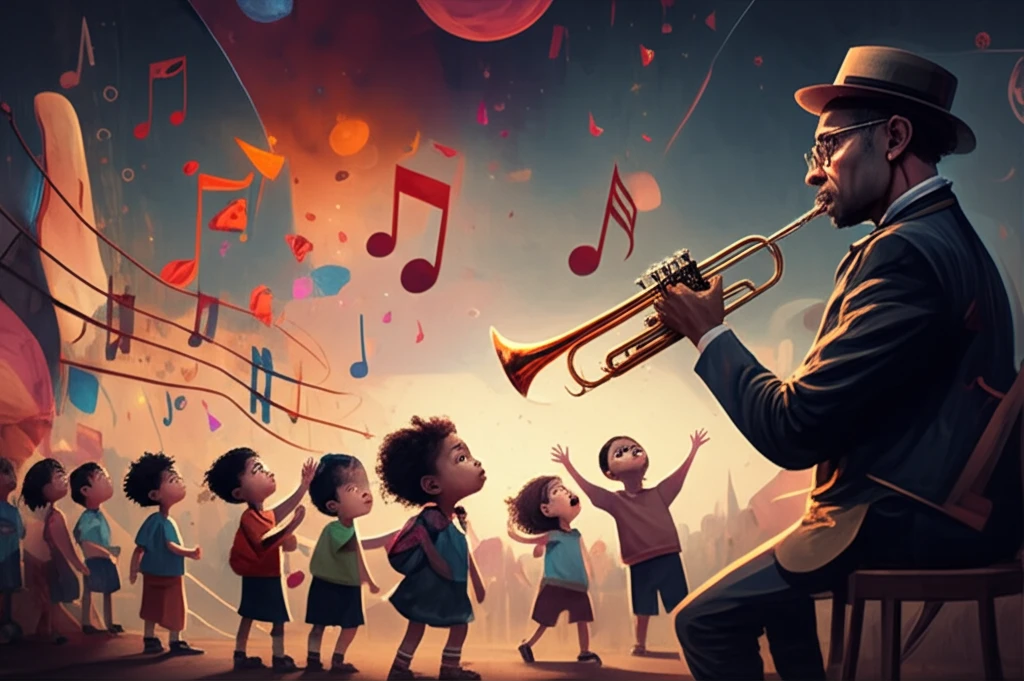
The Accidental Maestro: How Trumpet Concerts are Redefining Kids' Music
"Uncover the surprising ways interactive performances are engaging young audiences and sparking a lifelong love of music."
Imagine a concert hall, but instead of hushed reverence, there's laughter, curious questions, and the occasional toddler wandering on stage. This is the reality of interactive concert performances designed for young children, specifically those aged 3-6. These aren't your typical stuffy classical concerts; they're a vibrant blend of theatrical elements, improvisation, and direct engagement with the audience.
The goal is simple: to spark a love of music and foster musical understanding in a way that resonates with young minds. As more music programs are trimmed, it's become important to teach music to kids in a fun way. These shows are great for getting kids to enjoy music and understand it better.
One such innovative approach is the 'Trumpet Concert with Theatrical Flair,' a performance developed in Norway. This article dives into this concept, exploring the interactive aspects, challenges, and exciting possibilities that arise when the concert stage becomes a playground for musical discovery.
A Changing Musical Landscape
Trumpet concerts are increasingly being discussed as part of a broader effort to make children's music experiences more engaging and participatory. Their impact may depend on factors such as the quality of interaction, the child's age, and whether performances connect with sustained educational activity. Because no specific statistics are available here, claims about their reach or developmental effects should remain cautious.
Interactive and Structured Learning
Interactive teaching is presented as an important approach to improving musical literacy, with the cited research reporting that musical skills may support speech development among children with autism spectrum disorders by improving attention span. The 2023 study also identifies the Kodály method as a basis for applying interactive principles to musical-literacy education. Broader music-education approaches are described as accessible and applicable to people working with children and the arts. However, a review of longitudinal research highlights persistent socioeconomic disparities in access and argues that short-term interventions may be insufficient for lasting developmental benefits.
An Evolving Tradition
The development of children's music education appears to have unfolded through a range of teaching traditions rather than a single foundational breakthrough. Contemporary discussions commonly connect performance, participation, and educational purpose. For trumpet concerts, this history provides a broad context for experiments that make formal music experiences more accessible to young audiences.
What Makes a Trumpet Concert Interactive?
Interactive trumpet concerts throw out the traditional concert rules. From the moment the children enter, they're part of the show. Performers acknowledge them, talk to them, and encourage their participation. Costumes, simple stage designs, and storylines add a theatrical flair, capturing the children's imaginations. It's all about creating an experience that feels inclusive and engaging.
- Direct Address: Performers speak directly to the children, acknowledging their presence and inviting them to respond.
- Theatrical Elements: Costumes, simple sets, and a storyline create a narrative that captures the children's imagination.
- Musical Games: Children might be asked to identify melodies, suggest songs, or even conduct the musicians.
- Instrument Exploration: Performers might demonstrate the different sounds a trumpet can make, explaining how it works and inviting children to try it themselves.
- Improvisation: Musicians might incorporate children's suggestions or reactions into their performance, creating spontaneous and unique musical moments.
Evidence, Mediation, and Engagement
A 2025 meta-analysis examines music teaching and learning activities in relation to musical-artistic outcomes and argues that collaborative research can improve evaluation of musical growth. Research on NMH's Children's Concert Series suggests that performing for children in higher music education can function as a "pedagogy of interruption," strengthening students' music-mediational skills. A 2024 scoping review further analyzes children's and adolescents' engagement with music beyond formal education using topic modeling.
Limits of the Concert Model
Trumpet concerts should not automatically be treated as effective for every child or setting. Their educational value may vary with audience participation, preparation, accessibility, and the continuity of activities after the performance. Without specific evidence in the supplied material, broad claims about failure rates or universal benefits would be premature.
Different Educational Priorities
Music-education systems differ in how they organize curricula and prioritize musical participation. A comparative account contrasts structured programs in Europe with innovative approaches in Asia, suggesting that cultural context shapes what aspiring musicians encounter. Other discussions consider alternatives to elementary music performances that require less preparation and align more closely with classroom activity. These contrasts suggest that trumpet concerts are one possible format rather than a universally superior model.
The Future of Kids' Concerts: A Call for Innovation
Interactive trumpet concerts represent an exciting shift in how we introduce children to the world of music. By embracing theatrical elements, improvisation, and direct audience engagement, these performances create a dynamic and inclusive experience that sparks a lifelong love of music. As research continues to explore the benefits and best practices of these innovative approaches, we can expect to see even more creative and engaging concerts for young audiences in the years to come. The stage is set, and the future of kids' music is looking brighter than ever.
Designing for Young Listeners
Interactive technology is being explored as a way to support early music education for children aged 3 to 5. A thesis on interactive speakers examines devices that respond to voice commands and aim to engage and support preschool learners. This points toward a wider educational-concert model in which young audiences are invited to respond rather than remain passive listeners.
Toward More Responsive Concerts
Future developments may place greater emphasis on interactive formats, audience response, and connections between live performance and ongoing learning. New technology could expand the ways young children participate in musical experiences. The likely direction is experimentation, although the supplied material does not establish which approaches will prove most effective.
Access Shapes Participation
The broader success of children's music initiatives may depend on more than the design of a concert itself. Cost, availability, school resources, and sustained institutional support can shape which children receive meaningful musical opportunities. Any expansion of trumpet concerts therefore needs to be considered alongside wider questions of inclusion and access.
Music as Shared Experience
For children, a live trumpet concert can make music feel immediate, social, and connected to real performers. Its human value may come from the encounter itself as well as from any formal learning objective. The strongest impact is likely to emerge when performance, interaction, and continued encouragement work together.