
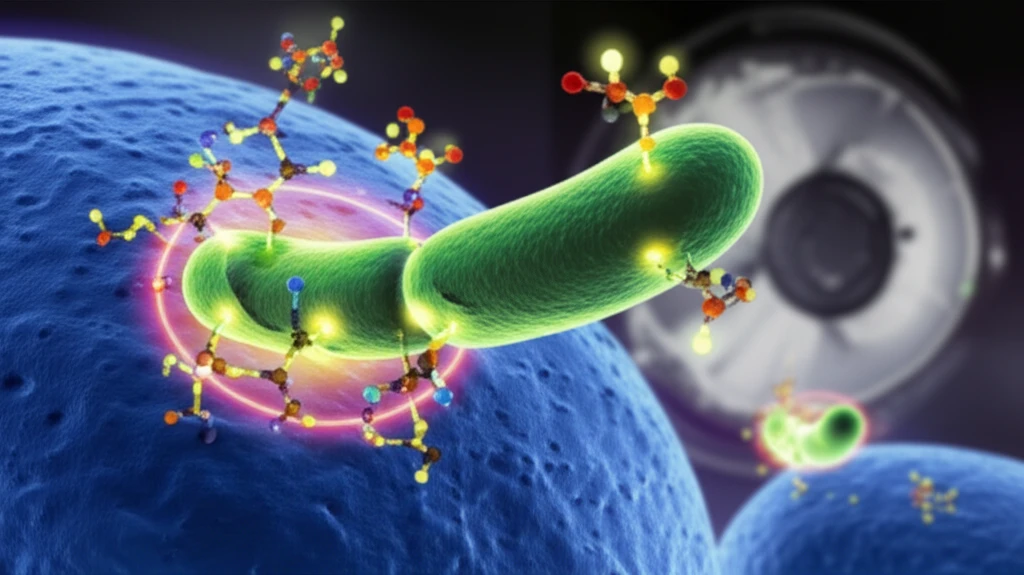
Illustration of *Pseudomonas aeruginosa* bacteria targeted by Ga-68-labeled pyoverdine, with a PET scan overlay.

Targeting Infections: How a Novel Imaging Technique Could Revolutionize Treatment

"Using Ga-68-labeled pyoverdine, scientists are developing a new method to pinpoint bacterial infections, potentially leading to faster diagnoses and more effective treatments."


In the relentless battle against infectious diseases, scientists are constantly seeking more effective diagnostic tools. Early and accurate detection of infections is crucial, as it directly impacts patient outcomes and can significantly improve survival rates. The ongoing search has led researchers to explore novel approaches, including the use of advanced imaging techniques. Recent advancements in medical imaging are now enabling the development of more precise and effective ways to visualize and understand infections within the body.

One such advancement involves using siderophores, small molecules produced by bacteria to scavenge iron. These molecules, when combined with radioactive isotopes like Gallium-68 (Ga-68), can be used in Positron Emission Tomography (PET) scans to pinpoint the location of infections. This innovative approach offers a targeted way to identify and monitor infections, potentially leading to quicker diagnoses and more effective treatments.

A study published in "Scientific Reports" highlights the effectiveness of this novel imaging technique, particularly for detecting Pseudomonas aeruginosa infections. This is a significant breakthrough, considering P. aeruginosa is a common and dangerous pathogen. The findings suggest a promising future for more precise, targeted treatment strategies.

The Science Behind the New Imaging Technique

Illustration of *Pseudomonas aeruginosa* bacteria targeted by Ga-68-labeled pyoverdine, with a PET scan overlay.

The study focuses on a siderophore called pyoverdine PAO1 (PVD-PAO1), which is produced by P. aeruginosa. By attaching the radioactive isotope Ga-68 to PVD-PAO1, researchers created a compound that specifically targets and binds to the bacteria. This targeted approach allows for precise imaging of P. aeruginosa infections using PET scans.

The Ga-68-labeled PVD-PAO1 works by taking advantage of the bacteria's need for iron. Here's how:

  • Siderophores at Work: Bacteria produce siderophores like PVD to capture iron from their environment.
  • Targeting the Bacteria: The Ga-68-labeled PVD-PAO1 is designed to mimic the behavior of natural siderophores, allowing it to be taken up by the bacteria.
  • Imaging Infections: PET scans can then detect the Ga-68, highlighting the location of the infection within the body.
Researchers tested this new technique in both laboratory and animal studies. The results showed that the Ga-68-labeled PVD-PAO1 could accurately identify and visualize P. aeruginosa infections. Furthermore, this method was more effective than other imaging techniques, such as the use of 18F-fluorodeoxyglucose (18F-FDG) and 68Ga-citrate, that are currently used in clinical settings.

Looking Ahead: Potential Impact and Future Directions

This research marks a substantial advancement in how we identify and combat bacterial infections. The targeted imaging approach using Ga-68-labeled PVD-PAO1 offers improved accuracy and sensitivity compared to existing methods. As a result, it has the potential to significantly impact patient care. The ability to detect infections early and accurately can lead to more timely and effective treatment, ultimately improving patient outcomes. Moreover, this research opens avenues for further investigation into the application of this technique to other types of infections, potentially expanding its impact in the field of medicine.

About this Article -

This article was crafted using a human-AI hybrid and collaborative approach. AI assisted our team with initial drafting, research insights, identifying key questions, and image generation. Our human editors guided topic selection, defined the angle, structured the content, ensured factual accuracy and relevance, refined the tone, and conducted thorough editing to deliver helpful, high-quality information.See our About page for more information.

This article is based on research published under:

DOI-LINK: 10.1038/s41598-018-33895-w, Alternate LINK

Title: Imaging Of Pseudomonas Aeruginosa Infection With Ga-68 Labelled Pyoverdine For Positron Emission Tomography

Subject: Multidisciplinary

Journal: Scientific Reports

Publisher: Springer Science and Business Media LLC

Authors: Milos Petrik, Eva Umlaufova, Vladislav Raclavsky, Andrea Palyzova, Vladimir Havlicek, Hubertus Haas, Zbynek Novy, Dalibor Dolezal, Marian Hajduch, Clemens Decristoforo

Published: 2018-10-24

Everything You Need To Know

1

How does Ga-68-labeled pyoverdine help in detecting bacterial infections, particularly those caused by *Pseudomonas aeruginosa*?

Ga-68-labeled pyoverdine (PVD-PAO1) works by exploiting the iron-scavenging behavior of bacteria like *Pseudomonas aeruginosa*. Pyoverdine is a siderophore, a molecule produced by bacteria to capture iron from their environment. When the radioactive isotope Gallium-68 (Ga-68) is attached to pyoverdine, it creates a compound that specifically targets and binds to the bacteria. This allows for precise imaging of *P. aeruginosa* infections using Positron Emission Tomography (PET) scans, as the Ga-68 highlights the location of the infection. The technique mimics natural siderophores and gets taken up by the bacteria, which concentrates the radioactive tracer at the site of infection.

2

Why is early and accurate detection of infections so important?

Early and accurate detection of infections is crucial because it directly impacts patient outcomes and survival rates. Identifying infections quickly allows for more timely and effective treatment, which can significantly improve a patient's chances of recovery. Advanced imaging techniques like those using Ga-68-labeled pyoverdine (PVD-PAO1) offer a more precise and sensitive way to visualize and understand infections within the body, enabling healthcare professionals to make more informed decisions and initiate targeted therapies sooner. Without such tools, infections can progress undetected, leading to more severe complications and increased mortality.

3

What are siderophores, and how are they utilized in imaging bacterial infections?

Siderophores are small molecules produced by bacteria to scavenge iron from their environment. Iron is essential for bacterial growth and survival, so siderophores play a crucial role in acquiring this nutrient. In the context of imaging bacterial infections, siderophores like pyoverdine (PVD-PAO1) are combined with radioactive isotopes, such as Gallium-68 (Ga-68). This combination creates a targeted imaging agent that specifically binds to bacteria, allowing for precise visualization of the infection site using Positron Emission Tomography (PET) scans. This method offers a targeted way to identify and monitor infections, potentially leading to quicker diagnoses and more effective treatments.

4

How does the Ga-68-labeled PVD-PAO1 imaging technique compare to other existing methods for detecting bacterial infections, such as 18F-fluorodeoxyglucose (18F-FDG) and 68Ga-citrate?

The Ga-68-labeled PVD-PAO1 imaging technique demonstrates improved accuracy and sensitivity compared to existing methods like 18F-fluorodeoxyglucose (18F-FDG) and 68Ga-citrate. While 18F-FDG is a common imaging agent used to detect areas of high metabolic activity, it is not specific to bacterial infections and can be taken up by other tissues, leading to false positives. Similarly, 68Ga-citrate, while used for infection imaging, lacks the specificity of PVD-PAO1. The Ga-68-labeled PVD-PAO1 specifically targets the *Pseudomonas aeruginosa* bacteria, providing a more precise and reliable method for identifying and visualizing these infections. This targeted approach reduces the likelihood of false positives and allows for earlier and more accurate diagnosis.

5

What are the potential future directions and applications of the Ga-68-labeled pyoverdine imaging technique beyond detecting *Pseudomonas aeruginosa*?

Beyond detecting *Pseudomonas aeruginosa* infections, the Ga-68-labeled pyoverdine (PVD-PAO1) imaging technique opens avenues for further investigation into its application to other types of infections. The same approach of labeling siderophores with radioactive isotopes could be adapted to target different bacterial species by using siderophores specific to those bacteria. This could lead to the development of a suite of targeted imaging agents for a wide range of bacterial infections, improving diagnostic capabilities across various clinical settings. Additionally, research could explore the use of this technique to monitor the effectiveness of antibiotic treatments, providing real-time feedback on treatment response and potentially guiding personalized therapy decisions. Further studies could investigate if this technique can be used for fungal infections as well.

Newsletter Subscribe

Subscribe to get the latest articles and insights directly in your inbox.