
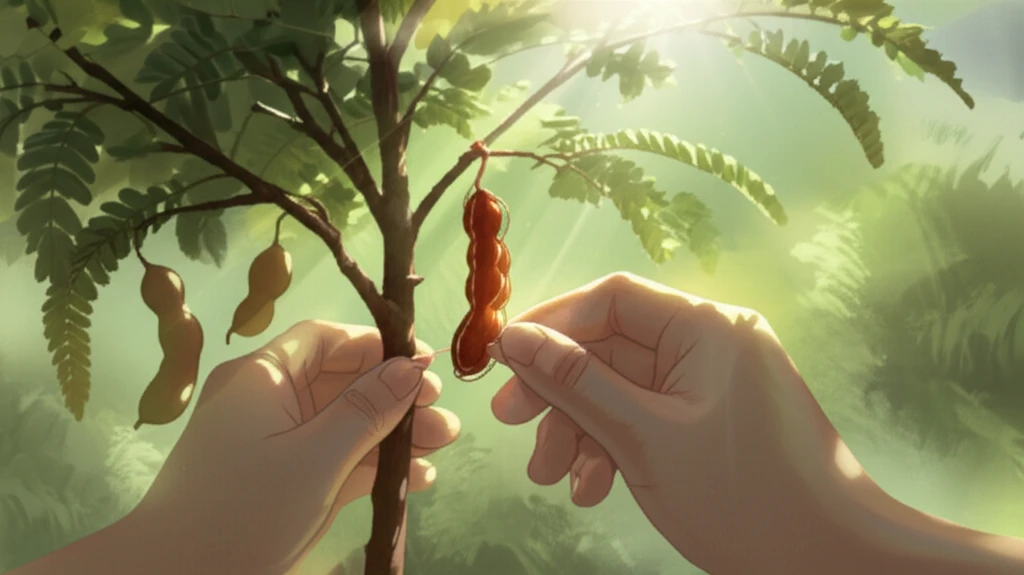
Tamarind Tree Grafting: The Secret to Bountiful Harvests?

"Unlock the potential of your tamarind trees with the right grafting method and learn how to boost your yield today!"
Tamarind (Tamarindus indica L.) is gaining traction in South America, prized for its potential health benefits. However, with limited research on the best growing techniques, cultivating this tropical fruit can be challenging. This article dives into the science of tamarind propagation, offering a practical guide for both novice and experienced growers.
While tamarind trees can be grown from seeds, this often leads to variability in fruit quality, delayed production, and trees that simply grow too large. Grafting, a technique where parts of two plants are joined to grow as one, offers a solution. By selecting superior branches (scions) from high-yielding trees and joining them to hardy rootstocks, you can ensure consistent fruit production, control tree size, and accelerate the time to harvest.
This article translates findings from a study conducted at the Universidade Federal Rural do Semi-Árido (UFERSA) in Brazil, which rigorously tested different grafting methods for tamarind trees. Whether you're a commercial farmer or a backyard gardener, understanding these techniques is key to maximizing your tamarind yield and enjoying consistent results.
Top Grafting Methods for Tamarind: What the Science Says
The UFERSA study compared five different grafting methods to determine which produced the highest success rates in tamarind seedlings. These methods included:
- Top Cleft Grafting: A common technique where the scion is inserted into a split in the top of the rootstock.
- English Top Cleft Grafting (Simple): A variation of cleft grafting with a specific cut and fit.
- English Top Cleft Grafting (Complicated): A more intricate version of the English cleft graft.
- Side Cleft Grafting: The scion is inserted into a slit on the side of the rootstock.
- Plate Budding: A method where a bud is taken from the scion and inserted under the bark of the rootstock.
Maximize Your Tamarind Harvest: Key Takeaways
If you're looking to propagate tamarind trees, focus on top cleft grafting and its English variations. These methods have demonstrated superior success rates in studies, leading to healthier seedlings and potentially higher fruit yields.
While plate budding proved ineffective in the UFERSA study, grafting offers a reliable approach to ensure the perpetuation of superior characteristics and uniform production.
By applying these research-backed techniques, you can take control of your tamarind cultivation, reduce variability, and accelerate your journey toward a bountiful harvest. Embrace grafting and unlock the full potential of your tamarind trees!