
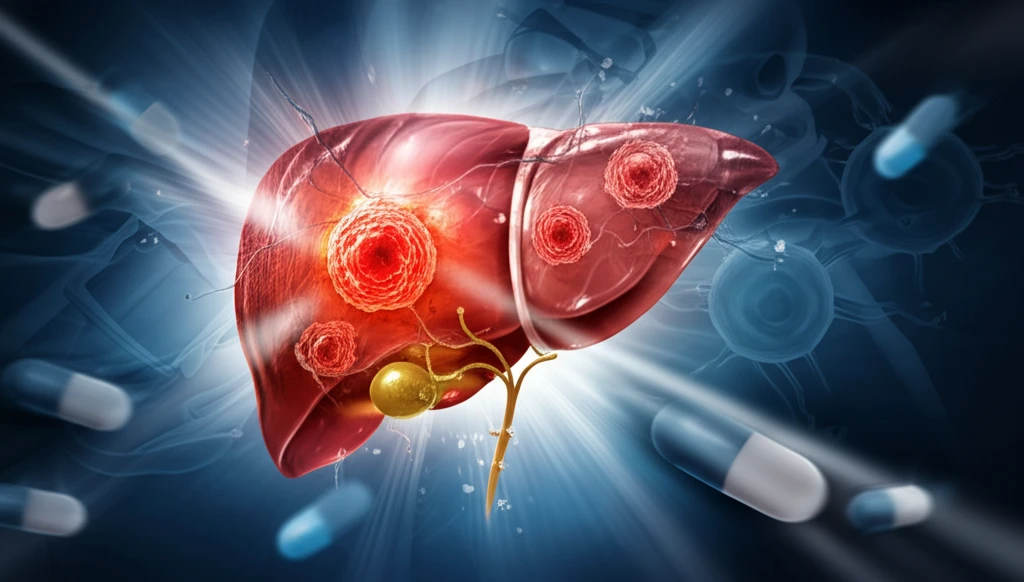
Liver cancer treatment combining chemotherapy and radiofrequency ablation.

TACE vs. cTACE + RFA: Which Liver Cancer Treatment Is Right for You?

"Uncover the facts about conventional chemoembolization (cTACE) and radiofrequency ablation (RFA) for treating early-stage hepatocellular carcinoma."


Hepatocellular carcinoma (HCC), a primary liver cancer, often requires a multi-faceted approach to treatment. Ultrasound (US) is a frequently used guidance for radiofrequency ablation (RFA) in treatment of hepatocellular carcinoma (HCC), but may not always be feasible. For early-stage HCC, where tumors are still relatively small, treatment options range from surgical resection to local ablation techniques. However, when tumors are not easily visible via ultrasound (US-invisible), treatment decisions become more complex.

Conventional transarterial chemoembolization (cTACE) has traditionally been a go-to palliative treatment for inoperable or advanced HCC, with the goal of controlling tumor growth and improving survival. cTACE works by delivering chemotherapy drugs directly into the tumor's blood supply, followed by embolization to block the vessels and starve the cancer cells.

More recently, combination therapies involving cTACE and other local ablation techniques like radiofrequency ablation (RFA) have shown promise. The idea is that cTACE can reduce blood flow to the tumor, making it more susceptible to the effects of RFA. The retention of iodized oil after cTACE also serves as a marker to facilitate targeting an index tumor under fluoroscopic or CT guidance. This study investigates whether combining cTACE with RFA offers a significant advantage over cTACE alone for US-invisible, early-stage HCCs.

cTACE vs. cTACE + RFA: Key Differences and What the Research Shows

Liver cancer treatment combining chemotherapy and radiofrequency ablation.

A study published in the Korean Journal of Radiology compared the outcomes of patients with US-invisible early-stage HCC who received either cTACE alone or cTACE followed by fluoroscopy-guided RFA. The study included 167 patients, with 85 in the cTACE group and 82 in the combined group. Researchers analyzed procedure-related complications, local tumor progression (LTP), time to progression (TTP), and overall survival (OS) to determine the efficacy of each treatment approach.

While both treatments were found to be safe, there were notable differences in the rates of local tumor progression and time to progression:

  • Local Tumor Progression (LTP): The cTACE group had higher 1-, 3-, and 5-year LTP rates compared to the combined group (12.5%, 31.7%, and 37.0% vs. 7.3%, 16.5%, and 16.5%, respectively; p = 0.013). This means that patients who received cTACE alone were more likely to experience tumor recurrence in the treated area.
  • Time to Progression (TTP): The median TTP was longer in the combined group (24 months) compared to the cTACE group (18 months; p = 0.037). This indicates that the combined therapy helped delay tumor progression for a longer period.
  • Overall Survival (OS): There was no significant difference in overall survival rates between the two groups.
The study also identified risk factors for local tumor progression and time to progression. cTACE monotherapy and tumor diameter greater than 20 mm were found to be independent risk factors for both LTP and TTP. This underscores the importance of considering tumor size when determining the appropriate treatment strategy.

Making Informed Treatment Decisions

Ultimately, the decision on whether to pursue cTACE alone or in combination with RFA should be made in consultation with a multidisciplinary team of specialists, including hepatologists, interventional radiologists, and surgeons. Factors to consider include tumor size, location, visibility on ultrasound, and the patient's overall health and preferences. Further research is needed to refine treatment strategies and optimize outcomes for patients with US-invisible, early-stage HCC, in particular, strategies with using fluoroscopy guided approaches and comparing it to fusion imaging modalities.

About this Article -

This article was crafted using a human-AI hybrid and collaborative approach. AI assisted our team with initial drafting, research insights, identifying key questions, and image generation. Our human editors guided topic selection, defined the angle, structured the content, ensured factual accuracy and relevance, refined the tone, and conducted thorough editing to deliver helpful, high-quality information.See our About page for more information.

This article is based on research published under:

DOI-LINK: 10.3348/kjr.2018.19.6.1130, Alternate LINK

Title: Comparison Of Combined Therapy Using Conventional Chemoembolization And Radiofrequency Ablation Versus Conventional Chemoembolization For Ultrasound-Invisible Early-Stage Hepatocellular Carcinoma (Barcelona Clinic Liver Cancer Stage 0 Or A)

Subject: Radiology, Nuclear Medicine and imaging

Journal: Korean Journal of Radiology

Publisher: The Korean Society of Radiology

Authors: Hyukjoon Lee, Chang Jin Yoon, Nak Jong Seong, Sook-Hyang Jeong, Jin-Wook Kim

Published: 2018-01-01

Everything You Need To Know

1

What is the difference between conventional transarterial chemoembolization (cTACE) and radiofrequency ablation (RFA) for treating liver cancer, and how do they work?

Conventional transarterial chemoembolization (cTACE) is a palliative treatment for hepatocellular carcinoma (HCC) that delivers chemotherapy drugs directly to the tumor's blood supply, followed by embolization to block the vessels and starve the cancer cells. Radiofrequency ablation (RFA) is another local ablation technique that uses heat to destroy cancer cells. When combined, cTACE reduces blood flow to the tumor, making it more susceptible to RFA's effects.

2

What did the study in the Korean Journal of Radiology reveal about the effectiveness of combining conventional transarterial chemoembolization (cTACE) and radiofrequency ablation (RFA) compared to using cTACE alone for early-stage HCC?

The study published in the Korean Journal of Radiology showed that patients with US-invisible early-stage HCC who received combined conventional transarterial chemoembolization (cTACE) and radiofrequency ablation (RFA) had lower rates of local tumor progression (LTP) and longer time to progression (TTP) compared to those treated with cTACE alone. However, there was no significant difference in overall survival (OS) between the two groups.

3

Are there any specific risk factors identified that can influence the outcome of conventional transarterial chemoembolization (cTACE) treatment for hepatocellular carcinoma (HCC)?

Yes, a tumor diameter greater than 20 mm and treatment with conventional transarterial chemoembolization (cTACE) alone were identified as independent risk factors for local tumor progression (LTP) and time to progression (TTP). This means that larger tumors and the use of cTACE monotherapy were associated with a higher likelihood of tumor recurrence and faster progression.

4

The study focuses on US-invisible tumors, but what role does ultrasound (US) typically play in the treatment of hepatocellular carcinoma (HCC), especially in the context of radiofrequency ablation (RFA)?

While the study focuses on US-invisible, early-stage hepatocellular carcinoma (HCC), the role of ultrasound (US) in guiding radiofrequency ablation (RFA) is crucial for visible tumors. When tumors are not easily seen on ultrasound, as discussed in the study, fluoroscopy or CT guidance may be used, especially in conjunction with conventional transarterial chemoembolization (cTACE), where iodized oil retention helps target the index tumor. The study suggests a need to explore fusion imaging modalities to improve targeting and outcomes further.

5

What factors should be considered when deciding whether to use conventional transarterial chemoembolization (cTACE) alone or in combination with radiofrequency ablation (RFA) for treating hepatocellular carcinoma (HCC)?

Deciding between conventional transarterial chemoembolization (cTACE) alone versus cTACE combined with radiofrequency ablation (RFA) involves a multidisciplinary team of specialists including hepatologists, interventional radiologists, and surgeons. Factors like tumor size, location, visibility on ultrasound, and the patient's overall health are critical. The study indicates combined therapy may offer better local control and delay progression, but overall survival was not significantly different. Therefore, weighing the benefits against potential risks and considering individual patient circumstances is essential.

Newsletter Subscribe

Subscribe to get the latest articles and insights directly in your inbox.