
T Cell Boosters: How to Supercharge Your Immune System with SEC2 Mutants

"Unlock the secrets of immune cell activation with cutting-edge research on Staphylococcal enterotoxin C2 (SEC2) mutants and their potential in future immunotherapies."
In the relentless pursuit of innovative therapies, scientists are constantly exploring the intricate mechanisms of the immune system. Staphylococcal enterotoxins (SEs), potent superantigens produced by bacteria like Staphylococcus aureus, have emerged as key players in immune response modulation. Among these, Staphylococcal enterotoxin C2 (SEC2) has garnered significant attention for its potential in tumor immunotherapy.
Recent research has focused on engineering SEC2 mutants with enhanced capabilities. One such mutant, ST-4, exhibits superior T lymphocyte activation, paving the way for more effective immunotherapeutic strategies. Understanding how ST-4 interacts with immune cells at the molecular level is crucial for unlocking its full potential.
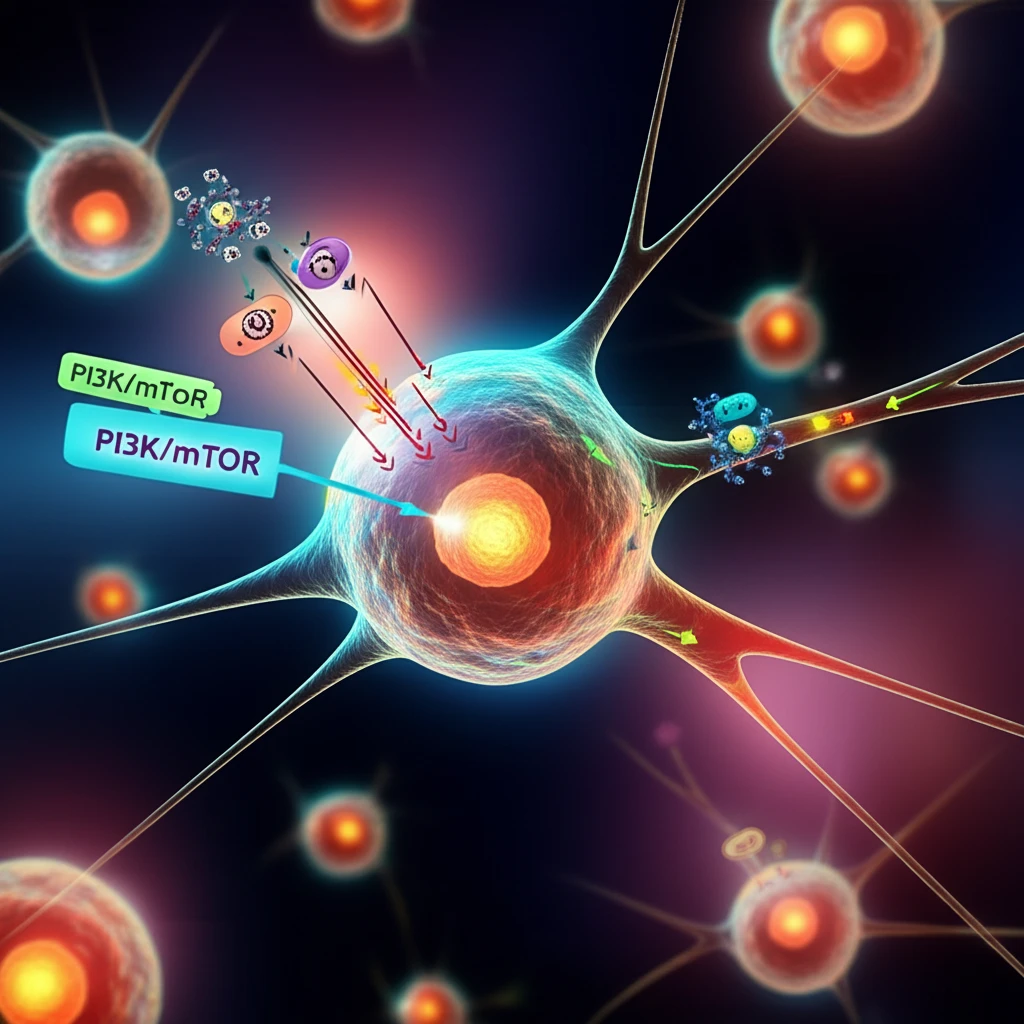
This article delves into the groundbreaking work of Xuanhe Fu and colleagues, who investigated the molecular mechanisms driving ST-4-mediated T lymphocyte activation. Their findings shed light on the pivotal roles of the PI3K/mTOR and NF-κB signaling pathways, offering valuable insights for future immunotherapy development.
T-Cell Activation and Cancer Immunity
The SEC2 mutant ST-4 has been studied for its interaction with T-cell receptor Vβ and its ability to activate T cells through signaling pathways involving PKCθ/NF-κB and IL-2R/STAT5. In one reported splenocyte experiment, ST-4 produced a calcium-response value of 25.3 ± 0.46. Broader cancer-immunotherapy research is using paired single-cell RNA and T-cell-receptor sequencing to examine clonal dynamics, including a 2025 meta-analysis of 767,606 T cells from patients treated with checkpoint immunotherapy. These studies connect CD8+ T-cell transcriptional states with clinical outcomes and reflect the wider goal of using immune-system memory and specificity to eliminate malignant cells.
Current T-Cell Therapy Frameworks
Current T-cell immunotherapy approaches are organized around the cancer-immunity cycle, including tumor-antigen recognition, T-cell activation, trafficking and infiltration into tumors, and target-cell killing. Recent reviews emphasize precision immunotherapy and the integration of multi-omics data to improve T-cell functionality and specificity. However, reported barriers include tumor heterogeneity, an immunosuppressive tumor microenvironment, inadequate generation or function of tumor-specific CD8+ T cells, limited suitable neoantigens, impaired antigen processing and presentation, and epigenetic modifications. These limitations can lead to ineffective T-cell activation and restrict clinical translation.
TCR and LCK Foundations
The T-cell receptor and the Src-family kinase LCK are presented as foundational components of T-cell activation. Research on their signaling potential has helped establish a mechanistic basis for therapeutic innovation. In cancer immunotherapy, this foundation supports efforts to harness TCR signaling for antitumor responses. The cited review places these molecular pathways within the broader development of T-cell-directed cancer treatment.
Decoding ST-4's Supercharged Activation of T Lymphocytes
The study by Fu et al. uncovers the specific mechanisms by which the SEC2 mutant ST-4 stimulates T lymphocytes, essential components of the adaptive immune system. Unlike conventional antigens that require processing by antigen-presenting cells (APCs), superantigens like SEC2 and ST-4 directly bind to major histocompatibility complex (MHC) class II molecules on APCs and T-cell receptors (TCRs). This interaction triggers a powerful immune response, characterized by the activation and proliferation of T cells and the release of cytokines.
- Enhanced T Cell Activation: ST-4 significantly boosts T lymphocyte activation compared to its parent molecule, SEC2.
- PI3K/mTOR Pathway Activation: ST-4 intensifies the PI3K/mTOR signaling pathway, promoting cell growth and proliferation.
- NF-κB Pathway Activation: ST-4 enhances the NF-κB signaling pathway, which regulates cytokine production and immune response.
- IL-2 Secretion: ST-4 promotes the secretion of interleukin-2 (IL-2), a critical cytokine for T cell growth and differentiation.
SEC2 Mutants and CD8+ T-Cell Metabolism
A study of the SEC2 mutant ST-4 examined fatty-acid and mitochondrial-energy metabolic programs associated with CD8+ T-cell activation. The reported findings showed that ST-4, but not SEC2, induced proliferation of purified CD8+ T cells from BALB/c mice in Vβ8.2- and Vβ8.3-specific patterns. Another cited study investigated low-dose SEC2 mutant treatment in relation to bone homeostasis and host T-cell effector immunity. Its authors stated that larger-animal models and clinical trials are still needed to verify the findings.
Mechanistic Promise and Translational Limits
Research on SEC2/ST-4 reports induction of lymphocyte proliferation, CD69 and CD25 expression, and IL-2 secretion through PI3K/mTOR and NF-κB signaling. The same source reports that pathway inhibitors reversed induced molecular changes and that ST-4 showed higher efficiency than SEC2 in these pathways. However, an antitumor study reported that tumor-growth inhibition unexpectedly fell to 41.2% at a dose of 20 mg/kg. More broadly, T-cell dysfunction associated with terminal differentiation, exhaustion, senescence, and activation-induced cell death can limit adoptive immunotherapy, so pathway activation alone does not establish durable therapeutic effectiveness.
Different Ways to Mobilize T Cells
Cancer immunotherapy has developed through roughly 50 years of active immunological research and has achieved clinical success. T-cell activation depends on antigenic peptides; their absence can produce incomplete activation and tolerance, while CTLA-4 and PD-1 provide inhibitory signals that restrain activation. Conventional immunotherapy generally boosts or guides immune responses with medicines, whereas CAR-T therapy involves removing T cells, modifying them in a laboratory, and returning them to the patient. Newer T-cell engager strategies are being compared with CAR-T therapy across efficacy, safety, toxicity, resistance, and cost, with approaches such as CD3-affinity tuning and tumor-selective activation proposed to improve specificity.
Future Directions and Therapeutic Implications
This research provides a solid foundation for the development of ST-4-based immunotherapies. By understanding how ST-4 manipulates key signaling pathways in T lymphocytes, scientists can design targeted strategies to enhance immune responses against cancer and other diseases. The intensified PI3K/mTOR and NF-κB signaling transduction induced by ST-4 offers a promising avenue for stimulating T cell activity and improving therapeutic outcomes. Further research is needed to fully explore ST-4's potential and translate these findings into clinical applications.
Beyond T-Cell Activation
Recent work identifies mechanotransduction as a potential way to enhance activation of antigen-presenting cells and T cells in cancer treatment. In mouse models, immunotherapy-induced intratumoral CD8+ T cells recruited nearby macrophages through CCR5 signaling and promoted their differentiation toward a late-stage activated M1-like phenotype. These macrophages were associated with effective tumor control in the mouse models and with clinical responses in humans. Together, the cited research presents T-cell therapy as an interaction involving immune-cell activation, local cellular communication, and tumor-microenvironment responses.
The Wider Risks of Immune Stimulation
Staphylococcal enterotoxin B and related superantigenic toxins can cause disease in humans and laboratory animals by activating immune-system cells. This context is important when considering immune-stimulating approaches based on enterotoxin-derived molecules. Separately, reviews of T-cell cancer immunotherapy identify barriers across the cancer-immunity cycle, including tumor-antigen recognition, T-cell trafficking and tumor infiltration, and killing of target cells. These findings indicate that stronger immune activation must be considered alongside specificity, tissue access, and the potential consequences of systemic immune stimulation.