
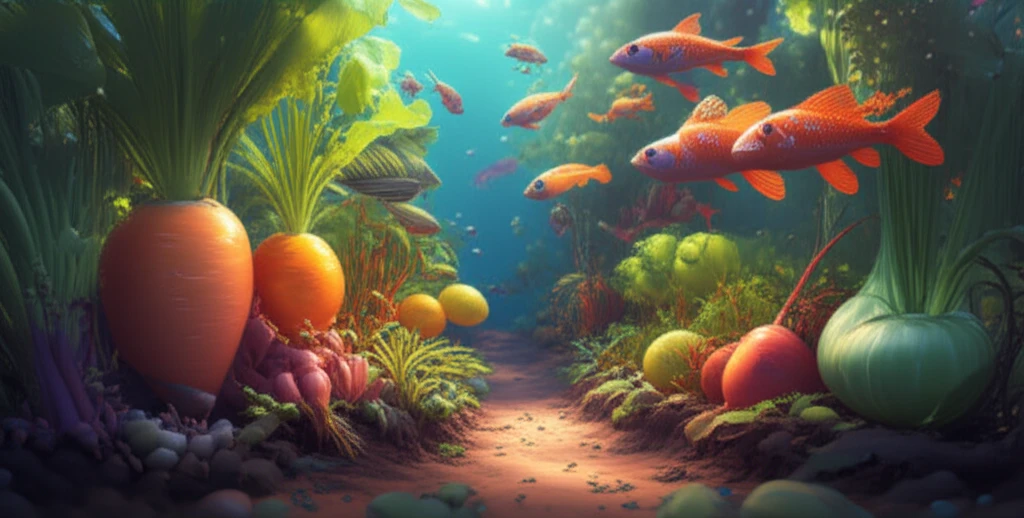
Sustainable Fish Feed: Can Vegetable-Based Diets Replace Fish Meal?

"Exploring the Potential of Extrusion Technology to Create Nutritious and Environmentally Friendly Fish Feed"
Aquaculture, the farming of aquatic organisms, is a rapidly growing industry crucial for meeting the increasing global demand for seafood. Traditional fish feed relies heavily on fish meal, a product derived from wild-caught fish. However, the use of fish meal raises sustainability concerns due to its impact on marine ecosystems and the finite nature of fish stocks. As a result, researchers and producers are actively seeking alternative, more sustainable ingredients for fish feed.
Vegetable-based diets have emerged as a promising alternative to fish meal. They offer a readily available and potentially more environmentally friendly source of nutrients for farmed fish. However, simply replacing fish meal with vegetable matter isn't enough. The nutritional composition and physical properties of the feed must be carefully optimized to ensure the fish receive adequate nutrition and the feed is palatable and digestible.
This article explores the optimization of single-screw extrusion process for producing fish feeds based on vegetable meals. Extrusion technology offers a means to transform raw vegetable ingredients into a palatable, digestible, and nutritionally balanced feed. Moreover, we’ll examine the nutritional effects of these extruded vegetable-based feeds on juvenile pacu, a commercially important fish species in South America, providing a case study for the potential of this approach.
Extrusion: The Key to Unlocking Vegetable-Based Fish Feed
Extrusion is a process where raw materials are forced through a die under pressure and heat. In the context of fish feed, extrusion cooking offers several advantages. It can improve the digestibility of vegetable proteins, enhance the palatability of the feed, and create a product with desirable physical characteristics, such as buoyancy and water stability. The research optimizes this process to create fish feed using corn meal, soybean meal, and bovine plasma protein concentrate. The aim was to maximize expansion and floatability while minimizing bulk density and water solubility.
- Expansion: Higher expansion was achieved at intermediate temperatures and low moisture levels.
- Bulk Density: The lowest bulk density was observed at specific temperature and moisture combinations, indicating a more porous and digestible feed.
- Water Absorption Index (WAI): WAI increased with temperature up to a certain point and decreased with higher moisture content.
- Water Solubility Index (WSI): WSI was inversely related to moisture content.
- Floatability: Maximum floatability was achieved at intermediate temperature and moisture levels.
The Future of Fish Farming: Sustainable and Nutritious
This research demonstrates that vegetable-based diets can effectively replace fish meal in aquaculture, offering a more sustainable and environmentally responsible approach to fish farming. By optimizing the extrusion process, it's possible to create feeds that not only meet the nutritional needs of farmed fish but also possess desirable physical properties for efficient feeding and reduced waste.
While this study focused on pacu, the principles and techniques can be applied to other commercially important fish species. Further research is needed to fine-tune the formulations and extrusion parameters for different fish types and to assess the long-term effects of vegetable-based diets on fish health and welfare.
The transition to sustainable fish feed is essential for the long-term viability of the aquaculture industry and the health of our oceans. By embracing innovative technologies and exploring alternative ingredients, we can ensure a future where fish farming contributes to, rather than detracts from, the sustainability of our planet's ecosystems.