
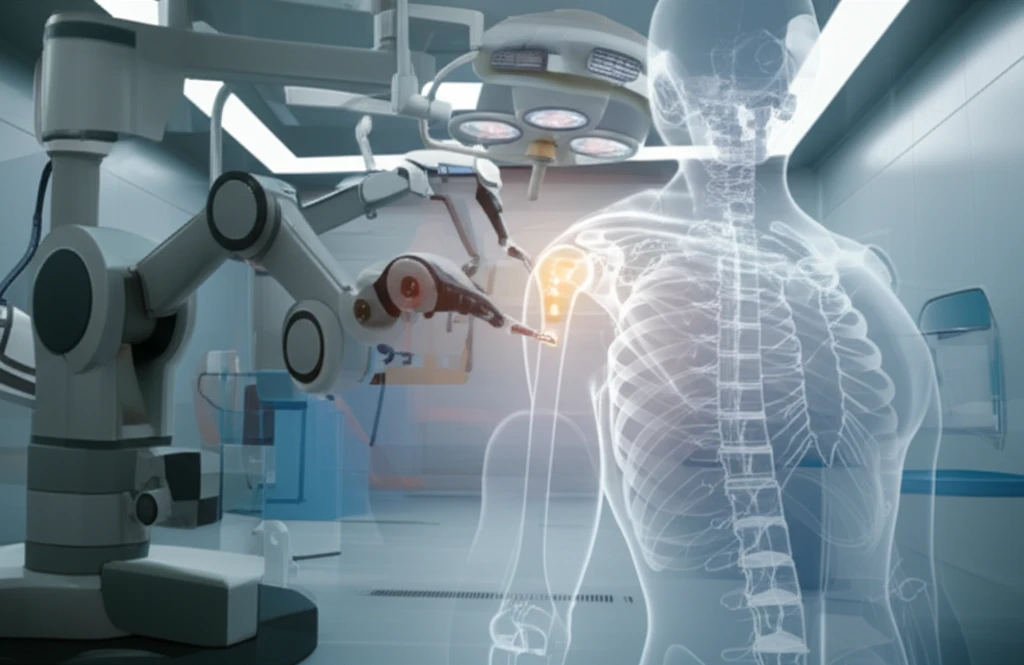
Futuristic operating room with robotic arm performing precise shoulder implant surgery.

Surgical Precision: How Personalized Guides are Revolutionizing Shoulder Replacements

"Discover how patient-specific instrumentation (PSI) is enhancing the accuracy of glenoid component placement in reverse shoulder arthroplasty, leading to better outcomes."


Reverse shoulder arthroplasty has become a game-changer for individuals suffering from cuff tear arthropathy and other complex shoulder conditions. While this procedure offers significant pain relief and improved function, the precise placement of the glenoid component (the socket part of the artificial joint) is critical for long-term success. Even slight misalignments can lead to instability, increased wear, and the need for revision surgery.

Traditionally, surgeons have relied on standard instruments and their expertise to position the glenoid component. However, anatomical variations and complexities can make it challenging to achieve optimal placement consistently. This is where patient-specific instrumentation (PSI) comes into play.

Recent research has explored the use of PSI – customized surgical guides created from a patient's own CT scans – to improve the accuracy of glenoid component placement. This article dives into a detailed study that investigates the precision of these guides in reverse shoulder arthroplasty, offering insights into how this technology is transforming the field.

Precision Perfected: How Patient-Specific Guides Enhance Shoulder Replacement Accuracy

Futuristic operating room with robotic arm performing precise shoulder implant surgery.

A groundbreaking study published in the journal Revue de chirurgie orthopédique et traumatologique evaluated the accuracy of PSI guides in assisting surgeons with glenoid component placement during reverse shoulder arthroplasty. The study involved 32 patients undergoing the procedure, with surgeons using PSI guides designed from each patient's unique 3D imaging.

The research team meticulously compared the planned position of the glenoid component (based on pre-operative 3D planning) with the actual position achieved during surgery using the PSI guides. They assessed key parameters such as version (rotation), inclination (tilt), entry point, and screw angulation. Here's what they discovered:

  • Version Accuracy: The average difference between planned and actual version was only 4.4 degrees, with 63% of cases falling within 5 degrees of the intended position.
  • Inclination Accuracy: The average inclination deviation was 5.0 degrees, with 59% of cases achieving placement within 5 degrees of the planned inclination.
  • Entry Point Precision: The entry point of the glenoid component varied by an average of just 2.4mm from the planned location.
  • Screw Angulation: The angles of the screws used to fix the glenoid component were also highly accurate, with the majority of cases showing minimal deviation from the planned trajectory.
These findings demonstrate that PSI guides can significantly improve the precision of glenoid component placement in reverse shoulder arthroplasty. By using these customized guides, surgeons can more closely replicate the pre-operative plan, leading to potentially better outcomes for patients.

The Future of Shoulder Replacement: Personalized Precision

The study's results suggest that patient-specific instrumentation holds immense promise for enhancing the accuracy and consistency of shoulder replacement surgery. By addressing the challenges associated with traditional techniques, PSI guides have the potential to reduce the risk of complications, improve implant longevity, and ultimately lead to better patient outcomes.

While this research provides compelling evidence for the benefits of PSI, it's important to note that the technology is not meant to replace the surgeon's skill and judgment. Successful implementation requires careful pre-operative planning, a thorough understanding of shoulder anatomy, and the ability to adapt to unforeseen circumstances during surgery.

As technology continues to advance, we can expect to see even more sophisticated PSI systems emerge, further refining the precision and personalization of shoulder replacement procedures. This evolution promises a future where every patient receives a customized surgical approach, tailored to their unique anatomy and needs, ultimately leading to improved function and a better quality of life.

About this Article -

This article was crafted using a human-AI hybrid and collaborative approach. AI assisted our team with initial drafting, research insights, identifying key questions, and image generation. Our human editors guided topic selection, defined the angle, structured the content, ensured factual accuracy and relevance, refined the tone, and conducted thorough editing to deliver helpful, high-quality information.See our About page for more information.

Everything You Need To Know

1

What is Patient-specific instrumentation (PSI), and why is it important?

Patient-specific instrumentation (PSI) are customized surgical guides created from a patient's own CT scans. These guides are designed to enhance the precision of glenoid component placement during reverse shoulder arthroplasty. Their significance lies in their ability to address the limitations of traditional surgical techniques, where anatomical variations can make optimal component placement challenging. The use of PSI guides can reduce the risk of complications, improve implant longevity, and lead to better patient outcomes.

2

What is reverse shoulder arthroplasty, and why is precise glenoid component placement crucial?

The reverse shoulder arthroplasty is a surgical procedure designed for individuals with cuff tear arthropathy and other complex shoulder conditions. In this procedure, the glenoid component, which is the socket part of the artificial joint, is precisely placed. The significance of accurate placement is paramount because slight misalignments can lead to instability, increased wear, and the need for revision surgery. This procedure provides significant pain relief and improved function.

3

What were the key findings of the study regarding the accuracy of Patient-specific instrumentation (PSI) in reverse shoulder arthroplasty?

The study found that using Patient-specific instrumentation (PSI) significantly improved the accuracy of the glenoid component placement. The average difference between planned and actual version was only 4.4 degrees, with 63% of cases falling within 5 degrees of the intended position. The average inclination deviation was 5.0 degrees, with 59% of cases achieving placement within 5 degrees of the planned inclination. The entry point of the glenoid component varied by an average of just 2.4mm from the planned location, and the angles of the screws used to fix the glenoid component showed minimal deviation from the planned trajectory. These results demonstrate that PSI guides enhance the precision of reverse shoulder arthroplasty.

4

What are the critical parameters evaluated in the study to assess the accuracy of glenoid component placement?

The key parameters assessed in the study include version (rotation), inclination (tilt), entry point, and screw angulation. These parameters are critical because they directly influence the stability and longevity of the reverse shoulder arthroplasty. Version and inclination relate to the orientation of the glenoid component, affecting how the shoulder joint functions. The entry point and screw angulation are vital for ensuring the component is securely fixed to the bone. The precision in these parameters is enhanced by using Patient-specific instrumentation (PSI).

5

What are the implications of using Patient-specific instrumentation (PSI) in reverse shoulder arthroplasty?

The implications of using Patient-specific instrumentation (PSI) are substantial. By enhancing the accuracy of glenoid component placement in reverse shoulder arthroplasty, PSI has the potential to reduce the risk of complications. This leads to improved implant longevity. Ultimately, the application of PSI results in better patient outcomes, including reduced pain, improved shoulder function, and a decreased likelihood of needing revision surgery. This technological advancement represents a significant step toward more personalized and effective shoulder replacement procedures.

Newsletter Subscribe

Subscribe to get the latest articles and insights directly in your inbox.