
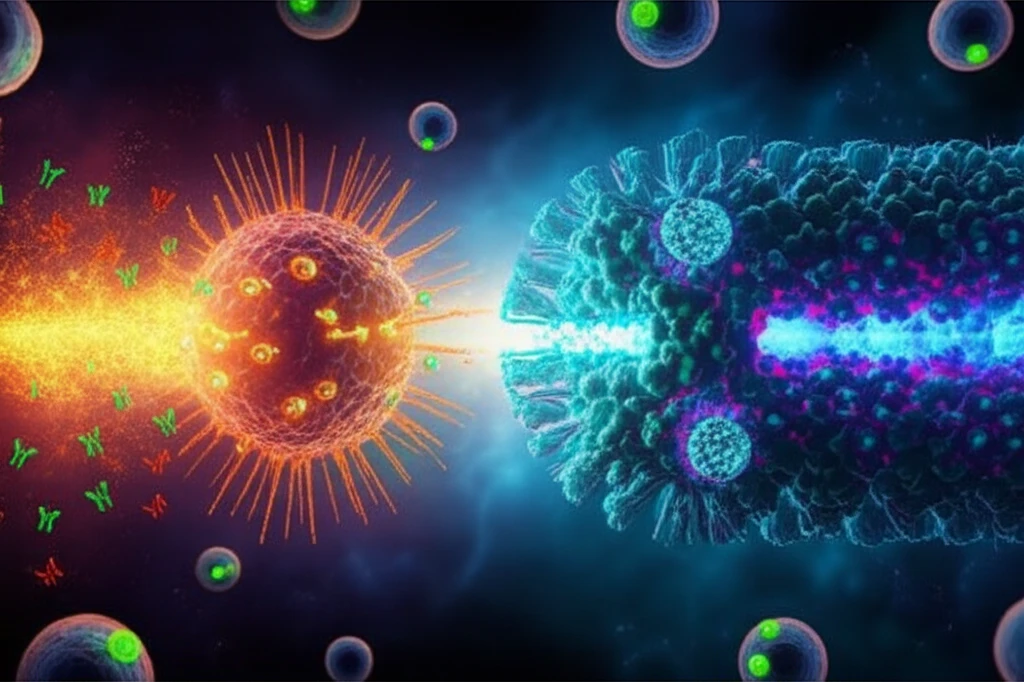
Molecular fusion enhancing immune response in TB vaccine development.

Supercharge TB Vaccines: How Molecular Fusion Could Enhance Immunogenicity

"New research explores how fusing a tuberculosis antigen to an oligomerization domain significantly boosts immune responses in both mice and non-human primates, offering a promising strategy for improved vaccine development."


Tuberculosis (TB), malaria, and HIV remain significant global health challenges, underscoring the urgent need for more effective vaccines. The key lies in stimulating robust T cell responses, which are crucial for combating these intracellular pathogens. Viral-vectored vaccines have shown promise, but enhancing their ability to trigger strong and lasting immunity is essential.

A novel approach involves the use of adjuvants—substances that boost the immune response. Recent studies have focused on oligomerization domains, protein structures that can enhance immune responses. One such domain, IMX313, derived from avian complement 4 binding protein (C4bp), has demonstrated potential in increasing both B and T cell responses in preclinical models.

This article explores groundbreaking research into fusing the Mycobacterium tuberculosis antigen 85A to the IMX313 adjuvant. This fusion aims to enhance T cell responses in preclinical models, offering a promising strategy to improve vaccine immunogenicity. The study’s findings in both mice and non-human primates could pave the way for more effective vaccines against TB and other infectious diseases.

Unlocking Enhanced Immunogenicity: The Science Behind Antigen Fusion

Molecular fusion enhancing immune response in TB vaccine development.

The study published in PLOS One, investigates whether fusing Mycobacterium tuberculosis antigen 85A to IMX313, a hybrid avian C4bp oligomerization domain, could amplify T cell responses. IMX313 was selected for its unique ability to induce high antibody titers without significant sequence homology to human C4bp, potentially minimizing safety concerns in human applications.

Researchers conducted experiments in mice and rhesus macaques to assess the impact of this fusion on immune responses. The antigen 85A was chosen because it is a primary component in current vaccine development, specifically the modified vaccinia virus Ankara (MVA)-Ag85A, which is being clinically tested for boosting T cell responses to BCG vaccination.

  • Mice Studies: Fusing antigen 85A to IMX313 resulted in consistent increases in both CD4+ and CD8+ T cell responses following DNA and MVA vaccination. This indicates a quantitative enhancement of the immune response.
  • Non-Human Primate Studies: Rhesus macaques vaccinated with MVA-Ag85A IMX313 showed higher IFN-γ responses after primary and secondary immunizations. This suggests a sustained improvement in immune recognition.
  • Multifunctional Enhancement: The fusion to IMX313 uniformly increased multifunctional cytokine production and augmented differentiation into effector and memory T cell subsets. This shows enhanced immune response breadth without skewing towards a specific T cell type.
  • Early Immune Response Initiation: In vivo characterization revealed that IMX313 improves the initiation of immune responses, with an increase in antigen 85A-specific cells observed as early as day 3 after vaccination. This points to a swift and effective immune activation process.
These findings highlight that IMX313 acts as a potent adjuvant by enhancing the presentation and recognition of the antigen, thereby boosting the overall immune response. The consistent results across different animal models underscore the potential of this method for broad applicability in vaccine development.

Future Directions: Broadening the Horizon for Vaccine Innovation

The research demonstrates that antigen multimerization using IMX313 is a simple and effective method to improve vaccine immunogenicity across species. This approach enhances both the magnitude and breadth of the immune response without compromising its quality, making it a promising candidate for further vaccine development.

Future studies are planned to directly compare MVA-Ag85A with MVA-Ag85A IMX313 in human trials to confirm the preclinical results and assess the safety and efficacy of this enhanced vaccine. Understanding the mechanisms by which IMX313 enhances antigen presentation and immune cell activation will be crucial for optimizing its use in future vaccines.

By continuing to explore novel adjuvant strategies like IMX313, scientists can pave the way for more effective vaccines against TB and other infectious diseases, ultimately contributing to improved global health outcomes. The modular nature of this technology allows it to be adapted for a wide variety of pathogens and vaccine platforms, making it a valuable tool in the ongoing fight against infectious diseases.

About this Article -

This article was crafted using a human-AI hybrid and collaborative approach. AI assisted our team with initial drafting, research insights, identifying key questions, and image generation. Our human editors guided topic selection, defined the angle, structured the content, ensured factual accuracy and relevance, refined the tone, and conducted thorough editing to deliver helpful, high-quality information.See our About page for more information.

This article is based on research published under:

DOI-LINK: 10.1371/journal.pone.0033555, Alternate LINK

Title: Fusion Of The Mycobacterium Tuberculosis Antigen 85A To An Oligomerization Domain Enhances Its Immunogenicity In Both Mice And Non-Human Primates

Subject: Multidisciplinary

Journal: PLoS ONE

Publisher: Public Library of Science (PLoS)

Authors: Alexandra J. Spencer, Fergal Hill, Jared D. Honeycutt, Matthew G. Cottingham, Migena Bregu, Christine S. Rollier, Julie Furze, Simon J. Draper, Karen C. Søgaard, Sarah C. Gilbert, David H. Wyllie, Adrian V. S. Hill

Published: 2012-03-28

Everything You Need To Know

1

What was the focus of the study on TB vaccines, and what was its main goal?

The study focused on fusing the Mycobacterium tuberculosis antigen 85A to the IMX313 adjuvant. This fusion was tested in mice and rhesus macaques to observe its impact on T cell responses, which are vital for fighting TB. The goal was to enhance the effectiveness of vaccines against tuberculosis by improving the immune system's ability to recognize and respond to the antigen.

2

What is IMX313, and why is it significant in vaccine development?

IMX313 is an oligomerization domain derived from avian complement 4 binding protein (C4bp). It's used as an adjuvant because it can enhance immune responses by increasing both B and T cell activity. A key feature of IMX313 is its ability to induce high antibody titers without significant sequence homology to human C4bp, which may reduce potential safety concerns in human applications.

3

What specific results were observed in animal studies when Mycobacterium tuberculosis antigen 85A was fused to the IMX313 adjuvant?

The fusion of Mycobacterium tuberculosis antigen 85A to the IMX313 adjuvant showed that it consistently increased both CD4+ and CD8+ T cell responses in mice following DNA and MVA vaccination. In rhesus macaques, vaccination with MVA-Ag85A IMX313 led to higher IFN-γ responses after primary and secondary immunizations. Furthermore, the fusion enhanced multifunctional cytokine production and augmented differentiation into effector and memory T cell subsets.

4

What are the potential implications of enhancing T cell responses using the fusion of Mycobacterium tuberculosis antigen 85A and the IMX313 adjuvant?

The enhancement of T cell responses through the fusion of Mycobacterium tuberculosis antigen 85A to the IMX313 adjuvant can lead to the development of more effective vaccines against tuberculosis and potentially other infectious diseases. By improving the magnitude, breadth, and quality of the immune response, vaccines may provide longer-lasting and more robust protection. This approach could also be applied to other vaccines to enhance their immunogenicity.

5

How does antigen multimerization using IMX313 enhance vaccine effectiveness, and what future research could build upon these findings?

This method uses IMX313 to improve vaccine immunogenicity across different species, as shown in studies involving mice and non-human primates. This enhancement doesn't compromise the quality of the immune response, making it a promising candidate for vaccine development. Future research could explore its application with different antigens and in various vaccine platforms to broaden its impact on global health challenges like TB, malaria, and HIV.

Newsletter Subscribe

Subscribe to get the latest articles and insights directly in your inbox.