
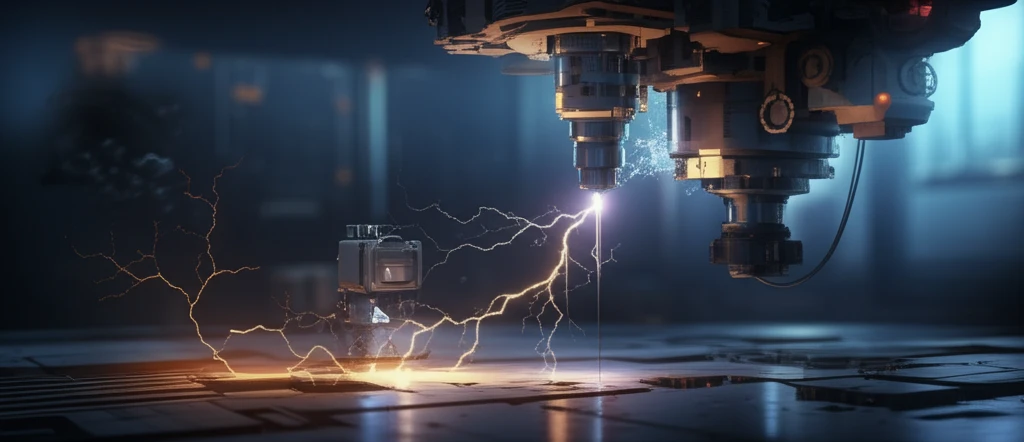
Microscopic view of powder particles enhancing EDM process

Supercharge Manufacturing: How Powder-Mixed EDM Can Revolutionize Your Workshop

"Unlock precision and efficiency with Powder-Mixed Electro Discharge Machining (PMEDM). Discover how this innovative technique optimizes performance and reduces costs."


In the world of modern manufacturing, precision and efficiency are paramount. Among the various nonconventional machining processes available, electro discharge machining (EDM) stands out as a popular and highly successful technique. EDM is based on an electro-thermal process, using electrical energy to generate sparks that remove molten metal from the workpiece. While conventional EDM methods have their advantages, they also come with certain drawbacks.

To address these limitations, hybrid EDM techniques have emerged, with powder-mixed EDM (PMEDM) being one of the most promising. PMEDM involves mixing electrically conductive powder into the dielectric fluid to enhance machining efficiency and surface finish. This innovative approach has garnered significant attention from researchers and industry professionals alike.

This article delves into the world of PMEDM, exploring its benefits, optimization strategies, and potential applications. We'll break down the complexities of this advanced machining technique, making it accessible and understandable for both seasoned engineers and curious newcomers.

What is Powder-Mixed Electro Discharge Machining (PMEDM)?

Microscopic view of powder particles enhancing EDM process

Powder-Mixed Electro Discharge Machining (PMEDM) is a cutting-edge hybrid machining process that enhances traditional EDM by introducing electrically conductive powder into the dielectric fluid. This seemingly simple modification has profound effects on the machining process, leading to improved material removal rates, reduced tool wear, and enhanced surface finish. Let's explore the key benefits that PMEDM offers:

The addition of powder to the dielectric fluid creates a more conductive environment, allowing for more efficient spark generation and material removal. This results in:

  • Increased Material Removal Rate (MRR): PMEDM significantly boosts the amount of material removed per unit of time, accelerating the machining process.
  • Reduced Tool Wear Rate (TWR): The powder particles help to distribute the spark energy more evenly, minimizing wear and tear on the tool electrode.
  • Improved Surface Finish (Ra): The presence of powder particles promotes a smoother and more uniform surface texture on the workpiece.
A study published in "Decision Science Letters" investigated the optimization of PMEDM using response surface methodology coupled with a fuzzy-based desirability function approach. The researchers focused on machining AISI 304 stainless steel with silicon carbide powder mixed into kerosene dielectric. Their findings highlighted the significant impact of PMEDM on achieving optimal machining performance.

Transform Your Manufacturing with PMEDM

Powder-Mixed Electro Discharge Machining (PMEDM) represents a significant advancement in manufacturing technology, offering a powerful solution for enhancing precision, efficiency, and cost-effectiveness. By understanding the principles and optimization strategies behind PMEDM, manufacturers can unlock its full potential and revolutionize their workshops. Whether you're working with hard-to-machine materials or striving for superior surface finishes, PMEDM provides the tools and techniques to achieve exceptional results.

About this Article -

This article was crafted using a human-AI hybrid and collaborative approach. AI assisted our team with initial drafting, research insights, identifying key questions, and image generation. Our human editors guided topic selection, defined the angle, structured the content, ensured factual accuracy and relevance, refined the tone, and conducted thorough editing to deliver helpful, high-quality information.See our About page for more information.

Everything You Need To Know

1

What exactly is Powder-Mixed Electro Discharge Machining (PMEDM) and how does it differ from conventional EDM?

Powder-Mixed Electro Discharge Machining (PMEDM) is an enhanced version of traditional Electro Discharge Machining (EDM). It introduces electrically conductive powder into the dielectric fluid. Unlike conventional EDM, which relies solely on the electro-thermal process, PMEDM leverages the powder to create a more conductive environment. This modification improves material removal rates, reduces tool wear, and enhances the surface finish of the workpiece. Conventional EDM might struggle with these aspects, particularly when machining hard materials or aiming for very fine surface textures.

2

In what ways does adding powder to the dielectric fluid in PMEDM actually improve the machining process?

The addition of electrically conductive powder to the dielectric fluid in Powder-Mixed Electro Discharge Machining (PMEDM) has a few key benefits. First, it increases the material removal rate (MRR) by creating a more conductive environment for spark generation. Second, the powder helps to distribute spark energy more evenly, which leads to a reduced tool wear rate (TWR). Finally, the presence of these particles also promotes a smoother, more uniform surface finish (Ra) on the workpiece. These three factors make PMEDM a much more efficient machining process.

3

What are the main advantages of using Powder-Mixed Electro Discharge Machining (PMEDM) in a manufacturing workshop?

Powder-Mixed Electro Discharge Machining (PMEDM) offers several key advantages for manufacturers. It enhances precision, improves efficiency, and can be more cost-effective compared to traditional methods. Specifically, PMEDM increases the material removal rate, reduces tool wear, and enhances the surface finish. This makes it especially useful for hard-to-machine materials, where it provides the tools and techniques necessary to achieve exceptional results. By optimizing processes with PMEDM, workshops can see a transformative improvement in their manufacturing capabilities.

4

What considerations are important when optimizing Powder-Mixed Electro Discharge Machining (PMEDM) for specific materials, such as AISI 304 stainless steel?

Optimizing Powder-Mixed Electro Discharge Machining (PMEDM) for materials like AISI 304 stainless steel requires careful consideration of several factors. A study cited used silicon carbide powder mixed into kerosene dielectric, highlighting the importance of selecting appropriate powder materials and dielectric fluids. Response surface methodology coupled with a fuzzy-based desirability function approach can be used to identify optimal parameter settings. Factors such as pulse-on time, pulse-off time, discharge current, and powder concentration need to be tuned to achieve the best material removal rate, tool wear rate, and surface finish for the specific material. These parameters interact in complex ways, so a systematic optimization approach is essential.

5

How can a manufacturing workshop integrate Powder-Mixed Electro Discharge Machining (PMEDM) to revolutionize its machining process?

Integrating Powder-Mixed Electro Discharge Machining (PMEDM) requires a strategic approach. First, assess current machining limitations and identify processes where PMEDM's benefits, such as increased material removal rate, reduced tool wear, and improved surface finish, can have the most impact. Begin by experimenting with different powder types (e.g., silicon carbide) and dielectric fluids to determine the optimal combination for specific materials like AISI 304 stainless steel. Use methodologies, like response surface methodology, to fine-tune process parameters, and invest in training for operators to maximize PMEDM's potential. Continuous monitoring and optimization, based on performance data, will drive long-term improvements and ensure PMEDM effectively revolutionizes the machining process.

Newsletter Subscribe

Subscribe to get the latest articles and insights directly in your inbox.