
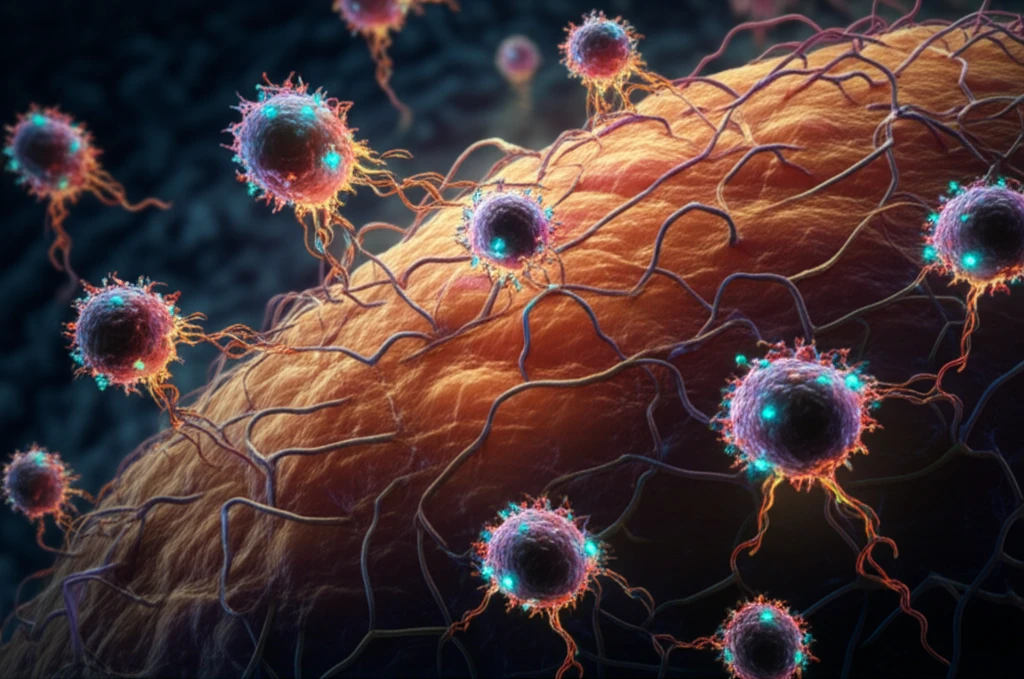
Illustration of nanoparticles attacking drug-resistant bacteria.

Superbugs vs. Super-Solutions: How Nanotech is Revolutionizing Antibiotic Warfare

"Scientists are deploying microscopic 'soldiers' to outsmart drug-resistant bacteria and save lives."


Antibiotic resistance is no longer a distant threat; it's a present-day reality. Every year, millions of people worldwide contract infections that are increasingly difficult, if not impossible, to treat. The overuse and misuse of antibiotics have fueled the evolution of "superbugs" – bacteria that have become impervious to the drugs we rely on to fight them. This crisis demands innovative solutions, and scientists are turning to a surprising ally: nanotechnology.

Nanotechnology, the manipulation of matter on an atomic and molecular scale, is providing new avenues for drug delivery and treatment. Tiny particles, measured in nanometers (billionths of a meter), are being engineered to target and destroy drug-resistant bacteria. This article explores the cutting-edge research that is revolutionizing how we fight infections, offering a glimpse into the future of medicine.

The core of the problem lies in the bacteria's ability to adapt and evolve. They develop resistance mechanisms, such as producing enzymes that break down antibiotics or building biofilms that shield them from the drugs. Traditional antibiotics often struggle to penetrate these defenses, allowing infections to persist and spread. Nanotechnology offers a targeted approach, allowing scientists to design treatments that can overcome these barriers.

The Nanotech Arsenal: Tiny Weapons Against Mighty Foes

Illustration of nanoparticles attacking drug-resistant bacteria.

Nanotechnology offers several advantages in the fight against antibiotic resistance. One key approach is the development of nanoparticles that can deliver antibiotics directly to the site of infection. These nanoparticles can be designed to penetrate biofilms, release drugs in a controlled manner, and even overcome bacterial resistance mechanisms. These advanced drug delivery systems are changing the game.

One of the most promising strategies involves creating nanoparticles that act as "Trojan horses." These particles carry antibiotics and other antibacterial agents, like enzyme inhibitors, directly to the bacteria. The nanoparticles are often designed to be smaller than the bacteria themselves, allowing them to slip past the bacteria's defenses. Once inside, the nanoparticles release their payload, effectively killing the bacteria.

  • Targeted Delivery: Nanoparticles can be engineered to target specific bacteria or areas of infection, minimizing harm to healthy cells.
  • Enhanced Penetration: Nanoparticles can penetrate biofilms and other bacterial barriers, allowing drugs to reach their targets.
  • Controlled Release: Nanoparticles can release drugs in a controlled manner, ensuring a consistent concentration of the drug over time.
  • Overcoming Resistance: Nanoparticles can be designed to overcome bacterial resistance mechanisms, such as enzyme production or efflux pumps.
Researchers are also developing nanoparticles that have intrinsic antibacterial properties. These nanoparticles, made from materials like silver or copper, can directly kill bacteria. They can also be combined with antibiotics to enhance their effectiveness. This multi-pronged approach is proving to be a powerful strategy in the fight against drug-resistant infections.

A New Era of Antibiotic Warfare

The rise of antibiotic resistance is a serious threat, but the innovative use of nanotechnology offers a beacon of hope. By developing new ways to deliver drugs, overcome bacterial defenses, and directly kill bacteria, scientists are creating new tools in the fight against infections. While challenges remain, the potential of nanotechnology to revolutionize antibiotic treatment is undeniable. As research progresses, these microscopic soldiers will play an increasingly important role in safeguarding our health and well-being for years to come.

About this Article -

This article was crafted using a human-AI hybrid and collaborative approach. AI assisted our team with initial drafting, research insights, identifying key questions, and image generation. Our human editors guided topic selection, defined the angle, structured the content, ensured factual accuracy and relevance, refined the tone, and conducted thorough editing to deliver helpful, high-quality information.See our About page for more information.

This article is based on research published under:

DOI-LINK: 10.1016/j.biomaterials.2017.08.024, Alternate LINK

Title: Metal–Carbenicillin Framework-Based Nanoantibiotics With Enhanced Penetration And Highly Efficient Inhibition Of Mrsa

Subject: Mechanics of Materials

Journal: Biomaterials

Publisher: Elsevier BV

Authors: Fei Duan, Xiaochen Feng, Yan Jin, Dawei Liu, Xinjian Yang, Guoqiang Zhou, Dandan Liu, Zhenhua Li, Xing-Jie Liang, Jinchao Zhang

Published: 2017-11-01

Everything You Need To Know

1

What is the primary challenge in treating bacterial infections today, and how are scientists addressing it?

The main issue is antibiotic resistance, where bacteria, often called "superbugs," evolve to withstand antibiotics. Scientists are combating this by using nanotechnology to develop new treatments. This involves creating nanoparticles that can target and destroy these drug-resistant bacteria, offering a more precise and effective way to fight infections compared to traditional antibiotics.

2

How does nanotechnology enhance the effectiveness of antibiotics against resistant bacteria?

Nanotechnology improves antibiotic effectiveness through several mechanisms. Nanoparticles can deliver antibiotics directly to the site of infection, even penetrating biofilms that shield bacteria. They can also release drugs in a controlled manner and overcome bacterial resistance mechanisms, such as enzyme production. This targeted approach ensures that the antibiotics reach the bacteria and remain effective for a longer period.

3

What are some of the specific advantages that nanoparticles offer in combating antibiotic resistance?

Nanoparticles provide targeted delivery, ensuring drugs reach specific bacteria while minimizing harm to healthy cells. They enhance penetration, allowing drugs to breach biofilms and other bacterial barriers. Controlled release ensures a consistent drug concentration over time. Crucially, nanoparticles can be designed to overcome bacterial resistance mechanisms, such as enzyme production or efflux pumps, which traditionally render antibiotics ineffective. Furthermore, some nanoparticles possess intrinsic antibacterial properties, directly killing bacteria or enhancing the effectiveness of existing antibiotics.

4

Can you explain the concept of 'Trojan horse' nanoparticles in the context of fighting superbugs?

The 'Trojan horse' strategy involves nanoparticles carrying antibiotics or antibacterial agents, like enzyme inhibitors, directly into the bacteria. These nanoparticles are designed to be smaller than the bacteria, allowing them to bypass defenses. Once inside, they release their payload, effectively killing the bacteria. This approach is particularly useful in overcoming resistance mechanisms and delivering drugs to bacteria that are otherwise difficult to reach.

5

What is the broader implication of using nanotechnology in antibiotic treatment, and what future advancements might we expect?

The utilization of nanotechnology marks a significant shift in how we approach antibiotic warfare, offering hope against increasingly resistant bacterial infections. The ability to precisely target and destroy bacteria while minimizing harm to healthy cells could reduce side effects and improve treatment outcomes. Future advancements may include more sophisticated nanoparticle designs that can respond to specific bacterial signals, deliver multiple drugs simultaneously, or even stimulate the body's immune system to fight infection. Continued research in this field promises to revolutionize medicine and safeguard our health against the evolving threat of antibiotic resistance, opening doors for personalized medicine approaches and the development of entirely new classes of antibacterial agents.

Newsletter Subscribe

Subscribe to get the latest articles and insights directly in your inbox.