
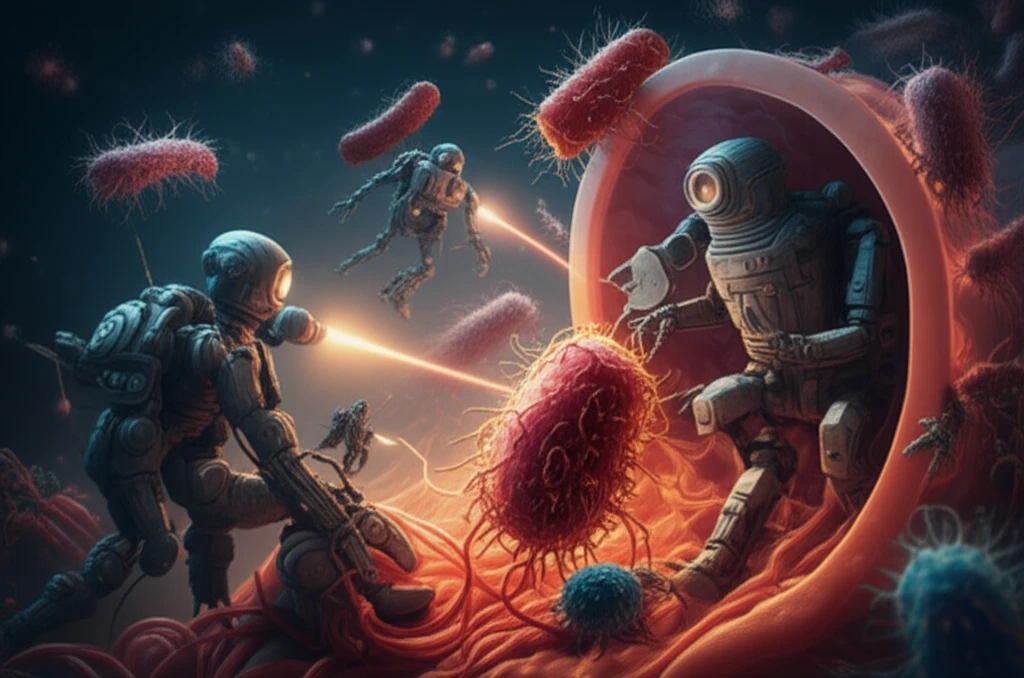
Microscopic robots battling bacteria within a human cell.

Superbug Showdown: Can We Outsmart Antibiotic Resistance?

"A deep dive into the rising threat of methicillin-resistant Staphylococcus aureus (MRSA) and innovative strategies to combat antibiotic resistance."


Imagine a world where common infections become life-threatening, where antibiotics—our trusted allies against bacteria—no longer work. This isn't a scene from a dystopian novel; it's the looming reality of antibiotic resistance, and methicillin-resistant Staphylococcus aureus (MRSA) is one of its most formidable faces. MRSA, a type of staph bacteria resistant to several antibiotics, poses a significant threat in healthcare and community settings alike.

MRSA's ability to shrug off traditional treatments stems from its alternative penicillin-binding protein, PBP2a, encoded by the mecA gene. This allows MRSA to resist beta-lactam antibiotics, a class that includes penicillin. But MRSA's resistance doesn't stop there. These strains often develop resistance to a wide array of antibiotics, severely limiting treatment options.

The challenge is clear: we need to understand how MRSA develops and spreads resistance to develop effective strategies to combat it. Recent research has shed light on a critical mechanism: efflux pumps. These pumps are like tiny bouncers inside the bacterial cell, ejecting antibiotics before they can cause harm. Understanding how these pumps work and how to block them could be key to restoring the effectiveness of our current antibiotics.

What are Efflux Pumps and How Do They Fuel Antibiotic Resistance?

Microscopic robots battling bacteria within a human cell.

Efflux pumps are protein structures within bacterial cells that actively transport antibiotics and other harmful substances out of the cell. Think of them as microscopic bilge pumps, constantly working to keep the cell free of toxins. While efflux pumps are a natural defense mechanism for bacteria, their overuse and adaptation contribute significantly to antibiotic resistance.

In MRSA, certain efflux pump genes, such as norA, norB, and mdeA, are frequently found to be overexpressed, meaning they are working in overdrive. This allows MRSA to efficiently pump out a variety of antibiotics, including ciprofloxacin, a commonly prescribed fluoroquinolone. The more active these pumps are, the less effective the antibiotic becomes.

  • The norA gene is one of the most well-studied efflux pump genes in S. aureus. Its overexpression leads to resistance to multiple antibiotics, including ciprofloxacin and other fluoroquinolones.
  • The mdeA gene is another significant contributor to ciprofloxacin resistance. Studies have shown that MRSA isolates with the mdeA gene are significantly more likely to be resistant to ciprofloxacin.
  • Other efflux pump genes, such as mepA and sepA, also play a role in antibiotic resistance, although their contributions may be less pronounced than norA and mdeA.
The study by Hassanzadeh et al. highlights the prevalence of these efflux pump genes in MRSA isolates from Tehran, Iran, demonstrating a concerning trend of increasing ciprofloxacin resistance. Their research found that the mdeA gene was present in a significant proportion of ciprofloxacin-resistant MRSA isolates, underscoring its importance in resistance development. This convergence of multiple efflux pump genes creates a 'superbug' effect, where the bacteria become incredibly difficult to treat.

Turning the Tide: What Can Be Done?

While the rise of antibiotic resistance is alarming, it is not insurmountable. Several strategies are being explored to combat efflux pumps and restore antibiotic effectiveness. These include developing efflux pump inhibitors (EPIs), which block the action of the pumps, and discovering new antibiotics that are not susceptible to efflux. Improved infection control practices and responsible antibiotic use are also crucial in slowing the spread of resistance. By understanding the mechanisms of resistance and working collaboratively, we can outsmart these superbugs and safeguard the future of antibiotic therapy.

About this Article -

This article was crafted using a human-AI hybrid and collaborative approach. AI assisted our team with initial drafting, research insights, identifying key questions, and image generation. Our human editors guided topic selection, defined the angle, structured the content, ensured factual accuracy and relevance, refined the tone, and conducted thorough editing to deliver helpful, high-quality information.See our About page for more information.

This article is based on research published under:

DOI-LINK: 10.1016/j.micpath.2017.08.026, Alternate LINK

Title: Frequency Of Efflux Pump Genes Mediating Ciprofloxacin And Antiseptic Resistance In Methicillin-Resistant Staphylococcus Aureus Isolates

Subject: Infectious Diseases

Journal: Microbial Pathogenesis

Publisher: Elsevier BV

Authors: Sepideh Hassanzadeh, Rahil Mashhadi, Masoud Yousefi, Emran Askari, Maryam Saniei, Mohammad Reza Pourmand

Published: 2017-10-01

Everything You Need To Know

1

What is Methicillin-resistant Staphylococcus aureus (MRSA), and why is it a concern?

MRSA, or methicillin-resistant Staphylococcus aureus, is a type of staph bacteria that has developed resistance to several antibiotics, including methicillin and other beta-lactam antibiotics like penicillin. This resistance stems from the presence of an alternative penicillin-binding protein, PBP2a, encoded by the mecA gene, which allows MRSA to evade the effects of these drugs. The rise of MRSA is a concern because it poses a significant threat in both healthcare and community settings. Infections caused by MRSA can be difficult to treat, leading to prolonged illness, increased healthcare costs, and, in severe cases, even death. The ability of MRSA to resist multiple antibiotics further complicates treatment options and underscores the need for effective strategies to combat its spread.

2

How do Efflux Pumps contribute to antibiotic resistance in MRSA?

Efflux pumps are protein structures within bacterial cells that actively expel antibiotics, preventing them from reaching their target and causing harm. In MRSA, specific efflux pump genes like norA, norB, and mdeA are frequently overexpressed. This means the pumps work overtime, efficiently removing a variety of antibiotics, including ciprofloxacin. When these pumps are highly active, they decrease the effectiveness of the antibiotics, as the drugs are ejected from the bacterial cell before they can act. This mechanism allows MRSA to survive exposure to multiple antibiotics, contributing significantly to its resistance profile and making infections harder to treat.

3

Which specific efflux pump genes are most relevant in MRSA, and how do they contribute to resistance?

Several efflux pump genes play a critical role in MRSA's antibiotic resistance. The norA gene is among the most studied and its overexpression leads to resistance against multiple antibiotics, including ciprofloxacin and other fluoroquinolones. The mdeA gene is another significant contributor, with research showing that MRSA isolates containing this gene are more likely to be resistant to ciprofloxacin. Other genes, such as mepA and sepA, also contribute, though their impact may be less pronounced. The combined action of these efflux pump genes creates a 'superbug' effect, where the bacteria become highly resistant to multiple drugs, making treatment extremely challenging.

4

What are Efflux Pump Inhibitors (EPIs), and how could they help combat antibiotic resistance?

Efflux Pump Inhibitors (EPIs) are substances designed to block the action of efflux pumps within bacterial cells. By inhibiting these pumps, EPIs prevent them from ejecting antibiotics, allowing the drugs to reach their target and kill the bacteria. The development of EPIs is a promising strategy in the fight against antibiotic resistance. By using EPIs in combination with existing antibiotics, we can potentially restore the effectiveness of drugs that MRSA has become resistant to. This approach could provide a way to overcome MRSA's resistance mechanisms and improve treatment outcomes.

5

Beyond efflux pumps, what other strategies are being explored to combat MRSA and antibiotic resistance?

While inhibiting efflux pumps is a critical strategy, other approaches are being explored to combat MRSA and antibiotic resistance. These include discovering new antibiotics that are not susceptible to efflux mechanisms and developing improved infection control practices. Responsible antibiotic use is also crucial, as overuse contributes to the development and spread of resistance. Furthermore, understanding the genetic basis of resistance, including the roles of genes like mecA, norA, and mdeA, helps researchers to design more effective treatments and prevention strategies. Collaborative efforts and continuous research are essential to stay ahead of these evolving superbugs.

Newsletter Subscribe

Subscribe to get the latest articles and insights directly in your inbox.