
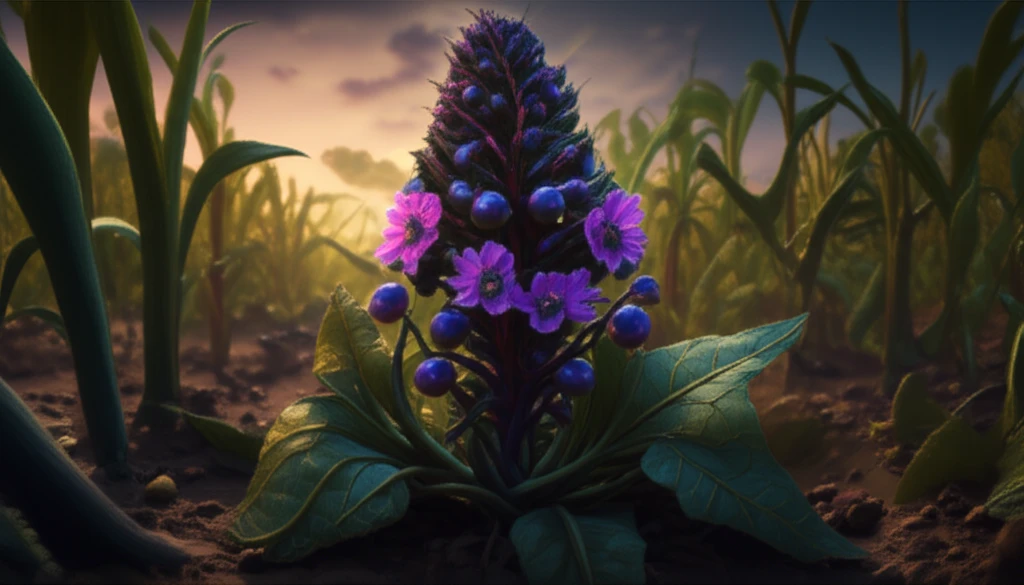
Mary-Nightshade thriving in partial shade, outcompeting nearby crops.

Sun's Out, Shades On: How Light Levels Impact Weed Growth

"Discover how different levels of light affect the growth and development of Mary-Nightshade plants, and what this means for managing this competitive weed."


In the world of agriculture, weeds are a persistent challenge. Among these, Mary-Nightshade (Solanum americanum) stands out as a particularly competitive species. Known for its ability to quickly dominate fields, this weed can significantly reduce crop yields, making its management a priority for farmers.

One key factor influencing plant growth is light. Plants use light to fuel photosynthesis, the process by which they convert carbon dioxide and water into energy-rich sugars. However, the amount of light available can vary greatly, depending on factors such as cloud cover, the density of surrounding vegetation, and even the time of day.

Recognizing the importance of light, researchers have been investigating how different light levels affect the growth and development of Mary-Nightshade. By understanding how this weed responds to varying degrees of shade, scientists hope to develop more effective strategies for controlling its spread and minimizing its impact on crops.

How Does Shading Impact Weed Development?

Mary-Nightshade thriving in partial shade, outcompeting nearby crops.

A recent study published in "Planta Daninha" explored the effects of different shading levels on Mary-Nightshade plants. The researchers grew the plants under three different conditions: full sunlight, 35% shade, and 65% shade. They then monitored the plants' growth and development over time, measuring factors such as total dry mass, leaf area, and the distribution of resources among different plant parts.

The results revealed that Mary-Nightshade plants exhibited different growth patterns depending on the amount of shade they received. Here's a breakdown of the key findings:

  • Total Dry Mass: Plants grown under 35% shade reached the highest total dry mass, indicating that they were most efficient at converting resources into biomass under these conditions.
  • Growth Rate: The rate of dry matter production was also highest in the 35% shade treatment, suggesting that these plants were able to grow more quickly than those in full sunlight or 65% shade.
  • Leaf Area: Plants in the 35% shade treatment developed a larger leaf area index, meaning they had more leaf surface area to capture sunlight.
  • Resource Allocation: The distribution of resources among different plant parts also varied with shading level. For example, plants in the 35% shade treatment allocated more resources to stem dry matter and fruit production.
These findings suggest that Mary-Nightshade plants are able to adapt to different light environments, but they thrive best under moderate shade conditions. This has important implications for weed management strategies, as it suggests that reducing light availability in fields may not always be effective in controlling this weed.

Implications for Weed Control

The study's findings highlight the complex relationship between light and weed growth. While reducing light availability can be an effective strategy for controlling some weeds, it may not be sufficient for Mary-Nightshade. In fact, the weed flourishes under moderate shade conditions. Future research should focus on developing integrated weed management strategies that combine multiple approaches, such as crop rotation, herbicide application, and physical removal, to effectively control Mary-Nightshade and minimize its impact on crop production. Understanding how weeds respond to different environmental factors is crucial for developing sustainable and effective weed management practices.

About this Article -

This article was crafted using a human-AI hybrid and collaborative approach. AI assisted our team with initial drafting, research insights, identifying key questions, and image generation. Our human editors guided topic selection, defined the angle, structured the content, ensured factual accuracy and relevance, refined the tone, and conducted thorough editing to deliver helpful, high-quality information.See our About page for more information.

Everything You Need To Know

1

What is Mary-Nightshade, and why is it a concern in agriculture?

Mary-Nightshade (Solanum americanum) is a particularly competitive weed in agriculture, known for its ability to rapidly colonize fields. Its aggressive growth can significantly reduce crop yields, making its management a key priority for farmers. Therefore, controlling its spread is crucial for maintaining agricultural productivity and minimizing economic losses.

2

How does light influence the growth of Mary-Nightshade?

Light is a critical factor for Mary-Nightshade growth because plants utilize it for photosynthesis, converting carbon dioxide and water into energy-rich sugars. The amount of light available, affected by cloud cover, surrounding vegetation, and time of day, directly impacts the plant's ability to grow and thrive. The study in "Planta Daninha" showed that varying light levels affect the plant's total dry mass, growth rate, leaf area, and resource allocation.

3

What were the key findings of the study on Mary-Nightshade and shade?

The study in "Planta Daninha" investigated Mary-Nightshade's response to varying shade levels: full sunlight, 35% shade, and 65% shade. The plants grown under 35% shade exhibited the highest total dry mass and growth rate, also developing a larger leaf area index. The resource allocation also varied, with more resources going to stem dry matter and fruit production under 35% shade. These results indicate that Mary-Nightshade thrives best under moderate shade.

4

Why is reducing light availability not always effective for controlling Mary-Nightshade?

The study revealed that Mary-Nightshade thrives under moderate shade conditions, making reducing light availability less effective than for other weeds. In fact, the research showed that plants grown in 35% shade were more efficient at converting resources into biomass. This suggests that simply reducing light might not be enough to control this particular weed. In some cases, this could even make the weed more competitive.

5

What integrated weed management strategies are recommended for Mary-Nightshade?

Given that Mary-Nightshade thrives under moderate shade, an integrated approach is recommended for its control. This involves combining multiple strategies such as crop rotation, herbicide application, and physical removal. This multifaceted approach aims to address the weed's adaptability and resilience, ensuring more effective control and minimizing its impact on crop production. Future research should focus on refining these combined strategies for sustainable and effective weed management practices.

Newsletter Subscribe

Subscribe to get the latest articles and insights directly in your inbox.