
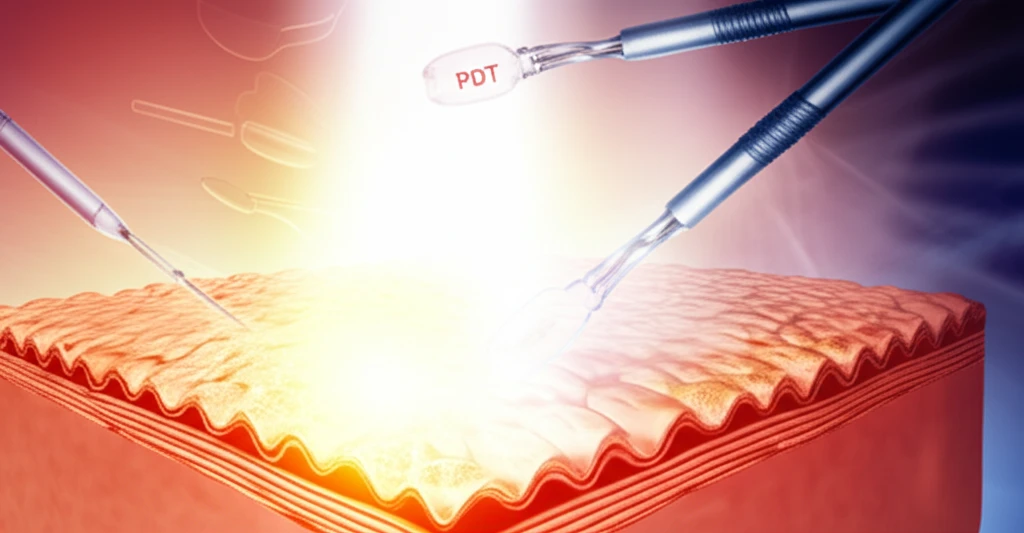
Illustration of a healthy skin, sun and skin cells

Sun's Out, Scalp's Out: Unveiling the Revolutionary Treatment for Actinic Keratosis

"Discover the Latest Breakthrough in Treating Sun-Damaged Skin and Preventing Skin Cancer"


Sunlight, while vital for life, can sometimes be a double-edged sword. While we love a sunny day, the sun's rays can cause significant damage to our skin over time. One of the most common outcomes of this damage is actinic keratosis (AK), a precancerous condition that appears as rough, scaly patches on the skin. If left untreated, AK can potentially develop into skin cancer, making its management a top priority.

Fortunately, medical advancements are constantly providing us with new tools to combat these issues. This article will discuss a recent study that has shown promising results in treating AK. The study focuses on a combination therapy that may change how we approach this common skin condition. Understanding the condition and its treatment options is key to maintaining skin health and preventing more serious problems.

This isn't just about aesthetics; it's about health. Actinic keratosis can be an early warning sign. Early and effective treatment is essential for maintaining skin health and preventing the development of more serious conditions. Let's delve into the latest findings to empower you with knowledge and proactive steps you can take for your skin.

Calcipotriol-Assisted MAL-PDT: The New Frontier in AK Treatment

Illustration of a healthy skin, sun and skin cells

The study we'll explore investigates a treatment that combines two existing therapies: photodynamic therapy (PDT) and a topical medication called Calcipotriol (CAL). PDT uses light to target and destroy abnormal skin cells. Meanwhile, Calcipotriol is known for its ability to regulate skin cell growth. The research aimed to determine whether the combination of these two treatments would provide better results than using PDT alone, especially for those tricky-to-treat AK lesions on the scalp.

The innovative approach tested in the study involves using Calcipotriol to prepare the skin, followed by PDT to eliminate the affected cells. The goal was to leverage the benefits of each treatment to improve overall outcomes, including higher efficacy and fewer side effects. The study's findings are important because they offer insights into a new treatment approach and how it can improve patient care.

  • Higher Efficacy: The combination therapy showed improved effectiveness in treating AK lesions, particularly on the scalp, compared to PDT alone.
  • Safety Profile: The combination was well-tolerated by patients, indicating a favorable safety profile, though some side effects were more common.
  • Targeted Approach: The study's design focused on addressing AK lesions, providing a targeted approach to skin treatment.
By combining these two proven methods, researchers have discovered a potentially more effective strategy for treating AK. This combined method offers a targeted way to combat the condition. This approach reduces the need for more invasive treatments, making the process more comfortable and efficient for patients. This innovative therapy is not just an upgrade; it is a more thoughtful strategy for maintaining healthy skin.

Protecting Your Skin: A Proactive Approach

This study highlights how the combination of Calcipotriol and PDT offers a promising solution for those dealing with AK, especially on the scalp. The study's results highlight a shift towards personalized, effective treatments. If you're concerned about AK or sun-damaged skin, consult with a dermatologist. Early detection and effective treatments can help you. Protect your skin today by wearing sunscreen. Seek advice from experts to embrace a future of healthy and radiant skin.

About this Article -

This article was crafted using a human-AI hybrid and collaborative approach. AI assisted our team with initial drafting, research insights, identifying key questions, and image generation. Our human editors guided topic selection, defined the angle, structured the content, ensured factual accuracy and relevance, refined the tone, and conducted thorough editing to deliver helpful, high-quality information.See our About page for more information.

This article is based on research published under:

DOI-LINK: 10.1111/bjd.17162, Alternate LINK

Title: Calcipotriol-Assisted Vs. Conventional Mal-Pdt In Actinic Keratosis

Subject: Dermatology

Journal: British Journal of Dermatology

Publisher: Wiley

Authors: L. Torezan, B. Grinblat, M. Haedersdal, N. Valente, C. Festa-Neto, R.M. Szeimies

Published: 2018-10-01

Everything You Need To Know

1

What is actinic keratosis (AK), and why is it important to treat?

Actinic keratosis (AK) is a common skin condition caused by sun exposure. It appears as rough, scaly patches on the skin and is considered precancerous. If left untreated, actinic keratosis can potentially develop into skin cancer. Therefore, management is a top priority for maintaining skin health and preventing more serious problems. Early and effective treatment of actinic keratosis is essential for stopping the progression into more severe conditions. While the text highlights treatment, it doesn't delve into diagnostic methods, such as biopsies, which are crucial for confirming the diagnosis. Furthermore, it does not cover the various stages or grading of actinic keratosis, which influence treatment decisions.

2

How does the combination therapy of Calcipotriol and photodynamic therapy (PDT) work to treat actinic keratosis?

The combination therapy of Calcipotriol and photodynamic therapy (PDT) works by leveraging the benefits of each treatment to improve overall outcomes for actinic keratosis. First, Calcipotriol, a topical medication known for regulating skin cell growth, is used to prepare the skin. Then, photodynamic therapy (PDT) uses light to target and destroy the abnormal skin cells affected by actinic keratosis. The research aimed to determine whether combining these two treatments provides better results than using photodynamic therapy (PDT) alone, especially for actinic keratosis lesions that are hard to treat, such as those on the scalp. While the basic mechanism is provided, the text omits the specific molecular pathways through which Calcipotriol modulates skin cell growth or the photosensitizing agents used in photodynamic therapy (PDT) and their mechanism of action when exposed to light.

3

What were the main findings of the study on Calcipotriol-assisted MAL-PDT for treating actinic keratosis?

The study showed that the combination of Calcipotriol and photodynamic therapy (PDT) improved effectiveness in treating actinic keratosis lesions, particularly on the scalp, compared to photodynamic therapy (PDT) alone. The combination was also well-tolerated by patients, indicating a favorable safety profile, although some side effects were more common. The study provided a targeted approach to treating actinic keratosis on the skin. However, the text does not provide specific data on the percentage of improvement or the types and severity of side effects observed. It also doesn't compare this treatment against other common actinic keratosis treatments, such as cryotherapy or topical medications like 5-fluorouracil or imiquimod, in terms of efficacy, cost, and patient convenience.

4

What are the implications of using Calcipotriol and photodynamic therapy (PDT) combination as a treatment for actinic keratosis?

The implications of using the Calcipotriol and photodynamic therapy (PDT) combination for treating actinic keratosis include higher efficacy compared to photodynamic therapy (PDT) alone. This means that patients may experience better clearance of actinic keratosis lesions, especially in difficult-to-treat areas like the scalp. Additionally, the treatment is well-tolerated, suggesting a good safety profile. This combination offers a targeted approach, reducing the need for more invasive treatments. However, the text doesn't explore long-term outcomes, such as recurrence rates or the potential for preventing the progression to skin cancer. Furthermore, it doesn't discuss the cost-effectiveness of this combination compared to other treatments or the accessibility of photodynamic therapy (PDT) in various clinical settings.

5

Besides treatment, what else can be done to protect skin and prevent actinic keratosis?

To protect the skin and prevent actinic keratosis, wearing sunscreen is crucial. Regular consultations with a dermatologist are also recommended for early detection and effective treatments. Early and effective treatment is essential for maintaining skin health and preventing the development of more serious conditions. This proactive approach helps maintain healthy and radiant skin. While the importance of sunscreen is mentioned, the text doesn't elaborate on the specific types of sunscreen (e.g., mineral vs. chemical), the recommended SPF levels, or the importance of reapplication. It also doesn't discuss other preventive measures, such as wearing protective clothing (hats, long sleeves) or avoiding peak sun hours. Lifestyle changes and dietary considerations that could potentially reduce the risk of actinic keratosis are also not mentioned.

Newsletter Subscribe

Subscribe to get the latest articles and insights directly in your inbox.