
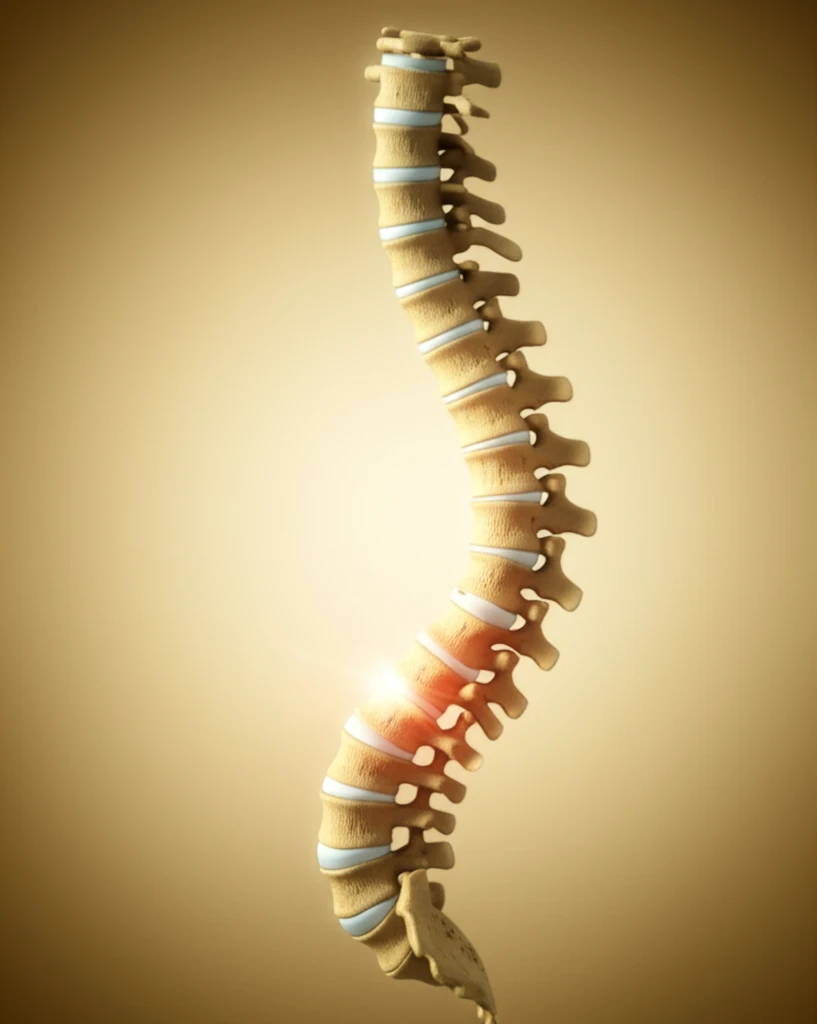
Suffering from Spondylolisthesis? Discover How Spinal Fusion Can Help!

"Exploring the Benefits of Spinal Fusion with Interbody Devices (CAGE) for Spondylolisthesis."
Spondylolisthesis, a condition where one vertebra slips over the one below it, can cause significant back and leg pain, impacting daily life. While various treatments exist, lumbar spinal fusion has emerged as a common surgical approach, often involving the use of interbody fusion devices (cages) to stabilize the spine. These cages aim to promote fusion (the joining of two vertebrae into one solid bone) and enhance the construct's overall stability.
For individuals experiencing persistent pain and instability despite conservative treatments, spinal fusion might offer a solution. This procedure aims to alleviate pain, improve function, and prevent further slippage of the vertebrae. The decision to undergo spinal fusion, however, should be made in consultation with a qualified spine surgeon after careful consideration of individual circumstances and potential risks and benefits.
This article will delve into the specifics of anterior spinal fusion with or without interbody fusion devices (CAGE) for spondylolisthesis. It is based on a research study that assessed the functional and radiological outcomes of patients undergoing this procedure. It will provide a clear understanding of what the surgery entails, what to expect during recovery, and the potential benefits it can offer.
Current Impact
Degenerative spondylolisthesis and isthmic spondylolisthesis are identified as the two most common types. Degenerative spondylolisthesis is associated with arthritic changes and degenerative disc disease, whereas isthmic spondylolisthesis results from a pars interarticularis defect. In adults with degenerative or isthmic lumbar spondylolisthesis, vertebral slippage can produce significant neurological impairment, and spinal fusion is described as a common treatment.
Approach and Limits
Treatment decisions for spondylolisthesis generally require consideration of the underlying condition, symptoms, and the degree of spinal instability. Spinal fusion may be considered when stabilization is part of the surgical goal, but it is not a universally appropriate solution for every patient. Because the available material does not establish one standard technique or outcome for all cases, patients should discuss potential benefits, risks, and alternatives with a qualified spine specialist.
Historical Foundations
The history of spondylolisthesis includes debates about its etiology, reflecting the evolution of the scientific method in orthopaedics. The history of spinal fusion traces early landmark advances and considers their importance in light of later developments. Spondylolisthesis is most commonly described in the lumbar spine, particularly at L5-S1, where L5 may translate anteriorly over S1.
Is Spinal Fusion with Interbody Cage Right for You? Understanding the Research
A prospective nonrandomized study examined adults aged 28 to 68 years with LSS who underwent spinal fusion with or without an interbody cage. The study, conducted between 2010 and 2012, meticulously tracked patient progress through clinical follow-ups at 6 weeks, 3, 6, and 12 months. These follow-ups included assessments of pain levels using the visual analog scale (VAS), fusion progress via radiographs (AP, lateral, and flexion-extension views), and overall functional outcome measured by the Oswestry disability index (ODI), SF-36, and a modified Benzel Japanese Orthopaedic Association score.
- Faster Union: Earliest union was observed at 6 months follow-up in 30% of the bone graft (BG) group and 50% of the cage group (CG).
- Improved Radiological Union: At the end of 1 year, 90% of the BG group and 100% of the CG group showed radiological union.
- Fusion Rate: Average fusion rates were 10 and 8.5 months in the BG and CG groups, respectively.
- Radicular Improvements: Radicular improvements were noted in 70% and 90% of the BG and CG groups, respectively.
- Better Functional Outcome: Functional outcome was significantly better at 3, 6 months, and 1 year in both groups (p<0.001).
- Fewer Complications: Complications were observed in 60 and 20% of cases in the BG and CG groups, respectively.
- Patient Satisfaction: Patient satisfaction was 80% and 90% in the BG and CG groups, respectively.
Current Research
Recent review work is comparing posterolateral fusion with posterior lumbar interbody fusion in adults with isthmic spondylolisthesis. Another review examines why fusion with decompression may be superior to decompression alone in selected patients with lumbar spondylolisthesis. Current research also emphasizes that, although instrumentation has become more common, the methods used to optimize fusion remain less standardized.
Risks and Uncertainty
A systematic review and meta-analysis is examining minimally invasive spinal fusion versus open spinal fusion for spondylolisthesis, underscoring that surgical approach remains an important comparison. Spinal fusion is commonly used for adult degenerative or isthmic lumbar spondylolisthesis, but vertebral slippage can involve significant neurological impairment. Patient guidance also emphasizes realistic recovery alongside symptoms, testing, treatment choices, and risks, so fusion should not be presented as risk-free or universally successful.
Comparing Options
Without a subsection-specific source set, comparisons between decompression, fusion, minimally invasive surgery, and open surgery should be treated cautiously. The most appropriate option may depend on the patient's symptoms, spinal stability, neurological findings, and overall health. A clinician-led comparison should address expected benefits, limitations, risks, and recovery rather than assuming that one procedure fits every case.
Making an Informed Decision About Spinal Fusion
Spinal fusion with an interbody cage can be an effective treatment option for spondylolisthesis, offering potential benefits like increased stability, reduced pain, and improved function. The decision to undergo surgery should be made after thorough discussion with your healthcare provider, carefully weighing the potential benefits and risks.
Putting Evidence Together
The available material supports viewing spinal fusion as one surgical strategy for selected cases of lumbar spondylolisthesis, not as a universal remedy. Decisions should account for the type of spondylolisthesis, neurological effects, the role of decompression, and how fusion can be optimized. Because techniques and patient circumstances vary, individualized specialist assessment remains important.
Future Directions
Future treatment research is expected to focus on biologics that may enhance fusion in patients treated for spondylolisthesis. The cited review also projects that deep learning and artificial intelligence models may improve selection of the right operation for the right patient with lumbar spondylolisthesis. These directions point toward research on both biological healing and more individualized surgical decision-making.
Healthcare Context
Evidence-based decision-making for degenerative spondylolisthesis remains an important healthcare issue. A 2026 Springer chapter reports that spondylolisthesis was the most common indication for elective spinal fusion in the United States, accounting for 45.2% in 2015. That figure highlights the condition's role in surgical care while also reinforcing the need to match fusion decisions to individual evidence and patient circumstances.
Patient Experience
A reported case involved a 60-year-old patient with L5-S1 spondylolisthesis, leg pain, and foot weakness. The treatment goals were to restore stability and prevent secondary spinal cord and nerve-root compression; the case describes decompression with transforaminal lumbar interbody fusion after a violent lumbar impact and a successful outcome. The source also notes that many patients with degenerative lumbar disease and spondylolisthesis present with severe chronic low-back and leg pain when conservative care has failed.
Remember that while the study suggests advantages to using interbody cages, individual results can vary. A comprehensive evaluation, including imaging and neurological assessment, is crucial to determine the most appropriate treatment plan for your specific condition.
If you are considering spinal fusion, ask your surgeon about their experience with interbody fusion devices, the specific type of cage they recommend, and what to expect during the recovery process. Actively participate in the decision-making process to ensure the best possible outcome for your spinal health.