
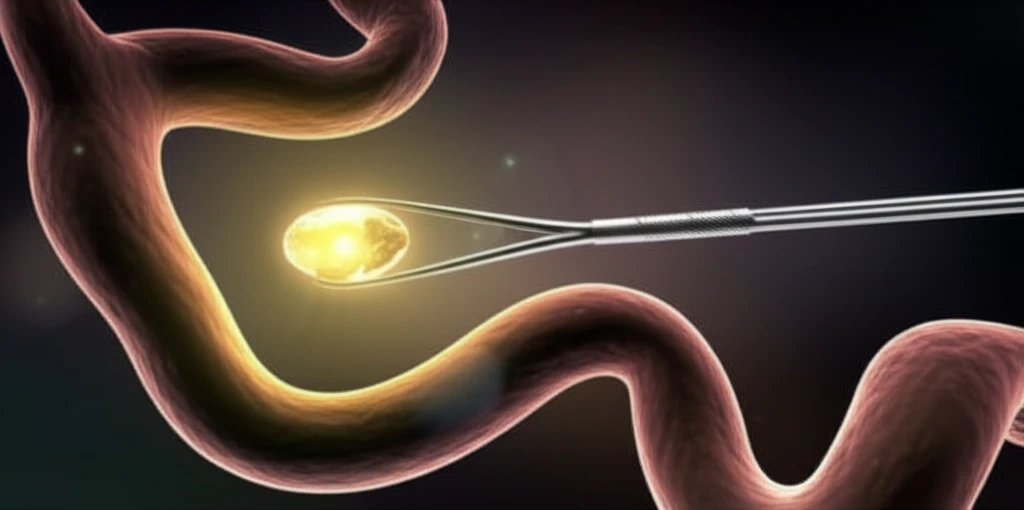
Illustration of goose-neck snare removing a trapped gallstone.

Stuck Bile Duct Stone? How a Goose-Neck Snare Can Help

"When standard methods fail, innovative techniques like percutaneous transhepatic snare retrieval offer hope for impacted lithotripter baskets."


Endoscopic retrograde cholangiopancreatography (ERCP) is the primary method for treating choledocholithiasis, or gallstones in the bile duct. In most cases, doctors can successfully remove these stones using instruments like Dormia baskets or balloon catheters, achieving success rates of 85% to 95%. This is typically done after a sphincterotomy, a procedure to widen the opening of the bile duct.

However, sometimes standard techniques aren't enough. In these situations, doctors turn to lithotripsy, which involves breaking up the stones. Several methods exist, including mechanical lithotripsy, electrohydraulic probe lithotripsy, extracorporeal shock wave lithotripsy (ESWL), and laser lithotripsy. Stenting, where a small tube is placed to keep the duct open, may also be used until a more definitive treatment can be performed.

Mechanical lithotripsy is often the preferred method after a sphincterotomy because it's practical and cost-effective. It boasts high success rates, with studies reporting effectiveness in 90% to 97% of cases. However, complications can occur, such as the lithotripter basket becoming stuck with a stone or the traction wire breaking. These issues arise in 0.8% to 6% of procedures. This article explores a unique approach to resolving such complications.

The Problem: Impacted Baskets and Fractured Wires

Illustration of goose-neck snare removing a trapped gallstone.

Imagine a scenario: a 66-year-old man arrives at the hospital with severe abdominal pain. A CT scan reveals stones in his common bile duct (CBD), causing it to dilate. His bilirubin levels are alarmingly high at 10.1 mg/dL (normal range: 0.2-1.3 mg/dL), indicating a significant blockage of the bile flow.

An ERCP is performed, but attempts to remove the stones are thwarted by retained food in the stomach and duodenum, hindering access to the CBD. A percutaneous transhepatic biliary drainage (PTBD) is then performed to relieve the immediate pressure and pain. A cholangiogram reveals a 2.5-cm stone lodged in the distal CBD.

  • Initial ERCP: Hindered by food, preventing CBD cannulation.
  • PTBD Performed: To relieve obstruction and pain.
  • Cholangiogram Results: Confirmed a large stone in the distal CBD.
During a subsequent ERCP attempt, while using a lithotripter basket to extract the stone, the basket becomes trapped in the distal CBD. Attempts to pull it free are unsuccessful. A metal sheath is advanced to crush the stone, but the stone proves too hard, and the lithotripter wire snaps outside the oral cavity. A second basket is used, but it doesn't work. The patient is now referred to interventional radiology for help.

A Minimally Invasive Solution

When faced with an impacted lithotripter basket and a fractured traction wire, the percutaneous transhepatic approach using a goose-neck snare offers a safe and effective alternative to open surgery. This method allows for the release of the entrapped stone and the removal of the basket and wire, providing relief and preventing further complications. This case highlights the importance of having a variety of techniques available to manage complex biliary issues and improve patient outcomes.

About this Article -

This article was crafted using a human-AI hybrid and collaborative approach. AI assisted our team with initial drafting, research insights, identifying key questions, and image generation. Our human editors guided topic selection, defined the angle, structured the content, ensured factual accuracy and relevance, refined the tone, and conducted thorough editing to deliver helpful, high-quality information.See our About page for more information.

This article is based on research published under:

DOI-LINK: 10.3348/kjr.2011.12.2.247, Alternate LINK

Title: Percutaneous Transhepatic Release Of An Impacted Lithotripter Basket And Its Fractured Traction Wire Using A Goose-Neck Snare: A Case Report

Subject: Radiology, Nuclear Medicine and imaging

Journal: Korean Journal of Radiology

Publisher: The Korean Society of Radiology

Authors: Jae Hyun Kwon, Jun Kyu Lee, Jin Ho Lee, Yong Seok Lee

Published: 2011-01-01

Everything You Need To Know

1

What is Endoscopic Retrograde Cholangiopancreatography (ERCP) and when is it typically used?

Endoscopic Retrograde Cholangiopancreatography, or ERCP, serves as the primary method for addressing choledocholithiasis, a condition characterized by the presence of gallstones within the bile duct. Typically, ERCP employs instruments such as Dormia baskets or balloon catheters to effectively remove these stones. Success rates generally range from 85% to 95%, frequently following a sphincterotomy, which widens the opening of the bile duct to facilitate stone removal. While generally effective, alternative treatments are sometimes necessary when standard techniques don't suffice.

2

What happens when standard ERCP methods fail to remove bile duct stones?

When standard ERCP methods are insufficient, doctors may turn to lithotripsy, a technique used to break up the stones. Lithotripsy can involve mechanical lithotripsy, electrohydraulic probe lithotripsy, extracorporeal shock wave lithotripsy (ESWL), or laser lithotripsy. In some cases, stenting, which involves placing a small tube to keep the bile duct open, may be used as a temporary measure until a more definitive treatment can be performed.

3

What is mechanical lithotripsy, and what are the potential complications associated with it?

Mechanical lithotripsy is a common method used after a sphincterotomy to break up bile duct stones. It involves using a lithotripter basket to capture and crush the stones. While generally effective, with success rates between 90% and 97%, complications can occur in 0.8% to 6% of procedures. These complications may include the lithotripter basket becoming stuck with a stone or the traction wire breaking, requiring alternative retrieval methods.

4

What is a percutaneous transhepatic approach using a goose-neck snare, and when is it considered?

The percutaneous transhepatic approach using a goose-neck snare is a minimally invasive technique employed when standard methods fail, particularly in cases of impacted lithotripter baskets or fractured wires in the bile duct. This method involves accessing the bile duct through the skin and liver (percutaneous transhepatic) and using a goose-neck snare to capture and remove the entrapped stone, basket, or wire. It offers a safe and effective alternative to open surgery.

5

In the described case, what specific steps were taken when the initial ERCP failed, leading to the use of the goose-neck snare?

In the described case, the initial ERCP was hindered by retained food, preventing access to the common bile duct (CBD). A percutaneous transhepatic biliary drainage (PTBD) was performed to relieve the obstruction and pain. A cholangiogram revealed a large stone in the distal CBD. During a subsequent ERCP attempt, the lithotripter basket became trapped, and the traction wire snapped. Multiple attempts to free the basket and stone failed, leading to referral to interventional radiology for the percutaneous transhepatic approach using a goose-neck snare.

Newsletter Subscribe

Subscribe to get the latest articles and insights directly in your inbox.