
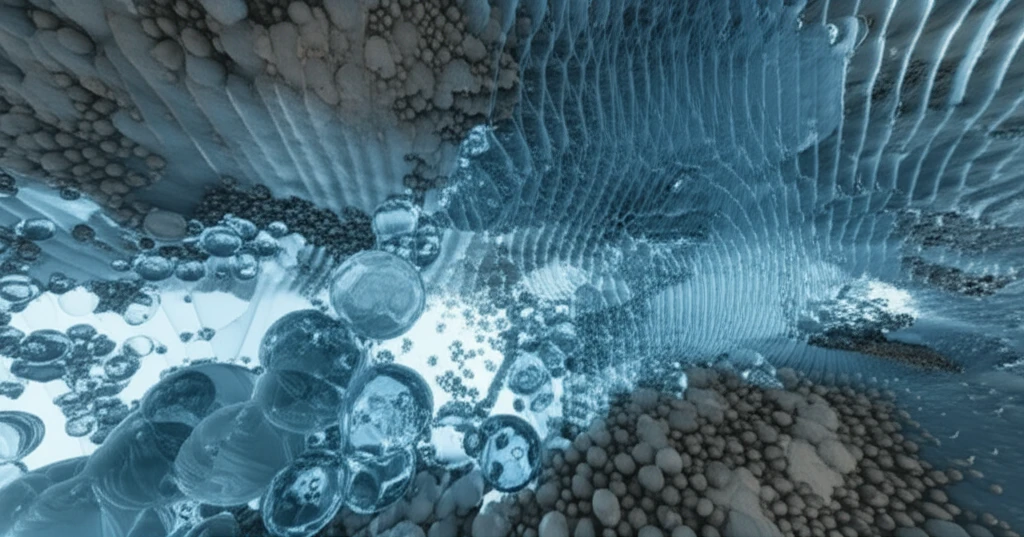
Microscopic view of particle interaction in concrete matrix.

Stronger Concrete: How to Build Better with Advanced Material Design

"Unlock the secrets to high-performance concrete by understanding liquid-particle interactions and optimizing vibro-vacuum technology."


In modern construction, the demand for thin-walled concrete elements with enhanced properties is constantly growing. These elements, mimicking natural stone or complex architectural forms, require a fine-grained concrete that balances workability with ultimate strength.

The key to achieving superior concrete lies in mastering the composite structure formation. Fine-grained concrete mixes often require a high water content to achieve necessary packability, but excess free water can compromise the final product's integrity. This is where innovative techniques come into play.

This article explores how optimizing the interaction between the liquid phase and disperse particles in concrete mixtures, particularly through a vibro-vacuumizing process, can lead to significant improvements in the density, strength, and water resistance of thin-walled concrete articles. We'll break down the science and practical applications of this advanced approach.

The Science of Strong Concrete: Optimizing Liquid-Particle Interaction

Microscopic view of particle interaction in concrete matrix.

Concrete's strength is deeply connected to how its components interact at a microscopic level. During concrete formation, three phases—gaseous, liquid, and solid—are constantly interacting. The liquid phase, primarily water, acts as a medium for chemical reactions and particle dispersion. Understanding these interactions is crucial for directing the structuring process.

Here's a breakdown of the key interactions:

  • Chemical Interaction: Hydration and crystallization create new formations and a binding gel.
  • Physicochemical Interaction: Water molecules are adsorbed onto the solid particle surfaces.
  • Technological Interaction: The process reduces the mixture's viscosity for better packability.
By carefully controlling these interactions, especially through techniques like vibro-vacuumizing, we can manipulate the concrete's structure to achieve superior qualities. This involves removing excess water while ensuring optimal particle packing.

The Future of Concrete: Building Stronger, Smarter, and More Sustainable

Optimizing the liquid phase and particle interactions through advanced techniques like vibro-vacuumizing unlocks a new level of concrete performance. The research clearly demonstrates that this method significantly improves the density and reduces water absorption, leading to stronger, more durable concrete structures.

The regime combines vibratory compaction and vacuumizing, followed by repeated vibratory compaction with a tightening weight which provides the best results, effectively eliminates directed capillary holes and optimizes cement composite packing.

As the construction industry continues to evolve, embracing these advanced material design principles will be crucial for creating sustainable, resilient, and high-performing infrastructure for the future. Further research and development in this area promise even greater advancements in concrete technology, paving the way for innovative architectural designs and long-lasting construction.

About this Article -

This article was crafted using a human-AI hybrid and collaborative approach. AI assisted our team with initial drafting, research insights, identifying key questions, and image generation. Our human editors guided topic selection, defined the angle, structured the content, ensured factual accuracy and relevance, refined the tone, and conducted thorough editing to deliver helpful, high-quality information.See our About page for more information.

This article is based on research published under:

DOI-LINK: 10.1051/matecconf/201711601010, Alternate LINK

Title: Formation Of Structure Of High-Strength Composites With Account Of Interactions Between Liquid Phase And Disperse Particles

Subject: General Medicine

Journal: MATEC Web of Conferences

Publisher: EDP Sciences

Authors: Andrii Plugin, Elena Dedeneva, Tatiana Kostyuk, Dmitro Bondarenko, Olga Demina

Published: 2017-01-01

Everything You Need To Know

1

What is the most important factor in creating stronger concrete?

The key to stronger concrete involves understanding and controlling the interactions between its components at a microscopic level. Specifically, this means optimizing the relationships between the gaseous, liquid, and solid phases during concrete formation. The liquid phase, mainly water, facilitates chemical reactions and particle dispersion. By mastering these interactions, especially through techniques like vibro-vacuumizing, we can manipulate the concrete's structure to achieve superior qualities, such as enhanced density and strength.

2

What is Vibro-vacuumizing and how does it help make stronger concrete?

Vibro-vacuumizing is an advanced technique that optimizes concrete by carefully controlling the liquid phase and particle interactions. This process significantly improves the density and reduces water absorption of the concrete. By removing excess water and ensuring optimal particle packing, vibro-vacuumizing leads to stronger, more durable concrete structures, especially beneficial for thin-walled elements requiring high performance.

3

What are the key interactions that affect concrete's strength during its formation?

There are three key interactions to consider during concrete formation: Chemical Interaction, where hydration and crystallization create new formations and a binding gel; Physicochemical Interaction, where water molecules are adsorbed onto the solid particle surfaces; and Technological Interaction, a process that reduces the mixture's viscosity for better packability. Controlling these interactions is crucial for directing the structuring process and achieving superior concrete qualities.

4

Why is optimizing liquid-particle interaction important for thin-walled concrete elements used to mimic natural stone?

Mimicking natural stone or complex architectural forms in modern construction requires fine-grained concrete that balances workability with ultimate strength. Achieving this involves innovative techniques to optimize the interaction between the liquid phase and disperse particles. While a high water content might be needed for packability, excess free water can compromise the final product. Therefore, methods like vibro-vacuumizing are crucial to removing excess water while maintaining optimal particle packing, leading to stronger, denser, and more water-resistant thin-walled concrete articles.

5

What are the broader implications of optimizing liquid-particle interaction in concrete production for the construction industry?

Optimizing liquid-particle interaction through techniques like vibro-vacuumizing has profound implications for concrete construction. It not only leads to stronger and more durable structures but also opens doors for creating complex architectural forms with thin-walled concrete elements. This approach contributes to more sustainable building practices by reducing material usage and extending the lifespan of concrete structures. Further research and development in this area could lead to even more innovative applications and advancements in concrete technology.

Newsletter Subscribe

Subscribe to get the latest articles and insights directly in your inbox.