
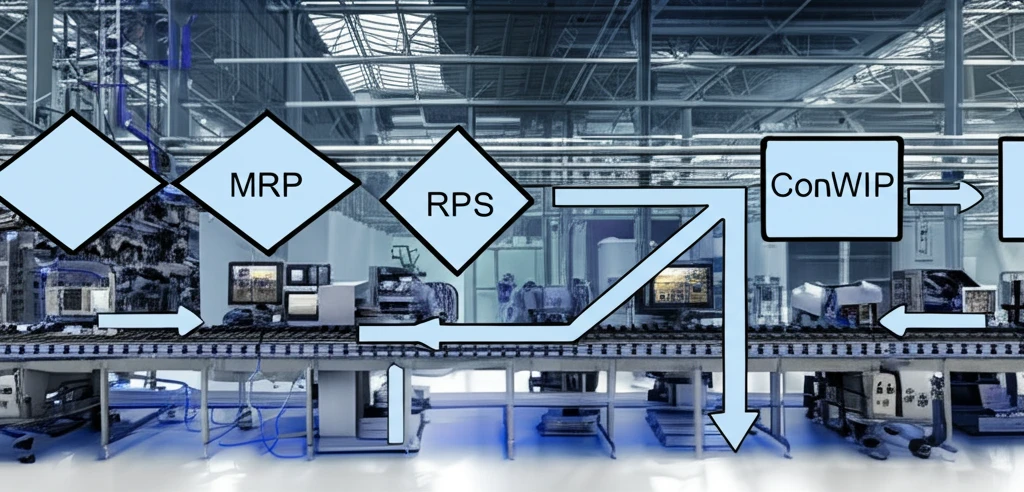
Streamlining Success: Choosing the Right Production System for Your Business

"Navigate the complexities of production planning with insights into MRP, RPS, and ConWIP to optimize costs and efficiency."
In today's fast-paced business world, ensuring your production systems align perfectly with customer demand is crucial. Production planning acts as the bridge between what your company can do and what the market expects, making it a central yet challenging role.
The challenge? Managing mountains of information – from customer orders to Bills of Materials (BoM). The importance? Your production system’s performance directly impacts your overall costs. Finding the right balance can feel overwhelming.
Luckily, various Production Planning and Control Systems (PPCS) are designed to streamline this process. Material Requirements Planning (MRP), Reorder Point System (RPS), and Constant Work In Progress (ConWIP) are widely used in both research and practice. But choosing the right one can be tricky, depending on your unique business environment.
Decoding Production Systems: MRP, RPS, and ConWIP Explained
To effectively manage production, it's crucial to understand the core differences between MRP, RPS, and ConWIP. Each system brings a unique approach to planning and control, impacting how resources are managed and orders are fulfilled.
- MRP (Material Requirements Planning): A 'push' system based on forecasting demand to plan production schedules.
- RPS (Reorder Point System): A 'pull' system triggered by inventory levels, focusing on restocking when levels fall below a set point.
- ConWIP (Constant Work In Progress): A 'pull' system that controls work-in-progress by maintaining a constant level of production.
Making the Right Choice: Aligning PPCS with Your Production Environment
The journey to optimizing your production system starts with understanding your unique environment and aligning it with the right PPCS. By considering factors like system structure and shop load, you can make informed decisions that drive efficiency and reduce costs. Don't be afraid to explore and adapt – the perfect system is within reach!