
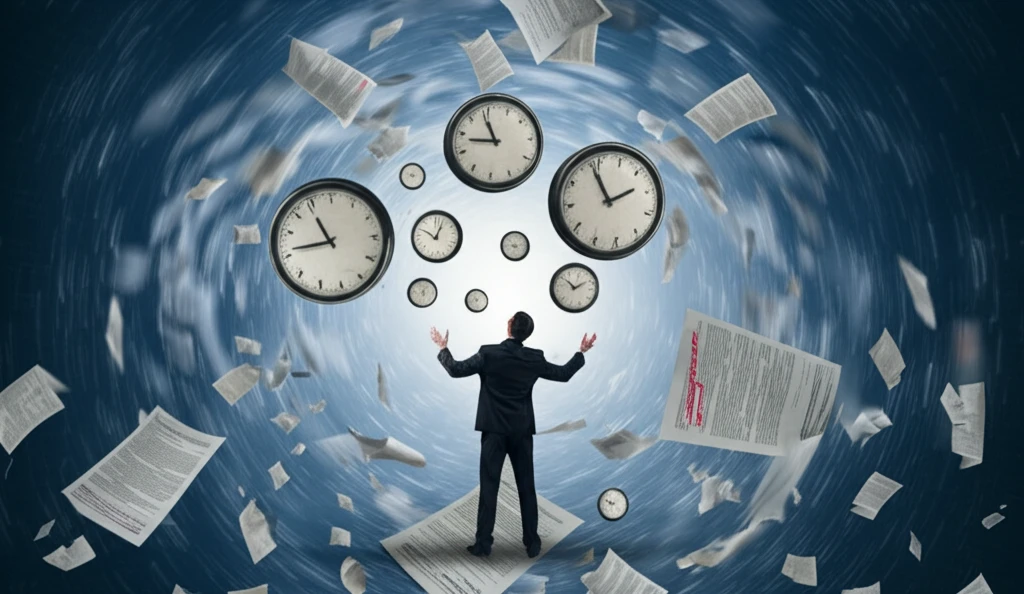
Stop 'Active Procrastination' Before It Stops You

"Unpacking the myth of productive delaying and why purposeful action beats last-minute rushes. Can delaying tasks really be a good thing? We break down the truth about 'active procrastination'."
In today's fast-paced world, procrastination is often painted as the ultimate productivity killer. We're bombarded with advice on how to combat it, overcome our tendencies to delay, and tackle tasks head-on. But what if procrastination wasn't always a bad thing? What if there were a way to procrastinate 'actively,' turning delay into a strategic advantage? This is the question that researchers Chu and Choi posed, introducing the concept of 'active procrastination' – the deliberate deferral of tasks until the last minute, supposedly leading to positive outcomes.
The idea of 'active procrastination' challenges our conventional understanding of self-regulation and productivity. Instead of viewing procrastination as a failure, it suggests that some individuals can thrive under pressure, using the looming deadline to fuel their motivation and enhance their performance. This concept has gained traction, resonating with individuals who feel they work best against the clock. But does 'active procrastination' truly exist? And more importantly, is it a sustainable or healthy approach to managing our responsibilities?
A recent study by Chowdhury and Pychyl casts a critical eye on the construct of 'active procrastination,' questioning its validity and exploring its underlying mechanisms. By examining the defining characteristics, correlates, and outcomes associated with this phenomenon, the researchers shed light on the true nature of 'active procrastination' and its impact on our well-being. Prepare to rethink everything you thought you knew about procrastination.
The Scale of Procrastination: Who It Affects
Procrastination is remarkably widespread: one study found that between 80% and 95% of college students engage in procrastination to some degree, suggesting it is a near-universal behavioral tendency rather than a rare flaw. Researchers have increasingly distinguished between two forms — active procrastination, in which a person puts off one task by deliberately engaging in a different productive activity, and passive procrastination, characterized by a general lack of action and paralysis. A PMC study on temperament and character found that while passive procrastination is consistently associated with distress and dysfunction, active procrastination may function as an effective coping style for some individuals. This emerging two-type framework challenges the assumption that all delay is inherently harmful and reframes the conversation around procrastination research.
Defining Active Procrastination: Promise and Problems
Traditional procrastination research treated all delay as dysfunctional, but scholars on ResearchGate proposed conceptually distinguishing passive procrastinators — who are paralyzed by indecision and fail to complete tasks — from active procrastinators, described as a 'positive' type who choose to delay in order to work under deadline pressure or prioritize competing tasks. However, according to SolvingProcrastination.com, the concept of active procrastination suffers from methodological issues and may not be as beneficial as initially proposed. Some researchers introduce procrastination as fundamentally an inefficient delay driven by personality or attitude characteristics rather than purely situational variables. The Atlantis Press notes that active procrastinators are sometimes characterized as 'decent' types of procrastinator, yet the overall field still debates whether this rebranding of delay obscures genuine self-regulation problems.
From Ancient Vice to Modern Science
Procrastination has long been recognized as an avoidance coping behavior involving unnecessary delay despite awareness of negative consequences, a definition that has remained largely stable across centuries of observation. The British Psychological Society highlights striking historical examples of so-called 'classic procrastinators,' including Charles Darwin, who took 20 years to write and publish On the Origin of Species despite being one of the brightest minds of the 19th century. Such examples illustrate that procrastination has affected even highly accomplished individuals and is not simply a product of modern distraction. The formal scientific study of procrastination, however, is relatively recent, with the conceptual framework only beginning to be systematized in the late twentieth century as researchers moved beyond moral judgment toward empirical investigation.
The Problem with "Active Procrastination": A Critical Look
Chu and Choi defined 'active procrastination' by four key traits: a preference for pressure, an intentional decision to delay, the ability to meet deadlines, and satisfaction with the outcomes. They argued that 'active procrastinators' aren't like 'traditional' procrastinators, who delay due to indecision or lack of self-control, leading to negative consequences. Instead, they portray 'active procrastinators' as individuals who strategically use time, possess strong self-efficacy beliefs, and experience positive outcomes like higher GPAs and reduced stress.
- Purposeful Delay: A conscious decision to postpone tasks to prioritize more pressing commitments.
- Arousal Delay: Postponing tasks to create a sense of urgency and excitement, using the pressure as a motivator.
What Current Research Tells Us
A 2024 systematic review and meta-analysis by Chen and Lyu examined the relationship between smartphone addiction and procrastination among students, reflecting a growing body of work connecting digital technology use to delay behavior. Research published in Frontiers in Psychology found that non-procrastinators and active procrastinators demonstrate better time control and more purposive use of time compared to passive procrastinators. A narrative review of academic procrastination characteristics identified active procrastination as a distinct type with its own profile, while acknowledging that some researchers still define procrastination primarily as an inefficient delay. These studies collectively show that the field is moving toward nuanced, type-specific models rather than treating procrastination as a single monolithic problem.
Critics Push Back on 'Active' Procrastination
The idea that active procrastination is a benign or even positive behavior has drawn pushback. On Academia.edu, researchers noted that while passive procrastinators are paralyzed by indecision and fail to complete tasks on time, calling active procrastinators a 'positive' type risks conflating intentional task-switching with genuine self-regulation failure. Fuchsia Sirois, quoted in Science Focus, identifies the core emotion driving procrastination as stress, and suggests strategies including mindfulness meditation — underscoring that even 'active' delay rooted in avoidance still involves emotional dysregulation. The concern is that relabeling procrastination as 'active' may give people permission to avoid difficult tasks under the guise of productivity, without addressing the underlying emotional causes.
Beyond the Active-Passive Binary
The distinction between passive and active procrastination, while useful, does not encompass the entirety of procrastination behavior. Writing on Medium, Jeremy argues that framing procrastination purely as a passive-active binary oversimplifies a phenomenon that involves complex interactions between motivation, emotion, task characteristics, and environmental factors. The active-passive model has value as an initial分类tool, but researchers caution that it should not become the sole lens through which procrastination is understood. A more complete analysis would integrate personality traits, situational pressures, and self-regulation capacity into a multidimensional framework rather than sorting individuals into two neat categories.
Embrace Purposeful Action, Not Just "Active" Delay
The research is clear: labeling a delay as “active procrastination” doesn't magically transform it into a productive strategy. True procrastination remains a self-regulation failure, linked to negative outcomes. The key takeaway is to understand your own tendencies and motivations behind delaying tasks. Are you strategically prioritizing, or are you seeking the temporary thrill of a last-minute rush? By embracing purposeful action and consciously managing your time, you can achieve genuine productivity without sacrificing your well-being.
What the Leading Experts Say
Dr. Tim Pychyl, widely regarded as one of the world's leading experts on procrastination, has written two books and numerous scientific papers on how and why people procrastinate. His work emphasizes that procrastination is fundamentally an emotion regulation problem rather than a time management problem, a perspective that has shifted how researchers approach interventions. Pychyl's research underscores that understanding the emotional roots of delay — including fear, frustration, and anxiety — is essential for developing effective strategies. His body of work represents a bridge between academic research and practical advice, helping translate decades of study into actionable guidance for individuals struggling with chronic delay.
Where Procrastination Research Is Headed
Procrastination research is a growing field with an increasing number of publications examining this complex behavioral tendency from multiple angles. A PMC paper aimed to elucidate the overall research perspective and identify emerging trends, noting that procrastination is generally perceived as a common behavioral tendency worthy of sustained scientific attention. Another study published in Hogrefe sought to provide a systematic characterization of trends in procrastination research while suggesting concrete future directions for both research and practice. Together, these reviews signal that the field is maturing, moving from descriptive studies toward more integrative models and evidence-based interventions.
Why Procrastination Persists in Modern Life
Procrastination is defined as the voluntary and unnecessary postponement of important action, often occurring because people do not enjoy the task at hand — though many other valid reasons exist for delaying. Active procrastination specifically involves putting off tasks or responsibilities by engaging in other productive activities, which can make it particularly insidious because the person feels busy while still avoiding what matters most. Psych Central notes that procrastination can stem from fear of failure, perfectionism, task aversion, or feeling overwhelmed, and these root causes vary widely across individuals. Understanding procrastination as a systemic challenge — not just a personal failing — is critical for developing workplace policies, educational practices, and mental health interventions that address its real drivers.
When Delay Isn't Always a Deficit
The American Psychological Association acknowledges that procrastination hinders many graduate students, but also notes that sometimes delaying work in order to plan ahead or take a necessary break can be beneficial. This nuanced view suggests that not all delay is pathological — strategic pausing, incubation periods, and deliberate rest can serve creative and cognitive functions. The key distinction lies in whether the delay is intentional and controlled or whether it stems from avoidance and emotional distress. Recognizing this difference is essential for students and professionals alike, as it reframes procrastination not as a moral failing but as a behavior that exists on a spectrum from harmful to potentially useful.