
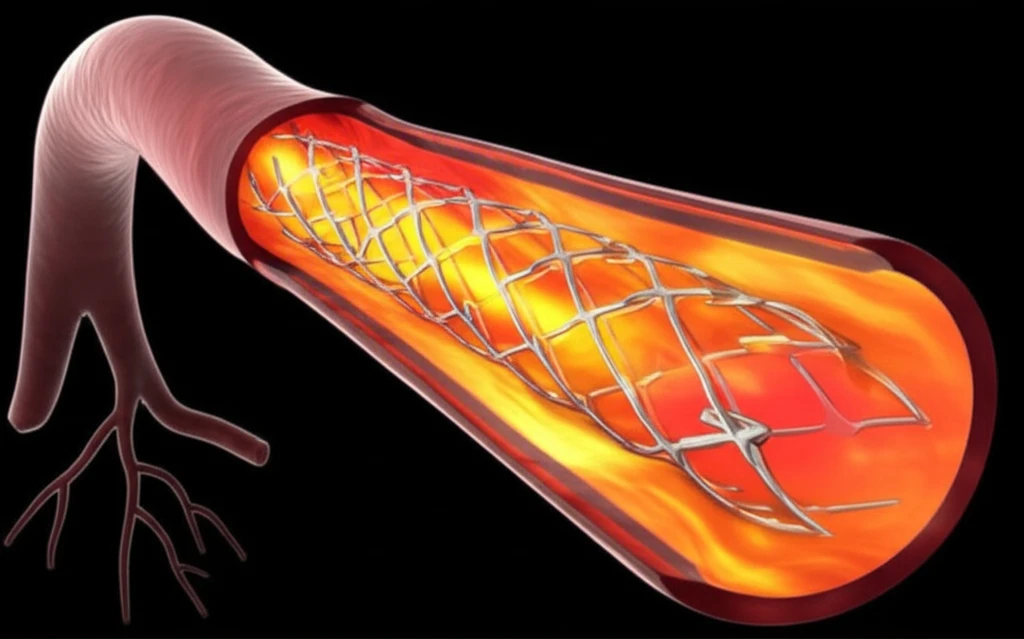
Coronary artery with stent and blood flow illustration

Stent Success: Can Blood Speckle Predict Long-Term Artery Health?

"New research explores how intraluminal blood speckle intensity (AIBS) measurements during intravascular ultrasound (IVUS) can predict the long-term success of coronary stent implants and reduce the need for repeat procedures."


Coronary artery disease, a condition characterized by the buildup of plaque inside the coronary arteries, is a leading cause of heart-related issues globally. Percutaneous coronary intervention (PCI), commonly known as angioplasty, is a procedure used to open up these blocked arteries, often involving the placement of a stent to keep the artery open. While drug-eluting stents (DES) have greatly reduced the risk of arteries re-narrowing compared to bare-metal stents, a significant number of patients still require repeat procedures, known as target vessel revascularization (TVR).

Fractional flow reserve (FFR) is a technique used to assess the physiological severity of coronary artery narrowings and is considered the gold standard in deciding whether to proceed with interventions like stenting. Optimizing PCI with FFR guidance has been shown to improve patient outcomes. However, intravascular ultrasound (IVUS) offers another valuable approach to optimizing PCI, with studies suggesting that IVUS-guided PCI can decrease the need for revascularization compared to relying solely on angiography. While minimal stent area (MSA) as assessed by IVUS is a known predictor of in-stent restenosis, its predictive power is limited to target lesion revascularization (TLR) and is heavily dependent on vessel size.

Recent research has focused on a new parameter measurable via IVUS: the difference in intraluminal intensity of blood speckle (IBS), termed AIBS (ΔΙBS), across a coronary artery stenosis. This measurement, obtained using integrated backscatter (IB)-IVUS, has shown promise in correlating with FFR values. The critical question, however, is whether AIBS measurements taken post-PCI can predict the need for future TVR. A new study has sought to explore this potential link, offering hope for more accurate prediction of long-term stent success.

How Can AIBS Measurements Improve Stent Outcomes?

Coronary artery with stent and blood flow illustration

The study, conducted at Chiba University Hospital, screened 703 vessels that underwent PCI with stents between April 2013 and December 2014. After excluding vessels based on specific criteria such as lack of IVUS guidance or follow-up information, 393 vessels in 298 patients were included in the final analysis. Follow-up coronary angiography (CAG) was routinely performed about 12 months post-PCI. The primary endpoint was TVR, defined as any clinically driven repeat intervention from the ostium to 5 mm distal to the implanted stent in the target vessel.

Intraluminal IBS values were measured using IB-IVUS in cross-sections at the ostium of the target vessel and at the distal reference of the implanted stent. AIBS was then calculated as the difference between the distal IBS and the ostium IBS. The data collected underwent rigorous statistical analysis to determine the relationship between AIBS values and the incidence of TVR.

  • AIBS as a Predictor: The study found that AIBS was significantly greater in vessels that required TVR compared to those that did not (11.10 ± 5.93 vs. 5.90 ± 5.49, P <0.001).
  • ROC Curve Analysis: Receiver operating characteristic (ROC) curve analysis showed that AIBS significantly predicted TVR (AUC 0.74, best cut-off value 8.24, P < 0.001).
  • Independent Predictors: Multiple logistic regression analysis identified the use of drug-eluting stents and AIBS values above 8.24 as independent predictors of TVR.
These findings suggest that AIBS measured post-PCI is significantly associated with TVR. This indicates that IVUS, when combined with AIBS measurements, may offer a way to predict the physiological outcomes of stent implantation and identify patients at higher risk of requiring repeat revascularization procedures.

Future Implications

This research opens new avenues for improving long-term outcomes in patients undergoing PCI. By incorporating AIBS measurements into routine IVUS assessments, clinicians may be able to better predict which patients are more likely to experience TVR. This could lead to tailored intervention strategies, such as more aggressive post-dilation or the use of specific stent types, to optimize outcomes and reduce the need for repeat procedures. Further studies are needed to validate these findings and explore the optimal methods for incorporating AIBS into clinical practice.

About this Article -

This article was crafted using a human-AI hybrid and collaborative approach. AI assisted our team with initial drafting, research insights, identifying key questions, and image generation. Our human editors guided topic selection, defined the angle, structured the content, ensured factual accuracy and relevance, refined the tone, and conducted thorough editing to deliver helpful, high-quality information.See our About page for more information.

Everything You Need To Know

1

What is intraluminal blood speckle intensity (AIBS) and why does it matter?

Intraluminal blood speckle intensity (AIBS) refers to a measurement taken during intravascular ultrasound (IVUS) that analyzes the intensity of blood speckle within a coronary artery. The difference in intraluminal intensity of blood speckle (IBS), termed AIBS (ΔΙBS), across a coronary artery stenosis. It is measured using integrated backscatter (IB)-IVUS. AIBS is significant because it can potentially predict the long-term success of coronary stent implants. Higher AIBS values after stent placement have been associated with a greater likelihood of needing repeat procedures, known as target vessel revascularization (TVR).

2

What exactly is target vessel revascularization (TVR) and why is it something doctors want to avoid?

Target vessel revascularization (TVR) is a repeat procedure that becomes necessary when a stented artery re-narrows or develops new blockages. TVR is important because it addresses the recurrence of coronary artery disease symptoms after an initial percutaneous coronary intervention (PCI) with a stent. Reducing the need for TVR improves patient outcomes, reduces healthcare costs, and enhances the longevity of stent treatments. Identifying factors like AIBS that predict TVR allows for more proactive and tailored treatment strategies.

3

Can you explain what intravascular ultrasound (IVUS) is and how it is used during stent procedures?

Intravascular ultrasound (IVUS) is an imaging technique used during angioplasty procedures to visualize the inside of coronary arteries. IVUS helps doctors assess the extent of plaque buildup and guide the placement and optimization of stents. IVUS is more than just a visual tool; it allows for measurements like minimal stent area (MSA) and the assessment of intraluminal blood speckle intensity (AIBS). IVUS-guided PCI can decrease the need for revascularization compared to relying solely on angiography. Using IVUS can lead to better stent placement, improved blood flow, and reduced risk of complications.

4

What is fractional flow reserve (FFR) and how does it relate to determining the need for a stent?

Fractional flow reserve (FFR) is a technique used to assess the physiological significance of coronary artery narrowings. It measures the pressure difference across a blockage to determine if it is indeed limiting blood flow to the heart muscle. FFR is considered the gold standard for deciding whether to proceed with interventions like stenting. Optimizing PCI with FFR guidance has been shown to improve patient outcomes. While FFR is a crucial tool, AIBS measurements obtained via IVUS offer another approach to optimize PCI.

5

What are drug-eluting stents (DES) and how have they impacted the treatment of blocked arteries?

Drug-eluting stents (DES) are stents coated with medication that helps prevent the re-narrowing of arteries after angioplasty. DES are used to reduce the risk of in-stent restenosis compared to bare-metal stents. DES are significant because they have greatly improved the long-term success of angioplasty procedures. However, even with DES, some patients still require repeat procedures. AIBS values, in conjunction with the use of DES, can help predict which patients are at higher risk of needing target vessel revascularization (TVR).

Newsletter Subscribe

Subscribe to get the latest articles and insights directly in your inbox.