
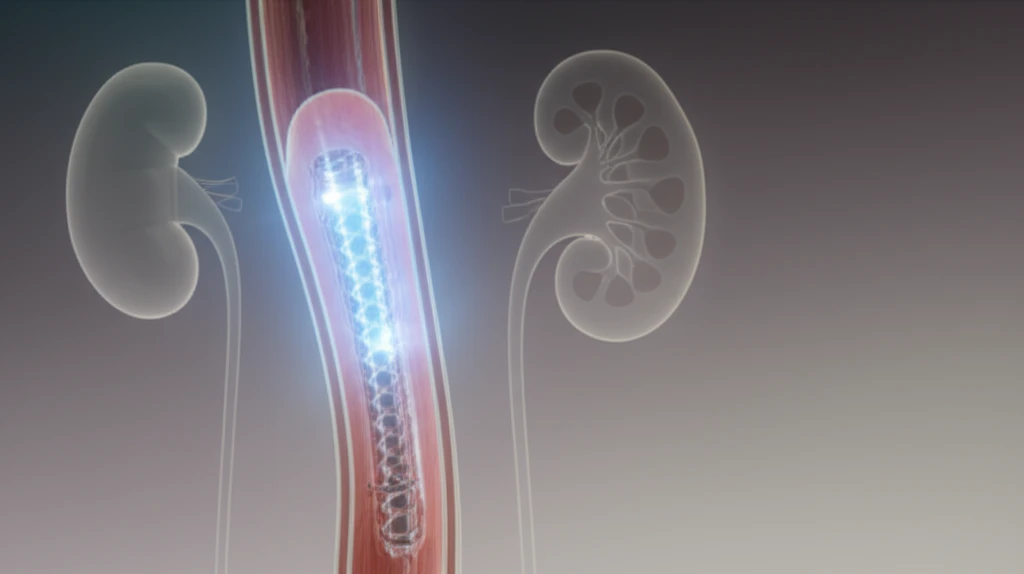
Illustration of a ureteral stent opening a blocked urinary tract.

Stent Failure in Ureteral Obstruction: Are You at Risk?

"A new risk stratification model helps predict ureteral stent failure, allowing for personalized treatment plans and better patient outcomes."


Malignant extrinsic ureteral obstruction (MUO) occurs when a tumor or growth outside the ureter (the tube that carries urine from the kidney to the bladder) presses on it, blocking the flow of urine. This can lead to serious complications, including kidney damage and even death. Ureteral stents are frequently used to open up the blockage, providing relief and maintaining kidney function. However, these stents can fail, requiring additional procedures and impacting a patient's quality of life. If untreated, ureteral obstruction can lead to renal failure and even death [4]. However, there is evidence that palliative urinary diversion prevents the deterioration of renal failure and may result in improved survival [5].

The challenge lies in predicting which patients are most likely to experience stent failure. Recognizing risk factors early on allows doctors to make more informed decisions about initial treatment strategies, potentially avoiding unnecessary procedures and improving patient outcomes. Current methods of managing MUO often involve ureteral internal stents, percutaneous nephrostomy (PCN) catheters, or extra-anatomic stents in order to provide symptomatic relief and maintain renal function.

A recent study published in the International Journal of Clinical Oncology has shed light on this critical issue, identifying key factors that predict ureteral stent failure in patients with MUO. This article breaks down the study's findings, explaining a new risk stratification model that can help doctors better manage this challenging condition. We will also provide a detailed explanation about the article and its data points for the audience.

What Predicts Stent Failure? Key Risk Factors Identified

Illustration of a ureteral stent opening a blocked urinary tract.

The study, led by Hiroshi Matsuura and colleagues, retrospectively analyzed data from 91 patients who underwent ureteral stent placement for MUO. The researchers looked at various clinical and radiological factors to determine which ones were associated with stent failure. Stent failure was defined as the necessity for another alternative form of urinary diversion (including PCN or an external ureteral stent) for one of the following reasons: an inability to replace the ureteral stent; increasing serum creatinine levels; complication by obstructive pyelonephritis; or the presence of a recurrent stent obstruction.

Through careful analysis, the researchers identified two significant predictors of stent failure:

  • Bladder Invasion: When the cancer has spread to involve the bladder.
  • Severe Hydronephrosis: Significant swelling of the kidney due to the backup of urine before stent insertion. The severity of hydronephrosis was evaluated by US according to the grading system of the Society for Fetal Urology.
Based on these two factors, the researchers developed a risk stratification model, dividing patients into three groups:

Empowering Patients and Optimizing Care

This study provides valuable insights for managing patients with malignant extrinsic ureteral obstruction. By identifying those at high risk of stent failure, clinicians can make informed decisions about initial treatment strategies, potentially improving patient outcomes and quality of life. The findings also highlight the importance of shared decision-making, ensuring that patients are fully informed about the risks and benefits of different treatment options.

About this Article -

This article was crafted using a human-AI hybrid and collaborative approach. AI assisted our team with initial drafting, research insights, identifying key questions, and image generation. Our human editors guided topic selection, defined the angle, structured the content, ensured factual accuracy and relevance, refined the tone, and conducted thorough editing to deliver helpful, high-quality information.See our About page for more information.

This article is based on research published under:

DOI-LINK: 10.1007/s10147-018-1348-6, Alternate LINK

Title: Ureteral Stents For Malignant Extrinsic Ureteral Obstruction: Outcomes And Factors Predicting Stent Failure

Subject: Oncology

Journal: International Journal of Clinical Oncology

Publisher: Springer Science and Business Media LLC

Authors: Hiroshi Matsuura, Shigeki Arase, Yasuhide Hori

Published: 2018-10-08

Everything You Need To Know

1

What is Malignant Extrinsic Ureteral Obstruction?

Malignant Extrinsic Ureteral Obstruction (MUO) is when a tumor or growth outside the ureter presses on it, blocking urine flow from the kidney to the bladder. This obstruction can cause serious issues like kidney damage or even death. Ureteral stents are often used to open the blockage and maintain kidney function. However, these stents can fail, leading to additional procedures and affecting a patient's well-being.

2

Why are ureteral stents used in cases of Malignant Extrinsic Ureteral Obstruction, and what are the challenges associated with them?

Ureteral stents are used to open blockages caused by Malignant Extrinsic Ureteral Obstruction (MUO), which helps to relieve the obstruction and maintain kidney function. However, stents can fail for several reasons, including the necessity for another alternative form of urinary diversion (including PCN or an external ureteral stent); an inability to replace the ureteral stent; increasing serum creatinine levels; complication by obstructive pyelonephritis; or the presence of a recurrent stent obstruction. Predicting which patients are likely to experience stent failure is a challenge, but recognizing risk factors early on allows doctors to make better decisions about treatment strategies.

3

What factors can predict ureteral stent failure?

The study identified two significant predictors of ureteral stent failure: bladder invasion and severe hydronephrosis. Bladder invasion refers to when cancer has spread to involve the bladder. Severe hydronephrosis is significant swelling of the kidney due to the backup of urine *before* stent insertion. Identifying these factors helps doctors determine the risk of stent failure and make informed treatment decisions.

4

What is the risk stratification model?

The risk stratification model, developed by researchers, categorizes patients into groups based on the presence of bladder invasion and the severity of hydronephrosis. This model helps clinicians estimate the likelihood of ureteral stent failure in patients with Malignant Extrinsic Ureteral Obstruction (MUO). By assessing these risk factors, doctors can tailor treatment plans to individual patients, potentially improving outcomes and quality of life.

5

What happens if ureteral stents fail?

If ureteral stents fail, alternative urinary diversion methods may be necessary. These include percutaneous nephrostomy (PCN) catheters or extra-anatomic stents. PCN involves placing a catheter directly into the kidney to drain urine, while extra-anatomic stents bypass the obstruction. The choice of method depends on the individual patient's condition and the specific cause of stent failure.

Newsletter Subscribe

Subscribe to get the latest articles and insights directly in your inbox.