
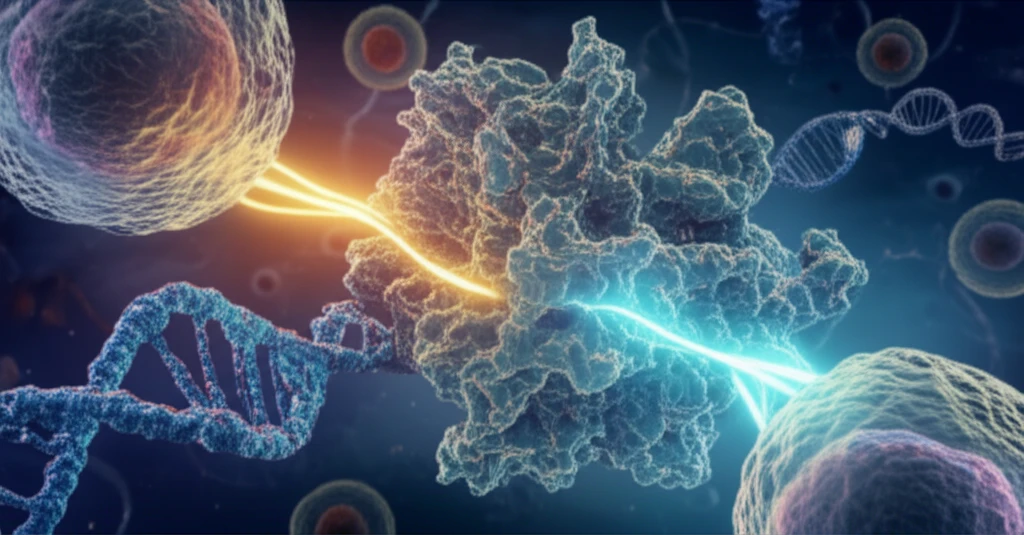
Microscopic view of cell nucleus with transforming DNA, symbolizing stem cell differentiation controlled by RBL2 and PARP1.

Stem Cell Secrets: How Blocking a Key Protein Boosts Cellular Renewal

"New research uncovers how inhibiting the RBL2 protein unlocks PARP1 transcription, potentially reversing cell differentiation and enhancing pluripotency. Could this be a step toward regenerative medicine?"


Stem cell research is constantly pushing the boundaries of what's possible in regenerative medicine and our understanding of human biology. One of the most intriguing areas is how cells decide what type to become – a process called differentiation. Now, a new study sheds light on how Poly (ADP-ribose) polymerase 1 (PARP1) transcription, a key player in cell identity, is regulated, potentially unlocking new ways to manipulate cell fate.

The study focuses on monocytes, a type of white blood cell derived from hematopoietic progenitor cells. These progenitor cells have the remarkable ability to transform into various blood cells. Researchers have found that a protein called Retinoblastoma-like 2 (RBL2) plays a critical role in suppressing PARP1 transcription within these cells. Understanding this suppression could be the key to reversing differentiation and enhancing stem cell pluripotency—a cell's ability to become any cell type in the body.

This article dives into this groundbreaking research, exploring how inhibiting RBL2 can unlock PARP1 transcription and the potential implications for future medical treatments. We'll break down the complex science into easy-to-understand terms, revealing how this discovery could pave the way for new therapies in regenerative medicine.

The RBL2-PARP1 Connection: How Cell Differentiation is Controlled

Microscopic view of cell nucleus with transforming DNA, symbolizing stem cell differentiation controlled by RBL2 and PARP1.

At the heart of this discovery is the relationship between RBL2 and PARP1. Researchers found that as hematopoietic progenitor cells differentiate into monocytes, the cell cycle slows, leading to a replacement of the E2F1 transcription factor with E2F4 at the PARP1 promoter. This switch initiates the assembly of a large repressor complex, E2F4-RBL2-HDAC1-BRM(SWI/SNF), which compacts chromatin and reduces PARP1 transcription.

In simpler terms, RBL2 acts like a switch that turns off PARP1 transcription during cell differentiation. When cells are in an undifferentiated state, PARP1 is active, but as they commit to becoming monocytes, RBL2 steps in to silence PARP1. This silencing is further enhanced by other molecules like HDAC1 and BRM, which tighten the DNA structure, making it harder for PARP1 to be transcribed.

  • E2F1 and E2F4: Transcription factors that bind to DNA and regulate gene expression.
  • RBL2: A protein that helps repress genes involved in cell cycle progression and cell differentiation.
  • HDAC1 and BRM: Enzymes that modify chromatin structure, making DNA less accessible for transcription.
  • PARP1: An enzyme involved in various cellular processes, including DNA repair and transcription.
To confirm the role of RBL2, scientists silenced the protein in monocytes and observed a substantial increase in PARP1 transcription. This means that by blocking RBL2, they could reactivate PARP1, suggesting a pathway to reverse cell differentiation. This is a pivotal discovery because it highlights RBL2 as a potential therapeutic target for manipulating cell fate.

The Future of Cell Manipulation: Implications for Regenerative Medicine

The implications of this research extend far beyond basic cell biology. By understanding how RBL2 controls PARP1 transcription, scientists may be able to develop new strategies for regenerative medicine. Imagine being able to take a patient's own cells and, by blocking RBL2, reprogram them to repair damaged tissues or organs.

Furthermore, the study found that reinstating PARP1 expression in monocytes increased the transcription of pluripotency stem cell factors like POU5F1, SOX2, and NANOG. These factors are essential for maintaining the "stemness" of cells, meaning they can differentiate into virtually any cell type. This suggests that manipulating RBL2 and PARP1 could be a key to unlocking the full potential of stem cells for therapeutic purposes.

While this research is still in its early stages, it opens up exciting new avenues for investigation. Future studies will likely focus on how to precisely control RBL2 and PARP1 in a clinical setting, ensuring that cell differentiation can be safely and effectively reversed to treat a wide range of diseases. The journey to harnessing the power of stem cells has taken another significant step forward, thanks to this groundbreaking discovery.

About this Article -

This article was crafted using a human-AI hybrid and collaborative approach. AI assisted our team with initial drafting, research insights, identifying key questions, and image generation. Our human editors guided topic selection, defined the angle, structured the content, ensured factual accuracy and relevance, refined the tone, and conducted thorough editing to deliver helpful, high-quality information.See our About page for more information.

This article is based on research published under:

DOI-LINK: 10.1038/s41598-017-10307-z, Alternate LINK

Title: Downregulation Of Parp1 Transcription By Promoter-Associated E2F4-Rbl2-Hdac1-Brm Complex Contributes To Repression Of Pluripotency Stem Cell Factors In Human Monocytes

Subject: Multidisciplinary

Journal: Scientific Reports

Publisher: Springer Science and Business Media LLC

Authors: Ewelina Wiśnik, Tomasz Płoszaj, Agnieszka Robaszkiewicz

Published: 2017-08-25

Everything You Need To Know

1

What's the major finding regarding the RBL2 protein and PARP1 transcription in cell differentiation?

Scientists have discovered that by blocking the Retinoblastoma-like 2 (RBL2) protein in human monocytes, they can unlock Poly (ADP-ribose) polymerase 1 (PARP1) transcription. This is significant because PARP1 transcription is crucial in reversing cell differentiation. By inhibiting RBL2, researchers aim to manipulate cell fate, potentially paving the way for regenerative medicine.

2

How does the RBL2 protein control PARP1 transcription during cell differentiation?

Retinoblastoma-like 2 (RBL2) acts as a key regulator. As hematopoietic progenitor cells differentiate into monocytes, RBL2 effectively turns off Poly (ADP-ribose) polymerase 1 (PARP1) transcription. This process involves a repressor complex, including E2F4, HDAC1, and BRM, which compacts chromatin and reduces PARP1 transcription. Understanding this mechanism is vital for potentially reversing cell differentiation.

3

What happens when the RBL2 protein is silenced in monocytes, and why is this important?

By silencing the Retinoblastoma-like 2 (RBL2) protein in monocytes, scientists observed a significant increase in Poly (ADP-ribose) polymerase 1 (PARP1) transcription. This reactivation of PARP1 suggests a pathway to reverse cell differentiation. This is a pivotal discovery that highlights RBL2 as a potential therapeutic target for manipulating cell fate. Further research can explore the complete set of effects caused by RBL2 silencing.

4

What are the potential applications of understanding the RBL2-PARP1 connection for regenerative medicine?

The discovery of the RBL2-PARP1 connection has broad implications for regenerative medicine. By understanding how Retinoblastoma-like 2 (RBL2) controls Poly (ADP-ribose) polymerase 1 (PARP1) transcription, scientists may be able to develop new strategies for repairing damaged tissues or organs using a patient's own cells. Future development depends on the ability to safely control RBL2 and PARP1 in in vivo.

5

What roles do E2F1 and E2F4 play in the regulation of PARP1 transcription, and how does this affect cell differentiation?

The E2F1 transcription factor is replaced by E2F4 at the PARP1 promoter as cells differentiate. Transcription factors E2F1 and E2F4 both bind to DNA and regulate gene expression. However, the switch from E2F1 to E2F4 initiates the assembly of the repressor complex E2F4-RBL2-HDAC1-BRM(SWI/SNF), which compacts chromatin and reduces PARP1 transcription. Understanding the nuances of how these transcription factors interact with RBL2 and PARP1 will be crucial for manipulating cell fate effectively.

Newsletter Subscribe

Subscribe to get the latest articles and insights directly in your inbox.