
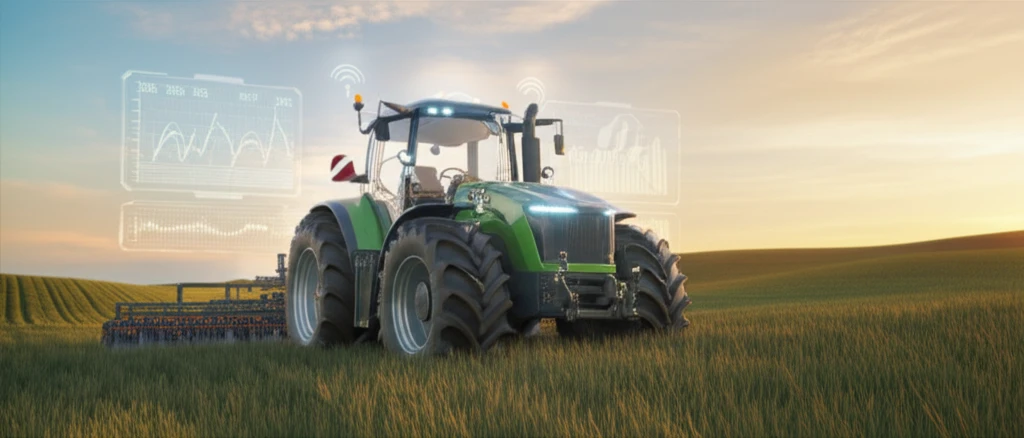
Tractor equipped with advanced sensor technology for enhanced safety.

Stay Safe on the Farm: How New Tech Can Prevent Tractor Accidents

"Cutting-edge sensor technology offers real-time stability warnings to tractor operators, significantly reducing the risk of rollovers and enhancing farm safety."


Tractors are essential for modern agriculture, but they also pose significant safety risks. Despite advancements like Roll-Over Protective Structures (ROPS), tractor accidents, particularly rollovers, remain a major cause of serious injuries and fatalities on farms. These incidents often result from a complex interplay of factors, including terrain conditions, operator skill, and equipment interactions.

To address this persistent problem, researchers are exploring new technologies designed to actively monitor tractor stability in real-time. These systems aim to provide operators with timely warnings and guidance, helping them avoid potentially dangerous situations before accidents occur.

This article delves into a promising technological advancement: a commercial warning device designed to assess tractor stability during normal field operations. We'll explore how this system works, its potential benefits, and the ongoing research evaluating its effectiveness in enhancing farm safety.

How Does This New Tractor Safety Tech Work?

Tractor equipped with advanced sensor technology for enhanced safety.

The core of this technology lies in a sophisticated warning device fitted to standard tractors. This device continuously monitors various factors that influence the tractor's stability. The system uses a combination of sensors to gather real-time data:

Here's a breakdown of the key components:

  • Accelerometers: These measure the tractor's acceleration and tilt, providing crucial information about its orientation and movement.
  • Gyroscope: This sensor detects the rate at which the tractor is turning, which is vital for assessing stability during maneuvers.
  • GPS (Global Positioning System): GPS provides precise location data, allowing the system to account for terrain variations and map potential hazards.
  • GSM/GPRS Module: This enables data transmission and communication, allowing for remote monitoring and analysis.
  • Implement Transceiver: This automatically recognizes tractor-connected equipment.
All the sensor data is fed into a microprocessor, which uses a dedicated algorithm to assess the level of risk. This algorithm takes into account the tractor's geometry and provides the operator with information on the likelihood of instability, along with suggestions for corrective actions.

The Future of Farm Safety: A Proactive Approach

The development and evaluation of these warning devices represent a significant step forward in farm safety. By providing real-time information and proactive warnings, these technologies empower operators to make informed decisions and avoid potentially life-threatening situations. While further research and refinement are ongoing, the potential of these systems to reduce tractor accidents and improve the overall safety of agricultural operations is undeniable.

About this Article -

This article was crafted using a human-AI hybrid and collaborative approach. AI assisted our team with initial drafting, research insights, identifying key questions, and image generation. Our human editors guided topic selection, defined the angle, structured the content, ensured factual accuracy and relevance, refined the tone, and conducted thorough editing to deliver helpful, high-quality information.See our About page for more information.

This article is based on research published under:

DOI-LINK: 10.4081/jae.2013.374, Alternate LINK

Title: Methodological Approach To Assess Tractor Stability In Normal Operation In Field Using A Commercial Warning Device

Subject: Industrial and Manufacturing Engineering

Journal: Journal of Agricultural Engineering

Publisher: PAGEPress Publications

Authors: V. Rondelli, R. Martelli, C. Casazza, A. Guarnieri

Published: 2013-09-08

Everything You Need To Know

1

How does this new tractor safety technology actually work?

The new tractor safety technology works by continuously monitoring factors that influence the tractor's stability. It uses a combination of sensors including Accelerometers, Gyroscope, GPS (Global Positioning System), and a GSM/GPRS Module. The sensor data is fed into a microprocessor which uses a dedicated algorithm to assess the level of risk, providing operators with information on the likelihood of instability and suggestions for corrective actions. The Implement Transceiver automatically recognizes tractor-connected equipment.

2

Why are Accelerometers so important for tractor safety?

The Accelerometers are critical because they measure the tractor's acceleration and tilt, providing crucial information about its orientation and movement. This data helps the system understand how the tractor is behaving on different terrains and during various operations. By knowing the acceleration and tilt, the system can identify potential instability issues before they lead to a rollover. The Gyroscope detects the rate at which the tractor is turning, essential for assessing stability during maneuvers.

3

What role does GPS play in enhancing tractor safety?

The GPS (Global Positioning System) is important because it provides precise location data, allowing the system to account for terrain variations and map potential hazards. GPS allows the device to understand where the tractor is operating, which is critical for assessing stability, particularly on uneven or sloping ground. Understanding the tractor's position and the characteristics of the terrain is essential to provide accurate and timely warnings.

4

Why is this new technology considered so significant?

The significance of this technology lies in its proactive approach to farm safety. By providing real-time information and warnings, the technology empowers operators to make informed decisions, thus preventing accidents. The goal is to reduce tractor accidents, particularly rollovers, which remain a major cause of serious injuries and fatalities on farms. This represents a significant advancement for farm safety.

5

What are the potential implications of this new tractor safety technology?

The potential implications of this technology are substantial. It offers the potential to significantly reduce the risk of tractor rollovers and other accidents. This leads to fewer injuries and fatalities, and improves the overall safety of agricultural operations. This is achieved by providing real-time warnings and guidance to operators, helping them avoid dangerous situations. It represents a proactive step to address the complex interplay of factors, including terrain conditions, operator skill, and equipment interactions, that contribute to tractor accidents.

Newsletter Subscribe

Subscribe to get the latest articles and insights directly in your inbox.