
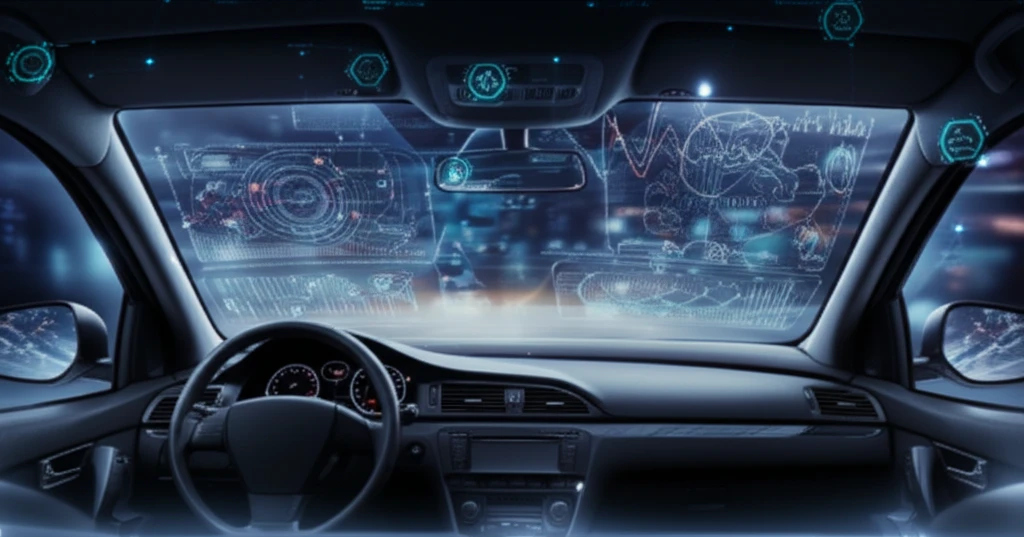
Futuristic car dashboard with sensors analyzing driver's alertness.

Stay Awake, Stay Safe: How New Tech Can Prevent Drowsy Driving

"Innovative fatigue detection systems are hitting the road, promising to reduce accidents and save lives. Learn how these technologies work and what they mean for the future of driving."


The open road, a symbol of freedom, can quickly turn treacherous when fatigue takes hold. Drowsy driving is a major contributor to accidents, with consequences that can be devastating. As our lives become increasingly hectic, and our reliance on personal vehicles remains strong, the need to combat driver fatigue is more critical than ever.

Fortunately, science and technology are stepping up to address this challenge. Researchers and engineers are developing sophisticated systems that can monitor a driver's alertness level in real-time. These systems use a combination of techniques, from analyzing facial expressions to tracking brainwave activity, to detect the warning signs of fatigue before they lead to an accident.

These advancements promise a future where our vehicles are not just modes of transportation, but also guardians of our safety. Let's dive into the world of integrated driver fatigue detection, exploring how these innovative algorithms and technologies are paving the way for safer roads for everyone.

How Does Driver Fatigue Technology Work?

Futuristic car dashboard with sensors analyzing driver's alertness.

At the heart of many modern driver fatigue detection systems lies a combination of sophisticated sensors and intelligent algorithms. These systems aim to capture a holistic view of the driver's state, analyzing multiple indicators to determine their level of alertness. Here's a breakdown of some key components:

These systems often integrate several key data points:

  • Eye-Tracking: Monitoring eye movements, blink rate, and eyelid closure to detect signs of drowsiness. Algorithms like PERCLOS (percentage of eyelid closure over time) are used to quantify fatigue levels.
  • EEG (Electroencephalography): Measuring brainwave activity to identify patterns associated with drowsiness and reduced cognitive function.
  • EMG (Electromyography): Monitoring muscle activity, particularly in the face and neck, to detect subtle changes that indicate fatigue.
  • ECG (Electrocardiography): Tracking heart rate variability, which can be an indicator of stress and fatigue.
Once the data is collected, it's fed into a sophisticated algorithm that uses principal component analysis (PCA) to reduce the amount of information into a more manageable and meaningful format. The PCA algorithm combines all the data into a comprehensive fatigue evaluation. The system then compares that level to a predetermined fatigue level standard. When fatigue is detected, the system triggers an alert, warning the driver to take a break.

The Road Ahead

Driver fatigue is a complex issue with far-reaching consequences, but thanks to advances in technology, we're gaining ground in the fight against drowsy driving. As these systems become more sophisticated and widely adopted, we can look forward to a future where our roads are safer for everyone. While current systems achieve around 76% accuracy, ongoing research is dedicated to enhancing algorithm robustness and adaptability, ensuring reliable performance across diverse driving conditions and individual differences.

About this Article -

This article was crafted using a human-AI hybrid and collaborative approach. AI assisted our team with initial drafting, research insights, identifying key questions, and image generation. Our human editors guided topic selection, defined the angle, structured the content, ensured factual accuracy and relevance, refined the tone, and conducted thorough editing to deliver helpful, high-quality information.See our About page for more information.

This article is based on research published under:

DOI-LINK: 10.1051/matecconf/201817302011, Alternate LINK

Title: A Study Of Integrated Driver Fatigue Judging Algorithm Based On Principal Component Analysis

Subject: General Medicine

Journal: MATEC Web of Conferences

Publisher: EDP Sciences

Authors: Zhipeng Ma, Shuwan Yao, Junxian Li

Published: 2018-01-01

Everything You Need To Know

1

What technologies are used in modern driver fatigue detection systems?

Modern driver fatigue detection systems use a combination of technologies to monitor a driver's alertness. These include eye-tracking to monitor eye movements and eyelid closure, EEG (Electroencephalography) to measure brainwave activity, EMG (Electromyography) to monitor muscle activity, and ECG (Electrocardiography) to track heart rate variability. These systems capture a holistic view of the driver’s state, analyzing multiple indicators to determine their level of alertness. While the article does not discuss specific types of sensors, this is another important element of the process.

2

How does eye-tracking technology help in detecting drowsy driving?

Eye-tracking technology monitors eye movements, blink rate, and eyelid closure to detect signs of drowsiness. Algorithms, such as PERCLOS (percentage of eyelid closure over time), are used to quantify fatigue levels. Prolonged eyelid closure and changes in blink rate are key indicators that the driver is experiencing fatigue. This data point is then combined with others to develop a comprehensive picture of the driver's fatigue level. The article does not talk about infrared technology that might be used in low light conditions to support eye tracking.

3

What is the role of algorithms like PERCLOS in fatigue detection systems?

Algorithms like PERCLOS (percentage of eyelid closure over time) quantify fatigue levels by measuring the percentage of time a driver's eyelids are closed over a specific period. This provides a quantifiable metric that the fatigue detection system can use to assess the driver's level of drowsiness. While PERCLOS is a key element, the article describes the use of Principal Component Analysis (PCA) that combines PERCLOS with other data to evaluate fatigue.

4

Once data is collected how does the system alert a driver?

Once the data is collected from eye-tracking, EEG, EMG and ECG, it's fed into an algorithm that uses principal component analysis (PCA) to reduce the amount of information into a more manageable and meaningful format. The PCA algorithm combines all the data into a comprehensive fatigue evaluation. The system then compares that level to a predetermined fatigue level standard. When fatigue is detected, the system triggers an alert, warning the driver to take a break. The system doesn't specifically describe the type of alert though. This may depend on the vehicle, driver state, road conditions etc.

5

How accurate are current driver fatigue detection systems, and what is being done to improve them?

Current driver fatigue detection systems achieve around 76% accuracy. Ongoing research is dedicated to enhancing algorithm robustness and adaptability, ensuring reliable performance across diverse driving conditions and individual differences. While 76% is a good start, the article does not describe the nature of the errors, or the distribution of them. For example, it would be important to understand if false negatives are more likely than false positives, and what the implications of each might be.

Newsletter Subscribe

Subscribe to get the latest articles and insights directly in your inbox.