
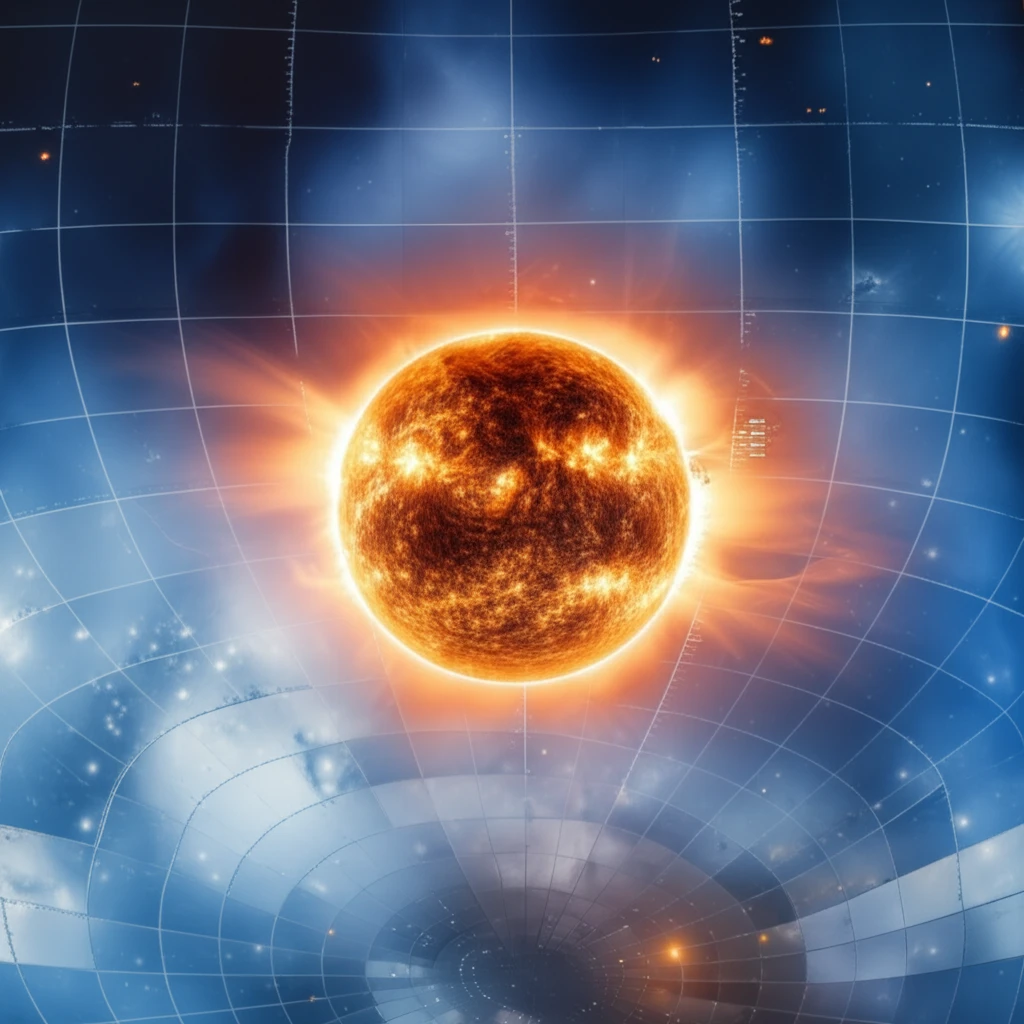
A pulsating star against the backdrop of the Hertzsprung-Russell diagram

Starry Harmonies: Unveiling the Energetic Secrets of Pulsating Stars

"How understanding stellar pulsations is revolutionizing our knowledge of stellar interiors and cosmic evolution."


Stellar pulsations, the rhythmic swelling and shrinking of stars, offer a unique window into their inner workings. Much like seismologists study earthquakes to understand Earth's interior, astronomers analyze stellar pulsations to probe the conditions within these distant celestial objects. The properties of these pulsations are determined by a star's internal structure and the mechanisms that drive them.

In principal, two primary processes cause these pulsations: thermal and dynamical processes. Thermal processes lead to self-excited pulsations, involving opacity and convective blocking mechanisms. Dynamical processes, on the other hand, result in forced oscillations, such as those caused by turbulent convection or tidal forces in binary systems.

Understanding these processes is crucial for interpreting the diverse range of stellar pulsations observed across the Hertzsprung-Russell diagram, a fundamental tool for classifying stars based on their luminosity and temperature. This article explores the energetic aspects of stellar pulsations, including excitation, kinetic energy distribution, mode amplitude, and lifetime, shedding light on the complex dynamics shaping the lives of stars.

What Drives Stellar Pulsations? The Role of Thermal Processes

A pulsating star against the backdrop of the Hertzsprung-Russell diagram

Self-excited pulsations occur when a star's internal conditions amplify oscillations. To understand this, astronomers calculate the work integral (W), which quantifies the net energy gained by an oscillation mode during each cycle. A positive work integral indicates that the mode is excited, meaning the star's internal processes can overcome damping and sustain the pulsation.

The work integral depends on several factors, including perturbations in the rate of nuclear energy production (ɛ) and the energy flux (F), which can be due to radiation and/or convection. Perturbations in nuclear energy production are usually negligible, making the opacity (κ) mechanism the dominant driver in many cases. This mechanism, which relates to how opaque the stellar material is to radiation, is responsible for pulsations in various types of stars:

  • Classical Cepheids
  • RR Lyrae stars
  • B-type main sequence stars
  • δ Scuti stars
  • roAp stars
  • White dwarf pulsators
  • Hot subdwarfs
In many models, a simplified approach called the convective flux freezing approximation is used, which assumes the perturbation of the convective flux is zero. This approximation is suitable for main sequence B-type pulsators, such as β Cephei and Slowly Pulsating B-type (SPB) stars, as well as hotter δ Scuti stars. By analyzing the differential work integral (d log W/d log T), scientists pinpoint the regions within a star that contribute most to driving the pulsations, often linked to the Z-bump, a feature in the opacity profile related to the abundance of heavy elements.

The Future of Stellar Pulsation Research

The study of stellar pulsations is a complex field, influenced by factors such as internal structure, excitation mechanisms, rotation, convection, and tidal forces. Building accurate seismic models of stars requires considering all these effects.

The wealth of data from space-based missions is revolutionizing our understanding of stellar pulsations, leading to new discoveries and solutions. However, interpreting this data also presents new challenges, demanding sophisticated techniques and models.

Despite the complexities, recent results demonstrate that we are entering a golden age of precision asteroseismology, where the rhythmic heartbeats of stars are unlocking the secrets of the cosmos.

About this Article -

This article was crafted using a human-AI hybrid and collaborative approach. AI assisted our team with initial drafting, research insights, identifying key questions, and image generation. Our human editors guided topic selection, defined the angle, structured the content, ensured factual accuracy and relevance, refined the tone, and conducted thorough editing to deliver helpful, high-quality information.See our About page for more information.

This article is based on research published under:

DOI-LINK: 10.1051/epjconf/201510101002, Alternate LINK

Title: Energetic Properties Of Stellar Pulsations Across The Hertzsprung-Russell Diagram

Subject: General Medicine

Journal: EPJ Web of Conferences

Publisher: EDP Sciences

Authors: Jadwiga Daszyńska-Daszkiewicz

Published: 2015-01-01

Everything You Need To Know

1

What are stellar pulsations?

Stellar pulsations are the rhythmic swelling and shrinking of stars. These pulsations provide astronomers with a unique way to investigate the inner workings of stars, similar to how seismologists study earthquakes to understand Earth's interior. The properties of these pulsations are directly related to the internal structure of a star and the mechanisms that drive them.

2

What causes stellar pulsations?

Thermal and dynamical processes are the primary causes of stellar pulsations. Thermal processes include self-excited pulsations driven by opacity and convective blocking mechanisms, while dynamical processes involve forced oscillations due to turbulent convection or tidal forces. Understanding these processes is vital for interpreting the different types of stellar pulsations observed across the Hertzsprung-Russell diagram.

3

What is the work integral and why is it important?

The work integral (W) quantifies the net energy gained by an oscillation mode during each cycle within a star. A positive work integral indicates that the mode is excited, meaning that the internal processes within the star are able to overcome damping and sustain the pulsation. Factors like perturbations in the rate of nuclear energy production and the energy flux, which includes radiation and convection, influence the work integral.

4

What role does the opacity mechanism play in stellar pulsations?

The opacity mechanism is a key driver for pulsations in many stars. This mechanism relates to how opaque the stellar material is to radiation. This mechanism is responsible for pulsations in a variety of stars, including Classical Cepheids, RR Lyrae stars, B-type main sequence stars, δ Scuti stars, roAp stars, White dwarf pulsators, and Hot subdwarfs. These types of stars pulsate because of the opacity mechanism.

5

What is the future of stellar pulsation research?

The future of stellar pulsation research involves building accurate seismic models of stars, taking into account factors such as internal structure, excitation mechanisms, rotation, convection, and tidal forces. These models aim to understand the complex dynamics shaping the lives of stars. This involves analyzing the differential work integral to pinpoint regions within a star that contribute most to driving pulsations, often linked to the Z-bump.

Newsletter Subscribe

Subscribe to get the latest articles and insights directly in your inbox.